
Free Building Regulations Practice Test 2026
200 questions on the Approved Documents A to T for England: foundations, fire escape, sound, ventilation, drainage, stairs, access and Part L. Tuned for mobile. No account needed.
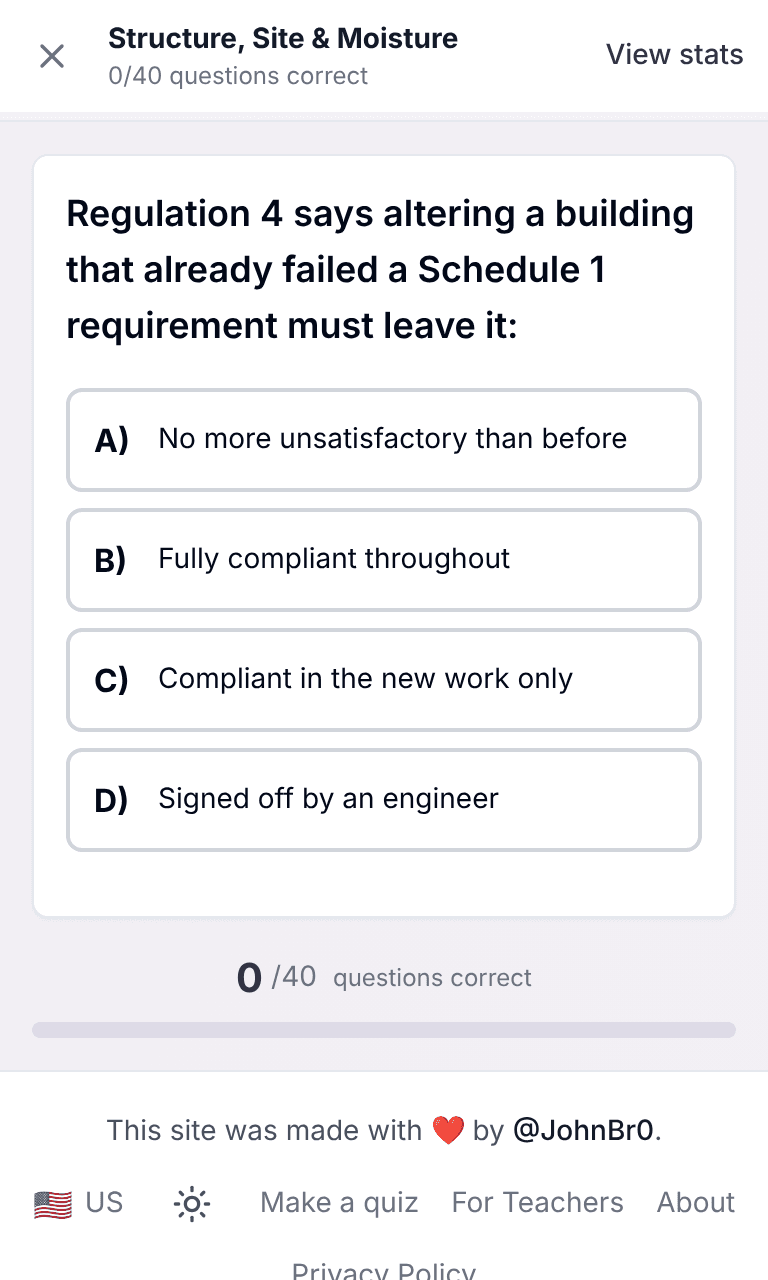
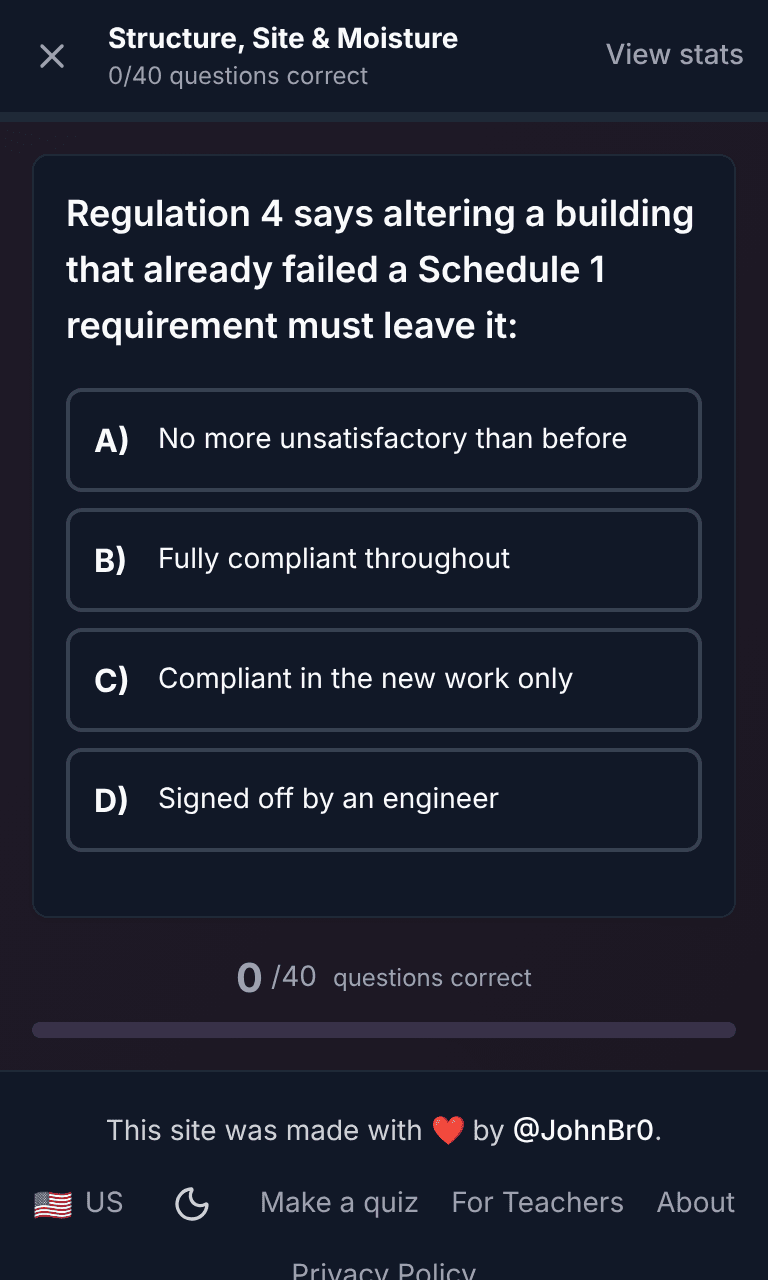
Train on mobile
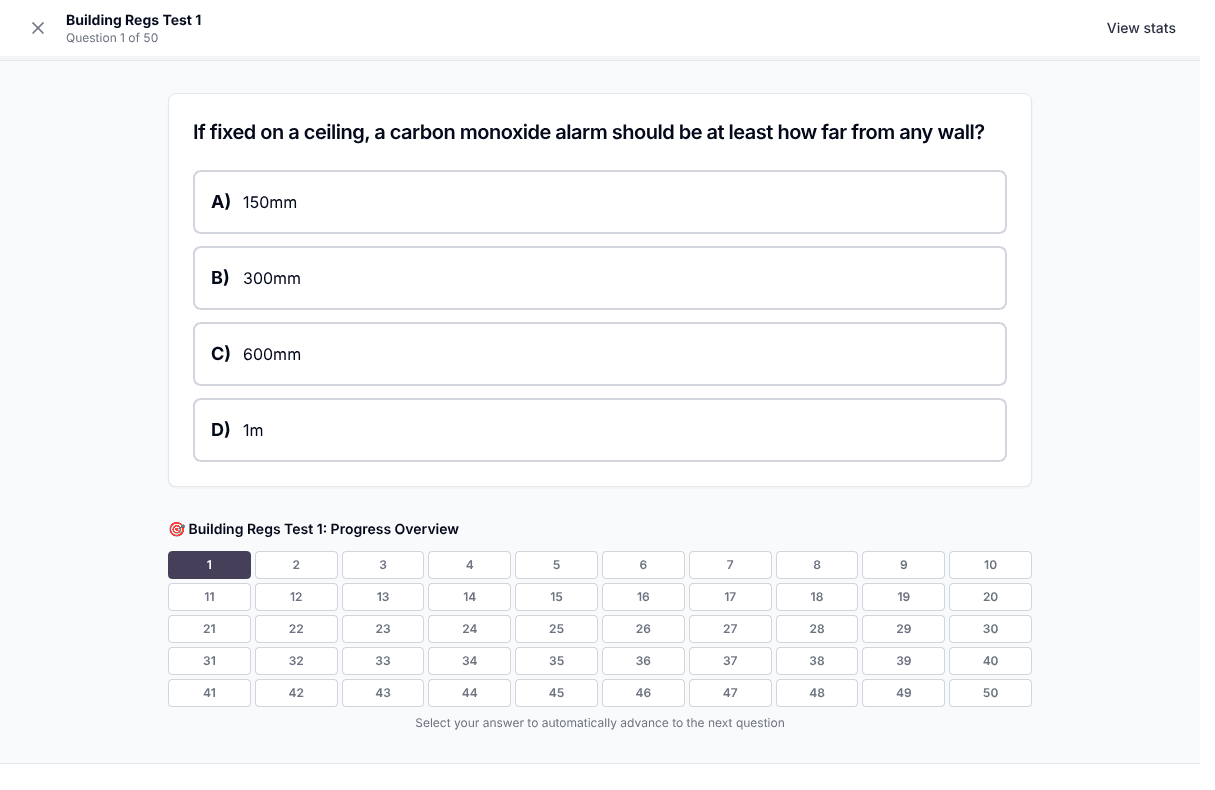
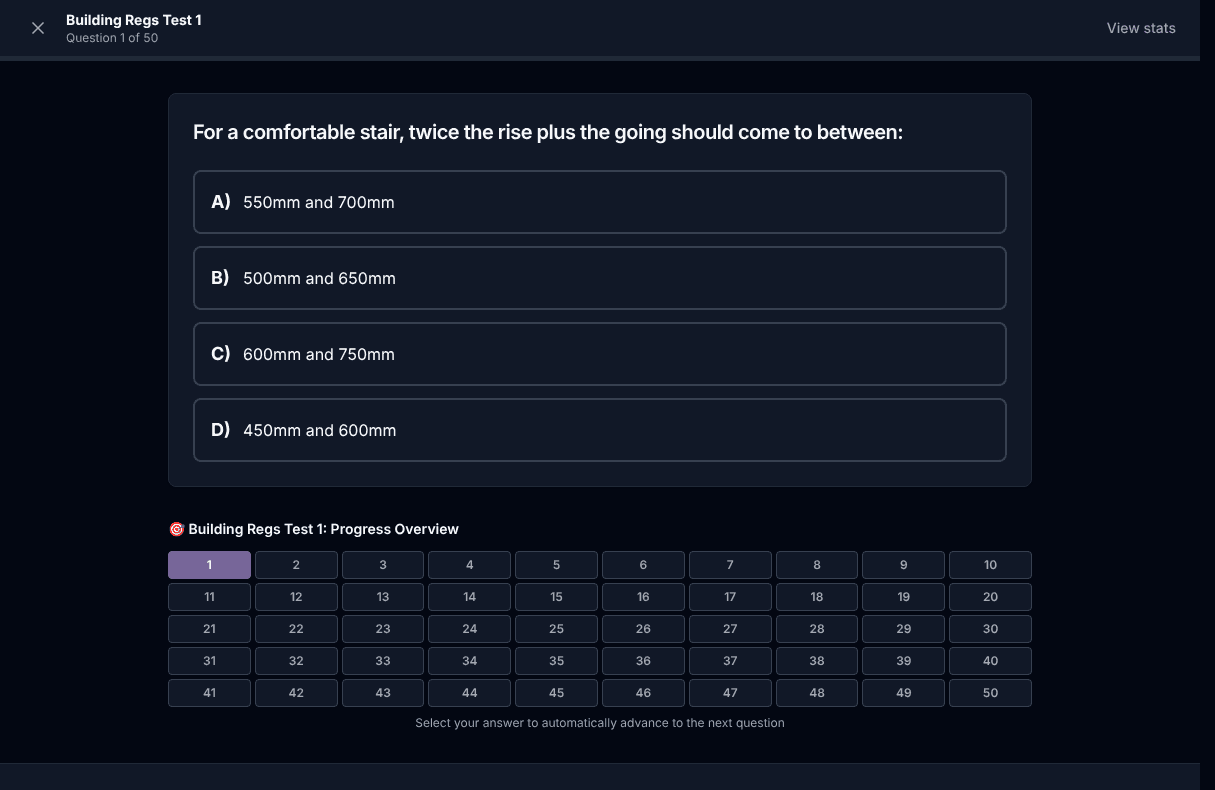
Test on desktop
The Building Regs exam at a glance
There is no single official Building Regulations exam. Builders, site managers, construction students and building control trainees are expected to know the requirements of Schedule 1 to the Building Regulations 2010 and the Approved Documents that show how to meet them in England. This practice test covers Parts A to T and regulation 7 with 200 original questions in four 50-question tests, and uses 70% as a readiness line.
Tigertest has 200 Building Regs practice questions with explanations, free to start with no account required.
- Who sets the rules
- MHCLG (Approved Documents approved by the Secretary of State)
- Law
- Building Regulations 2010 (SI 2010/2214), Schedule 1
- Covers
- England only; Wales and Scotland have their own
- Pass mark
- No official exam; Tigertest uses 70%
- Recent change
- Second stair for flats with a top storey of 18 m or more, from 30 September 2026
- Coming
- Future Homes Standard (Parts L and F) from 24 March 2027
Updated by the Tigertest team. Practice questions follow the Approved Documents on GOV.UK and SI 2010/2214, checked November 2026. Exam rules change, so confirm current details with GOV.UK: Approved Documents.
How It Works
Train, Then Test
Five training sets, from Structure, Site & Moisture to Safety, Access & Services. Master a topic, then take a test. Questions you miss come back until you have mastered them.
Practice Tests
Four 50-question practice tests across every Approved Document, with a 70% readiness line and an explanation of the right answer on every question.
Built on the Approved Documents A to T
Every question comes from the current Approved Documents and Schedule 1 of the Building Regulations 2010. Fire safety, structure and stairs and access carry the most questions because they are where site mistakes cost most. Every question is original.

For Course Tutors
Teaching construction, site management or building control? Set Tigertest as practice at tigertest.io/teach and see which Approved Documents your group misses most. It is free for you and your learners.
Help Make Tigertest Better
Have an idea, a topic you'd like covered, or a question that could be clearer? We read every message and use it to improve every test.
Share FeedbackHow to Learn the Building Regulations
1. Learn what each Part is for
Start with the 18 Parts and what each one controls: A structure, B fire, C site and moisture, E sound, F ventilation, G water and sanitation, H drainage, J heat producing appliances, K falls and glazing, L energy, M access and so on. Most questions name a situation and ask which rule applies.
2. Know the figures used on site
Learn the numbers that come up every day: stair rise and going limits, guarding heights, escape window sizes, fall on drains, hearth sizes and the U-value limits in Part L.
3. Watch for the 2026 changes
Approved Document B changed on 30 September 2026 for tall residential buildings, and Parts L and F change with the Future Homes Standard from 24 March 2027. Check the edition a project was approved under.
4. Fix your misses, then retest
Tigertest tracks your accuracy by Approved Document. Aim for 85 percent on every practice test, then retrain your weakest topic.
Building Regulations Frequently Asked Questions
Is there an official Building Regulations exam?
No single one. Building control bodies, colleges and employers test knowledge of the Building Regulations in their own courses and assessments. This test checks that you know the technical requirements and the Approved Document figures used on site in England.
Which Approved Documents does it cover?
Parts A (structure), B (fire), C and D (site, moisture, cavity fill), E (sound), F (ventilation), G (sanitation and water efficiency), H (drainage), J (combustion appliances), K (falling and glazing), L (energy), M (access), O (overheating), P (electrical safety), Q (security), R (broadband), S (EV charging) and T (toilets), plus regulation 7 on materials and workmanship.
Is it up to date with the 2026 changes?
Yes. It includes the Approved Document B amendments in force from 30 September 2026 (more than one common stair for flats with a top storey of 18 m or more, evacuation lifts) and notes the Future Homes Standard, which changes Parts L and F from 24 March 2027.
Does it cover Wales or Scotland?
No. Wales has its own Approved Documents and Scotland uses the Building Standards technical handbooks. The figures here are for England.
Are these real exam questions?
No. Every question is written by Tigertest from the Approved Documents and the Building Regulations 2010, without copying any course test or commercial question bank.
I teach a construction or building control course. Can my students use Tigertest?
Yes, for free. Make a class at tigertest.io/teach, post one link, and students join with just their name. You see who practised, their test scores and the topics your class misses most.
Building Regs sample questions and answers
6 of the 200 practice questions, one from each topic, with the answer explained.
1. Where should a notice plate for a new hearth or flue be fixed?
- A.Under the roof tiles
- B.Next to the consumer unit
- C.On the chimney stack outside
- D.Inside the boiler casing
Answer: B. AD J suggests an obvious place inside the building, such as next to the electricity consumer unit, the chimney or hearth, or the water stopcock.
2. Waste containers should be within how far of the point where the collection vehicle stops?
- A.10m
- B.30m
- C.50m
- D.25m
Answer: D. AD H says containers should be within 25m of the collection point. Householders should not have to carry waste more than 30m to the storage point.
3. For each new dwelling, the builder gives building control a BREL report together with:
- A.Photographic evidence
- B.A sound test certificate
- C.A drainage CCTV survey
- D.A structural calculation
Answer: A. AD L asks for a completion stage BREL report and photographic evidence of the construction details for each dwelling.
4. Under AD B, interlocked stairs in a block of flats count as:
- A.A firefighting shaft
- B.An evacuation lift
- C.A single escape route
- D.Two escape routes
Answer: C. The 2026 amendments say interlocked stairs are a single escape route and are not an alternative means of escape.
5. What is the legal status of an Approved Document?
- A.A mandatory British Standard
- B.A local authority bylaw
- C.Practical guidance on compliance
- D.Law that must be copied exactly
Answer: C. Approved Documents are approved by the Secretary of State and show common ways to meet the Building Regulations; other ways that meet the requirements are allowed. Following them tends to show compliance.
6. Under T1, universal toilets may be provided instead of single-sex toilets when:
- A.Space rules out single-sex toilets
- B.The building is under 100m²
- C.The owner prefers them
- D.There are under ten staff
Answer: A. T1 requires single-sex toilets, or universal toilets where space precludes single-sex provision. Universal toilets may also be added alongside single-sex ones.
Related practice tests
Every test on Tigertest is free to start, with no account needed.
- SIA Door Supervisor Practice TestSIA licence-linked qualification (UK)
- 18th Edition Practice TestCity & Guilds 2382-26 · BS 7671:2018+A4:2026
- Gas Safe ACS Practice TestACS · core domestic gas safety (CCN1)
- Registered Building Inspector Practice TestBuilding Safety Regulator · RBI competence
- Plumbing Theory Practice TestCity & Guilds · 6035 Plumbing Studies and ST0303 apprenticeship
- Unvented Hot Water (G3) Practice TestBPEC, LCL Awards · Unvented hot water (Part G3)
Ready to Test Your Building Regs?
Start for free. No account required. 200 questions across Parts A to T.
Start practising