
Free Unvented Hot Water (G3) Practice Test 2026
200 questions on Part G3 and Approved Document G for the unvented cylinder certificate: safety devices, tundish and D2 sizing, inlet controls, temperatures and commissioning. Tuned for mobile. No account needed.
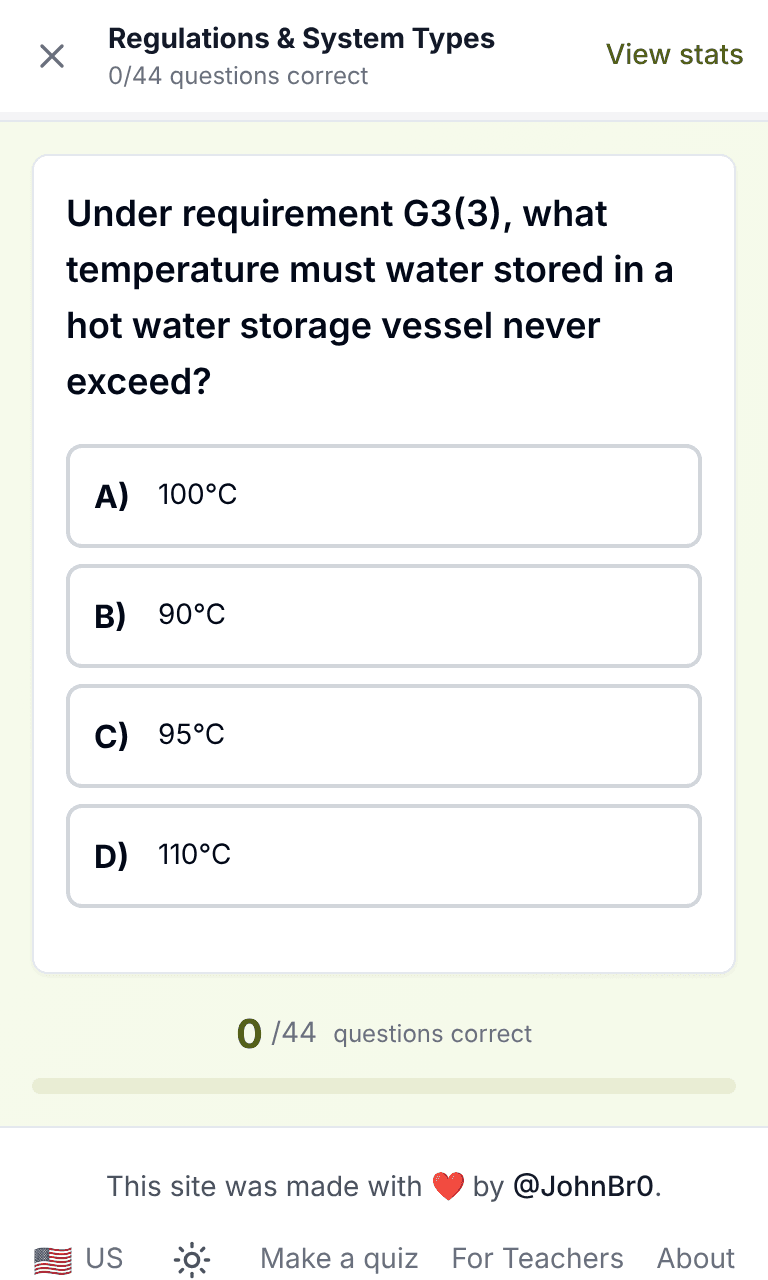
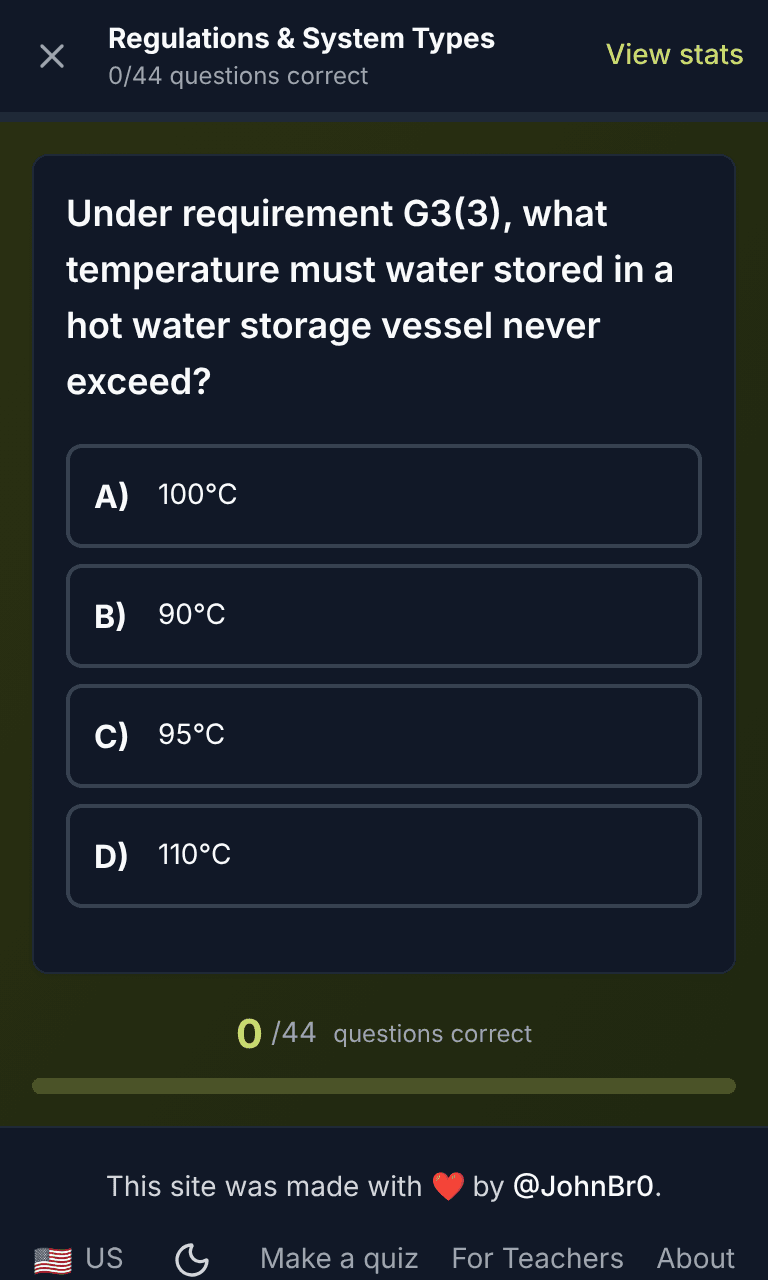
Train on mobile
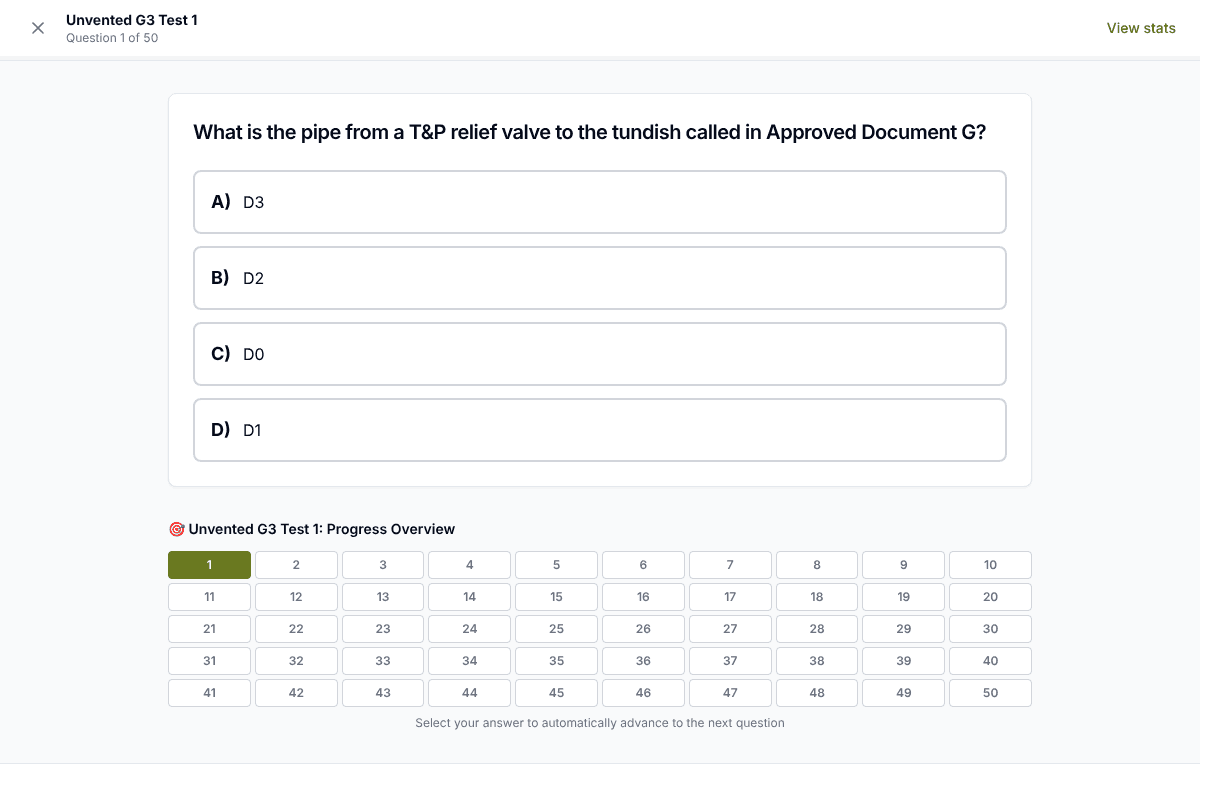
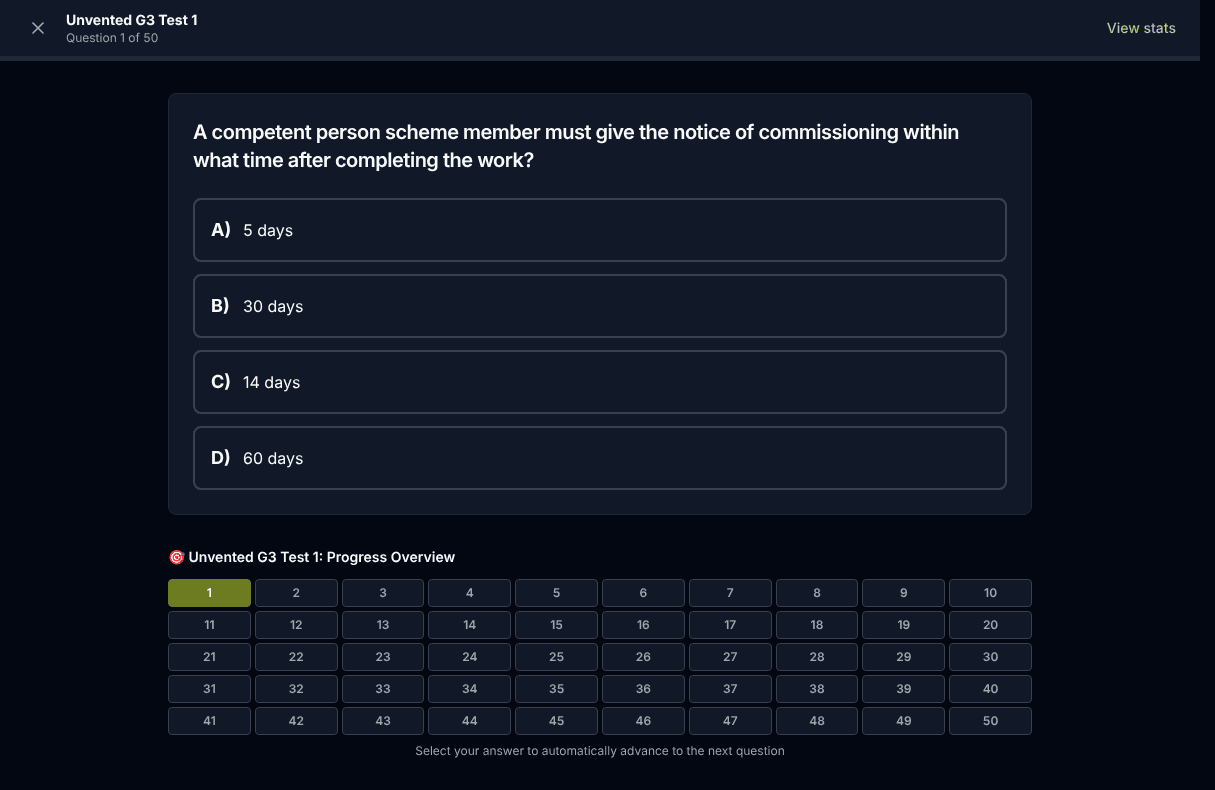
Test on desktop
The Unvented G3 exam at a glance
The unvented hot water (G3) certificate shows a plumber or heating engineer is competent to install unvented hot water cylinders under Part G3 of the Building Regulations. Awarding bodies such as BPEC and LCL Awards run it as a short course with a multiple-choice theory paper and a practical assessment, covering system types, inlet controls, the two independent safety devices, tundish and discharge pipe rules, temperature control, commissioning and maintenance. BPEC certificates last five years.
Tigertest has 200 Unvented G3 practice questions with explanations, free to start with no account required.
- Who runs it
- Awarding bodies: BPEC, LCL Awards, City & Guilds and others
- Law
- Building Regulations 2010 Part G3 and Approved Document G
- Format
- Multiple-choice theory paper plus a practical assessment
- Pass mark
- Not published; Tigertest uses 70% as a readiness line
- Validity
- BPEC certificates last 5 years
- Biggest areas
- Safety devices and discharge pipework
Updated by the Tigertest team. Practice questions follow BPEC's unvented hot water qualification page and Approved Document G (2015 edition with 2016 and 2024 amendments), checked November 2026. Exam rules change, so confirm current details with GOV.UK: Approved Document G.
How It Works
Train, Then Test
Four training sets, from Regulations & System Types to Install, Commission & Maintain. Master a topic, then take a test. Questions you miss come back until you have mastered them.
Practice Tests
Four 50-question practice tests across every topic, with a 70% readiness line and an explanation of the right answer on every question.
Built on Part G3 and Approved Document G
No awarding body publishes how many questions come from each topic, so the practice tests follow Approved Document G's order and put the most weight on the safety devices and discharge pipework, which the law and every assessment focus on. Every question is original.

For Course Tutors
Running unvented courses? Set Tigertest as practice before the assessment at tigertest.io/teach and see which topics your group misses most. It is free for you and your learners.
Help Make Tigertest Better
Have an idea, a topic you'd like covered, or a question that could be clearer? We read every message and use it to improve every test.
Share FeedbackHow to Pass the Unvented Hot Water Assessment
1. Know the safety devices in order
An unvented cylinder needs a thermostat plus two independent safety devices: the energy cut-out and the temperature and pressure relief valve. Know what each one does, what it protects against and the order they act in.
2. Practise D2 sizing sums
Expect to size the D2 discharge pipe from Approved Document G: take the allowance for the pipe size, subtract the resistance of each elbow and bend, and go up a size if the run is too long.
3. Learn the inlet group
Know each part of the inlet controls (strainer, pressure reducing valve, check valve, expansion relief valve and expansion vessel), what fails when each one goes wrong, and the symptoms that point to it.
4. Fix your misses, then retest
Tigertest tracks your accuracy by topic. Aim for 85 percent on every practice test before the real one, then retrain your weakest topic.
Unvented Hot Water (G3) Frequently Asked Questions
Who needs an unvented hot water certificate?
Anyone installing an unvented cylinder in England without building control inspecting it first. Approved Document G says installers can show the skills through a competent person scheme or a current unvented skills card, and schemes ask for this certificate.
What does the assessment cover?
System types, the inlet group (strainer, pressure reducing valve, check valve, expansion relief valve and vessel), the energy cut-out and temperature and pressure relief valve, the tundish and D1 and D2 discharge pipe rules, temperature control and legionella, commissioning, Benchmark paperwork and fault finding.
Do I need to do discharge pipe sums?
Yes. Expect to size D2 from Table 3.1 of Approved Document G: take the straight-pipe allowance for the size, subtract the resistance of each elbow, and go up a size if the run is too long.
Is the practical assessment covered here?
No. Tigertest practises the knowledge paper only. The practical, fitting or inspecting a system, is done at the training centre.
How long does the certificate last?
BPEC certificates are valid for five years, and you can reassess in the 12 months before expiry. Check your awarding body's rules.
I teach an unvented hot water (G3) course. Can my students use Tigertest?
Yes, for free. Make a class at tigertest.io/teach, post one link, and students join with just their name. You see who practised, their test scores and the topics your class misses most.
Unvented G3 sample questions and answers
6 of the 200 practice questions, one from each topic, with the answer explained.
1. Approved Document G says commissioning must be carried out so that it does not:
- A.Involve the customer
- B.Undermine health and safety
- C.Use any mains water
- D.Take more than a working day
Answer: B. AD G says commissioning must be carried out in such a way as not to prejudice compliance with any applicable health and safety requirements.
2. Where must any discharge from the safety devices be visible?
- A.Only at the outlet
- B.On the cylinder label
- C.On the programmer
- D.At the tundish
Answer: D. AD G says any discharge should be visible at the tundish; G3(3)(b) requires discharge to be conveyed to where it is visible.
3. What happens to expanded water on heating if the check valve is missing and the main is not otherwise protected?
- A.It is pushed into the main
- B.It boils in the vessel
- C.It leaves by the T&P relief valve
- D.It stays in the coil
Answer: A. With no check valve, heated water can travel back along the supply pipe. That wastes the vessel's capacity and risks backflow of warm water toward cold draw-offs.
4. Which standard does Approved Document G name for workmanship on domestic hot and cold water services?
- A.BS EN 806-5
- B.BS 6891
- C.BS 8000-15
- D.BS 7593
Answer: C. AD G says good workmanship is essential and points to BS 8000-15, the code of practice for hot and cold water services on site.
5. Approved Document G treats delivered hot water as heated wholesome water if the cold feed is wholesome and the installation complies with:
- A.The Pressure Systems Regs
- B.The Electricity at Work Regs
- C.The Water Fittings Regs 1999
- D.The Gas Safety Regs
Answer: C. AD G paragraph 3.1 links wholesome hot water to a wholesome cold supply and compliance with the Water Supply (Water Fittings) Regulations 1999.
6. Approved Document G says pressure, temperature or T&P safety devices should be fitted where relevant in addition to:
- A.A device such as a cut-out
- B.The tundish air break
- C.The cold water line strainer
- D.The vent pipe
Answer: A. AD G paragraph 3.34 says relief devices are fitted in addition to a safety device such as an energy cut-out, giving two independent layers.
Related practice tests
Every test on Tigertest is free to start, with no account needed.
- SIA Door Supervisor Practice TestSIA licence-linked qualification (UK)
- 18th Edition Practice TestCity & Guilds 2382-26 · BS 7671:2018+A4:2026
- Gas Safe ACS Practice TestACS · core domestic gas safety (CCN1)
- Building Regulations Practice TestMHCLG · Building Regulations 2010 (England)
- Registered Building Inspector Practice TestBuilding Safety Regulator · RBI competence
- Plumbing Theory Practice TestCity & Guilds · 6035 Plumbing Studies and ST0303 apprenticeship
Ready to Pass Your Unvented Assessment?
Start for free. No account required. 200 questions across every topic.
Start practising