
Free Gas Safe ACS (CCN1) Practice Test 2026
200 questions on the knowledge side of ACS CCN1: gas safety law and L56, unsafe situations, CO, ventilation, flues, tightness testing and safety devices. Tuned for mobile. No account needed.
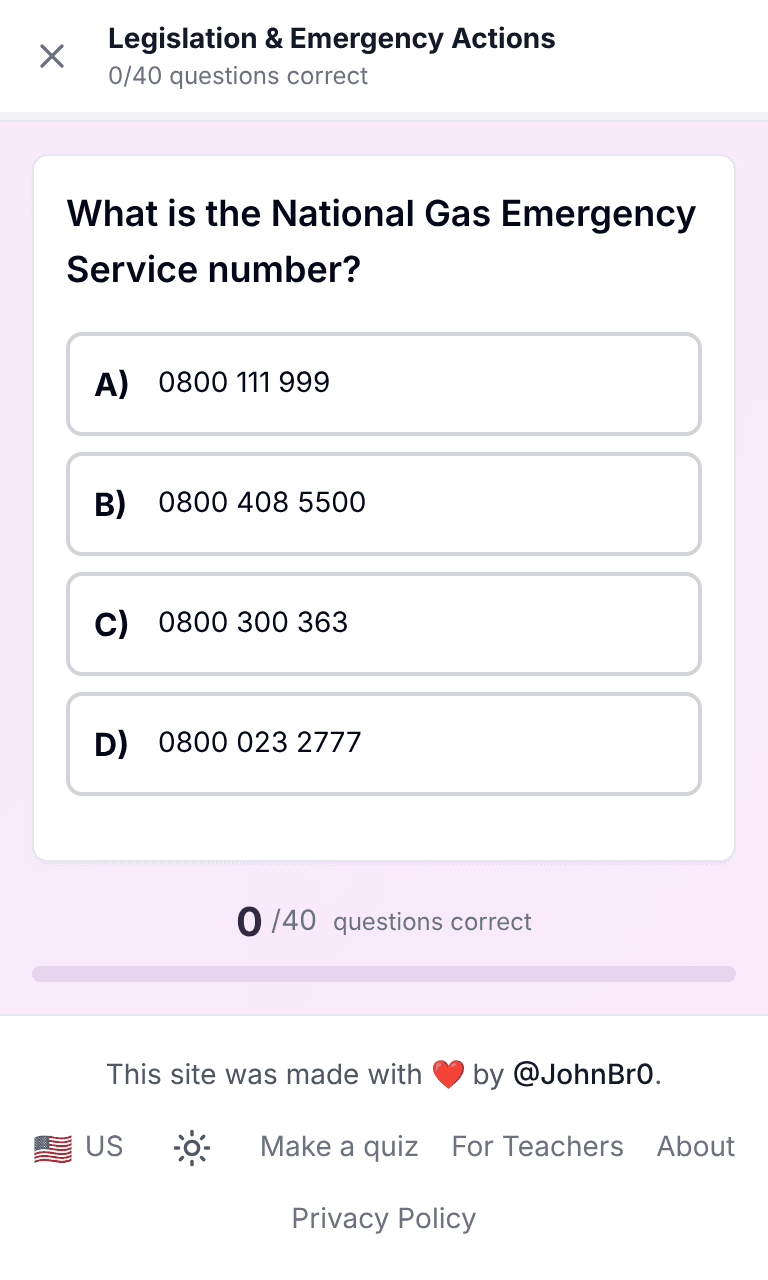
Train on mobile
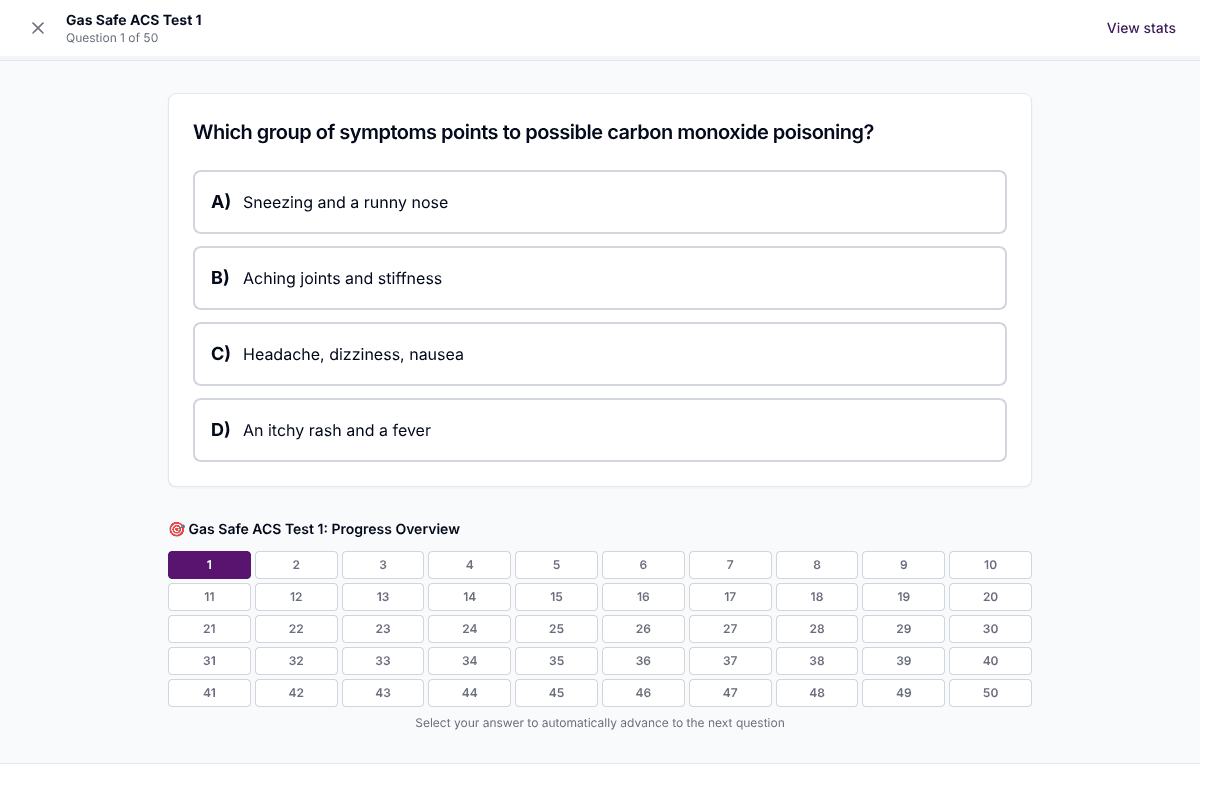
Test on desktop
The Gas Safe ACS exam at a glance
The ACS CCN1 assessment is the core domestic gas safety assessment of the Nationally Accredited Certification Scheme. Gas engineers in Great Britain who want to join Gas Safe Register show their competence by a recognised qualification or by passing CCN1 plus the appliance assessments they need at a UKAS-accredited certification body's assessment centre. Assessments combine practical tasks and theory, and certificates are renewed every five years. Tigertest covers the knowledge side: the Gas Safety (Installation and Use) Regulations 1998, HSE L56, the unsafe situations procedure, combustion and carbon monoxide, ventilation, flues, tightness testing, meters and safety devices.
Tigertest has 200 Gas Safe ACS practice questions with explanations, free to start with no account required.
- Scheme
- Nationally Accredited Certification Scheme (ACS), standards by IGEM
- Assessed by
- UKAS-accredited certification bodies at ACS centres
- Leads to
- A certificate Gas Safe Register accepts for registration
- Format
- Practical and theory assessments against the CCN1 criteria
- Pass mark
- Not published; Tigertest uses 70%
- Renewal
- Every 5 years
Updated by the Tigertest team. Practice questions follow the IGEM ACS assessment pages, the CCN1 criteria (Issue 20.1) and HSE L56, checked November 2026. Exam rules change, so confirm current details with IGEM: ACS assessment.
How It Works
Train, Then Test
Five training sets, from Legislation & Emergency Actions to Unsafe Situations & Safety Devices. Master a topic, then take a test. Questions you miss come back until you have mastered them.
Practice Tests
Four 50-question practice tests across every CCN1 topic, with a 70% readiness line and an explanation of the right answer on every question.
Built on the CCN1 Assessment Criteria
The ACS does not publish how the theory papers are weighted, so the practice tests spread across the sections of the CCN1 criteria, with the law, tightness testing, unsafe situations, flues and appliances carrying the most questions. Every question is original. Paid standards are not quoted.
For Course Tutors
Running ACS or gas training courses? Set Tigertest as practice before assessment at tigertest.io/teach and see which topics your candidates miss most. It is free for you and your learners.
Help Make Tigertest Better
Have an idea, a topic you'd like covered, or a question that could be clearer? We read every message and use it to improve every test.
Share FeedbackHow to Prepare for ACS CCN1
1. Know the unsafe situations procedure cold
Learn the difference between Immediately Dangerous and At Risk, what you must do for each, and what you need the responsible person's permission for. A wrong call here matters more than any score.
2. Learn the law by regulation
Know who the Gas Safety (Installation and Use) Regulations put duties on: the installer, the landlord, the responsible person. Know what the L56 code says about competence, safety checks and records.
3. Understand combustion and CO
Know what complete and incomplete combustion produce, the signs of an appliance making carbon monoxide, and the symptoms and actions when CO is suspected.
4. Fix your misses, then retest
Tigertest tracks your accuracy by topic. Aim for 90 percent on every practice test, then retrain your weakest topic.
Gas Safe ACS (CCN1) Frequently Asked Questions
What is ACS CCN1?
It is the core domestic natural gas safety assessment of the Nationally Accredited Certification Scheme. Passing it, with the appliance assessments for the work you do, gives a certificate of competence that Gas Safe Register accepts for registration.
Does this practice test cover the practical assessment?
No. It covers the knowledge side: the law, L56, the unsafe situations procedure, combustion, CO, ventilation, flues, tightness testing, meters and safety devices. Pipework, live testing and appliance work are assessed hands-on at the assessment centre.
What pass mark should I aim for?
The scheme does not publish a percentage for the theory papers. Tigertest uses 70% as a readiness line; aim well above it, because a single wrong call on an Immediately Dangerous situation matters more than a score.
Which rules does it follow?
The Gas Safety (Installation and Use) Regulations 1998 as amended and HSE's L56 code of practice, IGEM/G/11 Edition 2 (with the 2022 and 2024 amendments), the CCN1 criteria Issue 20.1 and, for building rules, England's Approved Document J. Northern Ireland has its own regulations.
How often do gas engineers have to be reassessed?
ACS certificates are renewed every five years, through ACS reassessment or the Group Competency Scheme.
I teach a gas safety (ACS) course. Can my students use Tigertest?
Yes, for free. Make a class at tigertest.io/teach, post one link, and students join with just their name. You see who practised, their test scores and the topics your class misses most.
Gas Safe ACS sample questions and answers
6 of the 200 practice questions, one from each topic, with the answer explained.
1. Where a pipe passes through a wall in a sleeve, the gap between pipe and sleeve is sealed at:
- A.The middle only
- B.One end only
- C.Both ends fully
- D.Neither end
Answer: B. L56 says the gap should be sealed with fire-retardant flexible sealant at one end only, so any leak cannot collect in the space between.
2. Domestic LPG is mainly made up of:
- A.Methane and some ethane
- B.Hydrogen mixed with methane
- C.Mostly carbon monoxide
- D.Propane, butane or both
Answer: D. UKHSA describes LPG as mainly propane, butane or a mixture. Like natural gas it is odourless when pure, so a stenching agent is added.
3. Confirmed re-entry of flue products giving what ambient carbon monoxide level is classed Immediately Dangerous?
- A.10 ppm or more
- B.50 ppm or more
- C.100 ppm or more
- D.1 ppm or more
Answer: A. IGEM/G/11 classes confirmed re-entry of products of combustion giving ambient carbon monoxide of 10 ppm or greater as ID. Even below 10 ppm it says further investigation is needed.
4. How many refillable cylinders on an automatic changeover device bring in the need for over-pressure protection?
- A.Three or more
- B.Six or more
- C.Four or more
- D.Two or more
Answer: C. Regulation 14(4) requires an adequate alternative means of protection against regulator failure for four or more refillable cylinders on an automatic changeover device. L56 recommends it for all.
5. A carbon monoxide escape from an LPG appliance is reported to the supplier. What is the supplier's duty under regulation 37(8)?
- A.Disconnect it within an hour
- B.Report it under RIDDOR 11(1)
- C.Give advice and urge a check
- D.Replace the faulty appliance
Answer: C. Regulation 37(8) limits the supplier's duty for a reported CO escape to advising the immediate action to take and the need for the fitting to be examined and, if needed, repaired by a competent person.
6. Approved Document J Table 5 gives what minimum flue dimension for an ILFE or DFE fire in an opening up to 500 mm x 550 mm?
- A.175 mm
- B.125 mm
- C.90 mm
- D.225 mm
Answer: A. Table 5 gives a minimum flue dimension of 175 mm for these fires, noting some ILFE and DFE appliances need a circular flue of at least 125 mm.
Related practice tests
Every test on Tigertest is free to start, with no account needed.
- SIA Door Supervisor Practice TestSIA licence-linked qualification (UK)
- 18th Edition Practice TestCity & Guilds 2382-26 · BS 7671:2018+A4:2026
- Building Regulations Practice TestMHCLG · Building Regulations 2010 (England)
- Registered Building Inspector Practice TestBuilding Safety Regulator · RBI competence
- Plumbing Theory Practice TestCity & Guilds · 6035 Plumbing Studies and ST0303 apprenticeship
- Unvented Hot Water (G3) Practice TestBPEC, LCL Awards · Unvented hot water (Part G3)
Ready for Your ACS Assessment?
Start for free. No account required. 200 questions across every CCN1 topic.
Start practising