
Free CogAT Practice Test
The Verbal and Quantitative Batteries for grades 3 to 6, timed like the real CogAT, plus six drills, one for each test. Everything is free, no account needed.
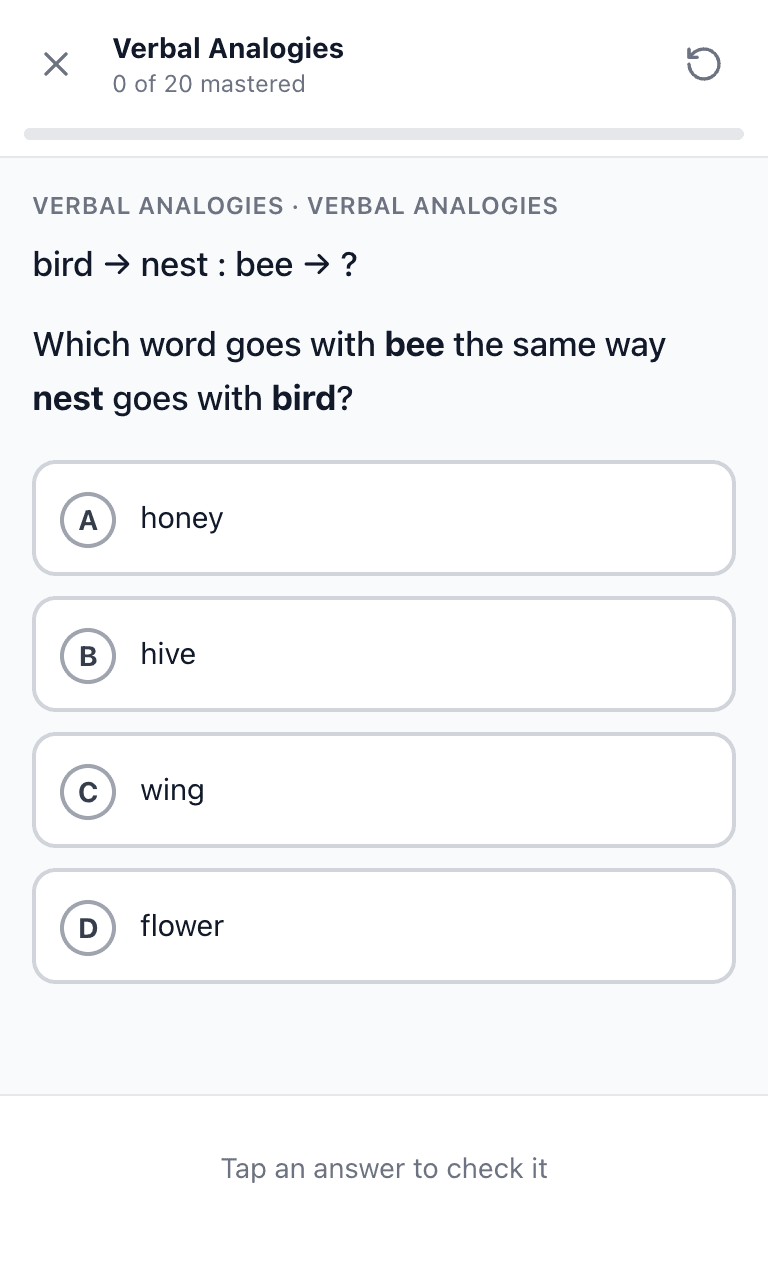
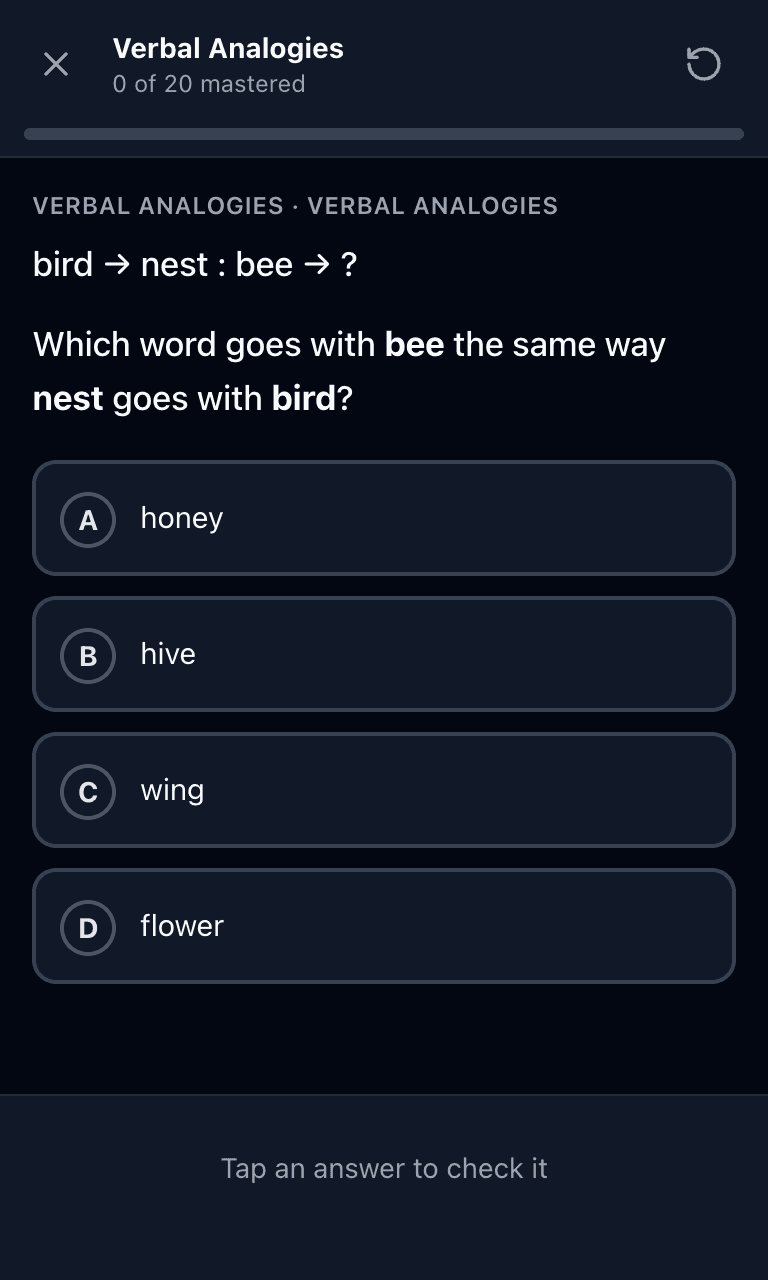
Train on mobile
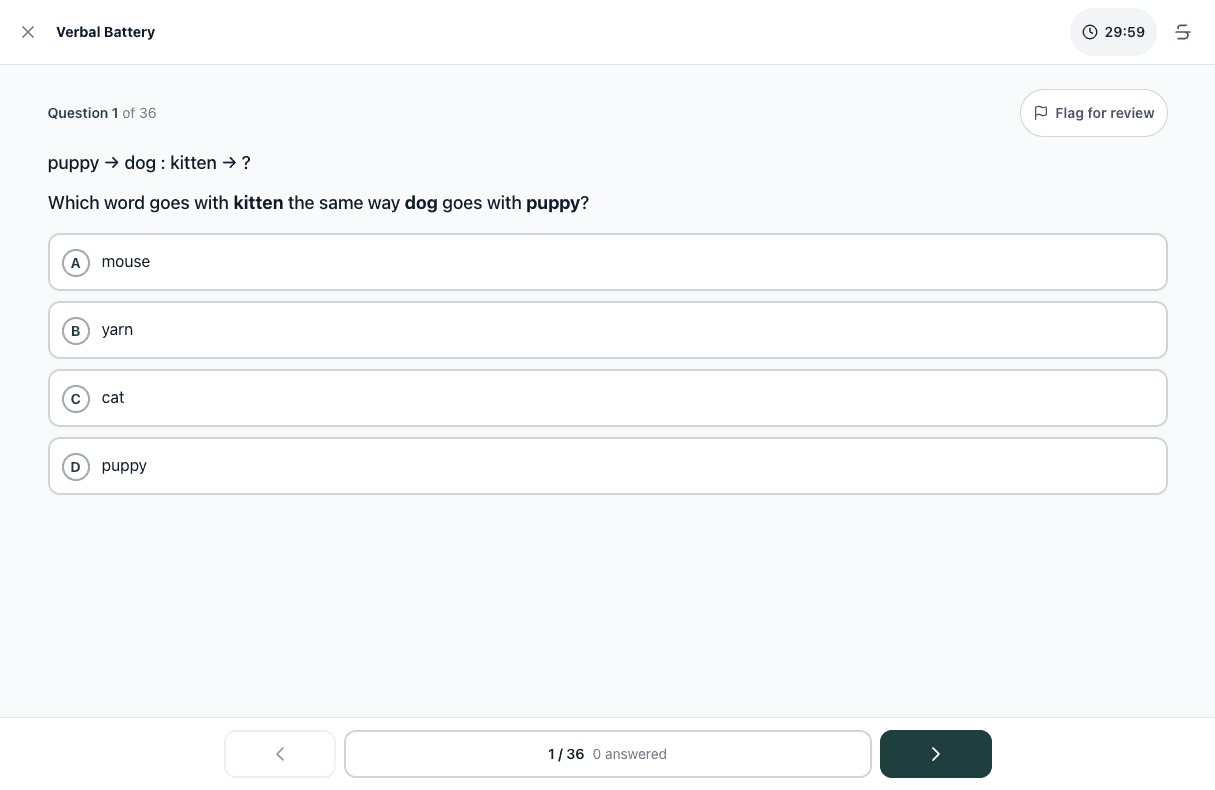
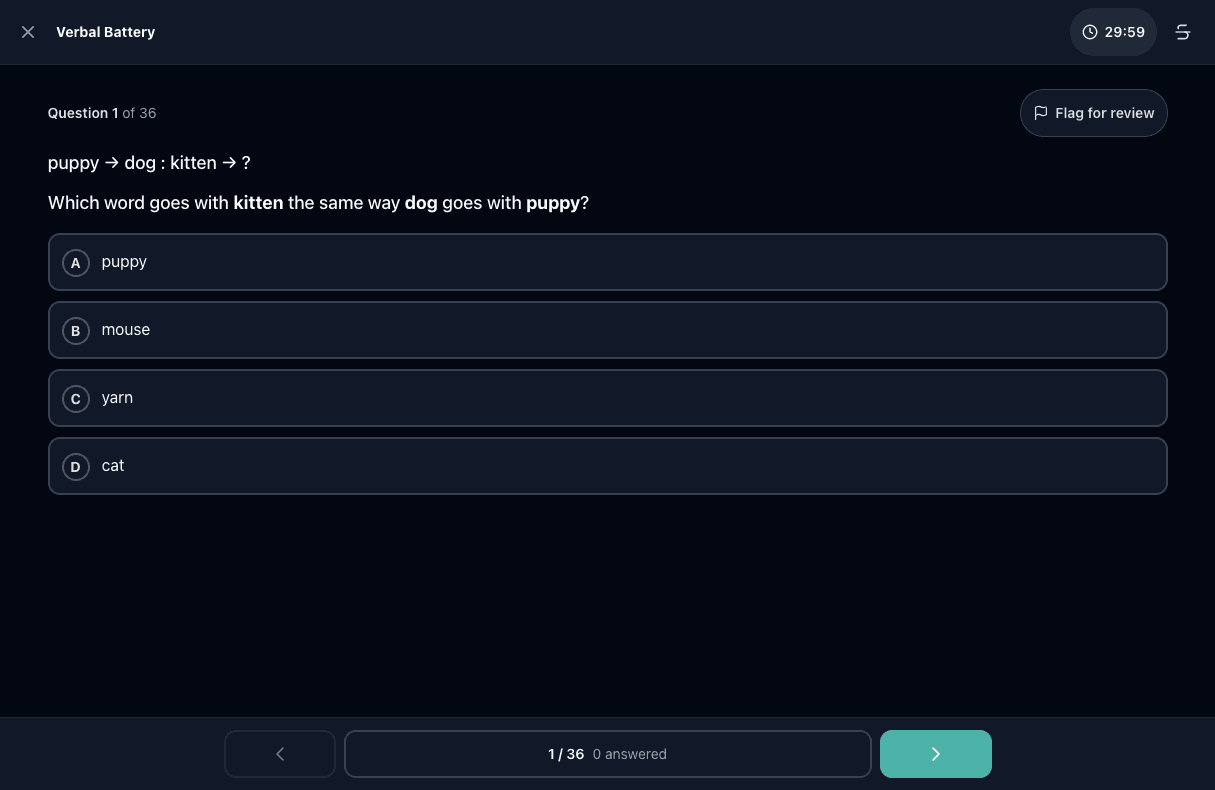
Test on desktop
The CogAT exam at a glance
CogAT, the Cognitive Abilities Test from Riverside Insights, is a reasoning test that many US schools use to screen students for gifted and talented programs and to plan instruction. It measures how well a student reasons with words, numbers and shapes, not how much of the curriculum they have learned. It has three batteries: Verbal (Verbal Analogies, Sentence Completion, Verbal Classification), Quantitative (Number Analogies, Number Puzzles, Number Series) and Nonverbal (Figure Matrices, Paper Folding, Figure Classification). There is a separate test level for each grade from K to 6; from Level 9 (grade 3) the Verbal and Quantitative questions are written in words and numbers, and each of the nine tests takes about 10 minutes. Scores compare a student with others of the same age.
Tigertest has two timed practice tests of the Verbal and Quantitative Batteries at Levels 9 to 12, 36 questions a battery with 12 for each CogAT test, and six drills, one per test. The Nonverbal Battery is picture puzzles and is not included. All of it is free with no account required. Scores are percent correct, never age scores or percentiles.
- Who takes it
- Students in grades K to 12; Levels 9 to 12 are for grades 3 to 6
- Batteries
- Verbal, Quantitative and Nonverbal, three tests each
- Time
- About 10 minutes per test at Level 9 and up, nine tests in all
- Forms
- Forms 7 and 8, two equivalent forms; Screening Forms of the three analogies tests take about 30 minutes
- Delivery
- Paper or online, set by the school
- Score
- Standard Age Score and age percentile rank from national age norms, age stanines and an Ability Profile
- Pass mark
- None: schools set their own cut scores for gifted programs
Updated by the Tigertest team. Practice questions follow Riverside Insights' CogAT Overview Brochure (Forms 7 and 8 testing times and descriptions) and Overview of CogAT for Parents. Exam rules change, so confirm current details with Riverside Insights: CogAT Overview Brochure.
How It Works
Drills on a Phone or Tablet
Six short drills, one for each CogAT test, from word analogies to number patterns. One tap to check, a kid-friendly explanation straight away, and every miss comes back until it is mastered.
Full Test on a Computer
The Verbal Battery, a short break, then the Quantitative Battery, each 36 questions in 30 minutes. Flag questions to come back to, turn the clock off if you prefer, and finish with a percent score per battery and a list of what to drill next.
Built on the Real Exam Format
Each practice test follows Riverside Insights' own description of CogAT Forms 7 and 8 at Level 9 and up: the six Verbal and Quantitative tests in their real order, about 10 minutes each. Questions run from grade 3 to grade 6, easy to hard within each test. The Nonverbal Battery is picture puzzles at every level, so it is not included here.

Teach Grades 3 to 6?
Teachers can set it for a class for free: post one link, students join with just their first name, and you see who practiced, their scores on each battery and the questions your class misses most.
Make a class at tigertest.io/teachHow to Help Your Child Prepare for the CogAT
1. Make the question types familiar
Analogies, classification and number puzzles look unusual the first time. A couple of short sessions means your child knows what each kind of question is asking before test day.
2. Say the rule out loud
For analogies and number patterns, the trick is to put the rule into words first ("a puppy grows up to be a dog", "each number is 3 more") and then test every answer against it.
3. Read every choice
Several answers often look close. Encourage your child to read every choice before picking one and to check a number answer by putting it back into the pattern or equation.
4. Keep it short and relaxed
Take Practice Test 1, look at the score for each test, and spend ten minutes a day on the weakest drill. Then take Practice Test 2. Its questions never appear in the drills, so it shows real progress.
CogAT Test Frequently Asked Questions
What is the CogAT test?
CogAT, the Cognitive Abilities Test, is a reasoning test from Riverside Insights that many US schools use to find students for gifted and talented programs and to see how each child learns best. It does not test what your child has been taught. It tests how well they reason with words, numbers and shapes, in three batteries: Verbal, Quantitative and Nonverbal, each made of three short tests.
What is on the Verbal and Quantitative Batteries?
From Level 9 (grade 3) up, the Verbal Battery is Verbal Analogies (work out how two words go together, then finish another pair the same way), Sentence Completion (choose the word that best completes a sentence) and Verbal Classification (choose the word that belongs with three others). The Quantitative Battery is Number Analogies, Number Puzzles (find the missing number in an equation) and Number Series (find the next number in a pattern). Riverside gives about 10 minutes for each test.
Which parts of the CogAT does Tigertest cover?
The Verbal and Quantitative Batteries at Levels 9 to 12, for grades 3 to 6, which are written in words and numbers at those levels. The Nonverbal Battery (Figure Matrices, Paper Folding and Figure Classification) is made of pictures and shapes at every level, and the primary levels for grades K to 2 are picture based too, so Tigertest leaves them out rather than turn a picture puzzle into a reading question.
How is the CogAT scored?
The real CogAT compares your child with other students of the same age, month by month: a Standard Age Score and an age percentile rank, with age stanines and an Ability Profile that sums up the pattern of strengths. Tigertest cannot give those scores, because a practice test is not normed. It gives percent correct per battery and shows which of the six tests need work.
How many questions are on each practice test?
36 questions a battery, 12 for each CogAT test, in 30 minutes a battery, so each test gets the 10 minutes Riverside gives it. Riverside publishes the time for each test rather than the number of questions, so the 12 per test is Tigertest's choice. There is a short break between the two batteries. Riverside says the full CogAT takes less than two class periods.
Can you prepare for the CogAT?
The CogAT measures reasoning, so there is no list of facts to learn. A little practice still helps: it makes the question types familiar, so on test day your child spends the time thinking, not working out what a number analogy is asking. Keep it short and calm. A few minutes of drills a day is plenty.
Is the Tigertest CogAT practice free?
Yes, all of it: both practice tests, all six drills and every explanation, with no account required. An account saves progress across devices.
I teach a grade 3 to 6 gifted and talented or enrichment class. Can my students use Tigertest?
Yes, for free. Make a class at tigertest.io/teach, post one link, and students join with just their name. You see who practiced, their test scores and the topics your class misses most.
CogAT sample questions and answers
6 of the 204 practice questions, one from each topic, with the answer explained.
- 1.
cow → calf : horse → ?
Which word goes with horse the same way calf goes with cow?
- A.
pony
- B.
foal
- C.
mare
- D.
stable
Answer: B.A young cow is a calf, and a young horse is a foal. A pony is a small kind of horse, and a mare is a grown female horse.
- A.
- 2.
The new rule was _____, so every student had to follow it.
Which word best completes the sentence?
- A.
optional
- B.
secret
- C.
forgotten
- D.
mandatory
Answer: D.Mandatory means required, so everyone must follow it. An optional rule is one you may choose to skip.
- A.
- 3.
Which word goes with sprint, dash and race?
- A.
rush
- B.
stroll
- C.
crawl
- D.
wander
Answer: A.To sprint, dash or race is to move very fast, and so is to rush. To stroll or wander is to move slowly.
- A.
- 4.
2 → 9 : 3 → 13 : 5 → ?
Which number finishes the last pair by the same rule?
- A.
21
- B.
22
- C.
23
- D.
25
Answer: A.The rule is multiply by 4, then add 1: 2 → 9 and 3 → 13. So 5 → 21.
- A.
- 5.
(? + 4) × 2 = 22
Which number goes where the ? is?
- A.
7
- B.
9
- C.
11
- D.
13
Answer: A.Undo the steps backward: 22 ÷ 2 = 11, then 11 − 4 = 7.
- A.
- 6.
3 5 9 17 33 ?
Which number comes next?
- A.
49
- B.
57
- C.
65
- D.
66
Answer: C.The jumps double each time: add 2, then 4, then 8, then 16, then 32. The next number is 65.
- A.
Related practice tests
Every test on Tigertest is free to start, with no account needed.
- MAP Growth Practice TestNWEA · grades 2 to 5, Math, Reading and Language Usage
- SHSAT Practice TestNYC Public Schools · Specialized High Schools Admissions Test
- HSPT Practice TestScholastic Testing Service · High School Placement Test, grade 8
- SSAT Practice TestE3n · SSAT Middle Level, grades 5 to 7
- ISEE Middle Level Practice TestE3n (ERB) · ISEE Middle Level, applicants to grades 7 and 8
Ready for Test Day?
Free. No account required. Two practice tests and six drills, from word analogies to number series.
Start practicing