
Free SSAT Practice Test
Middle Level Quantitative, Reading and Verbal for grades 5 to 7, in the real order with five choices per question, plus seven drills that teach the basics first. Everything is free, no account needed.
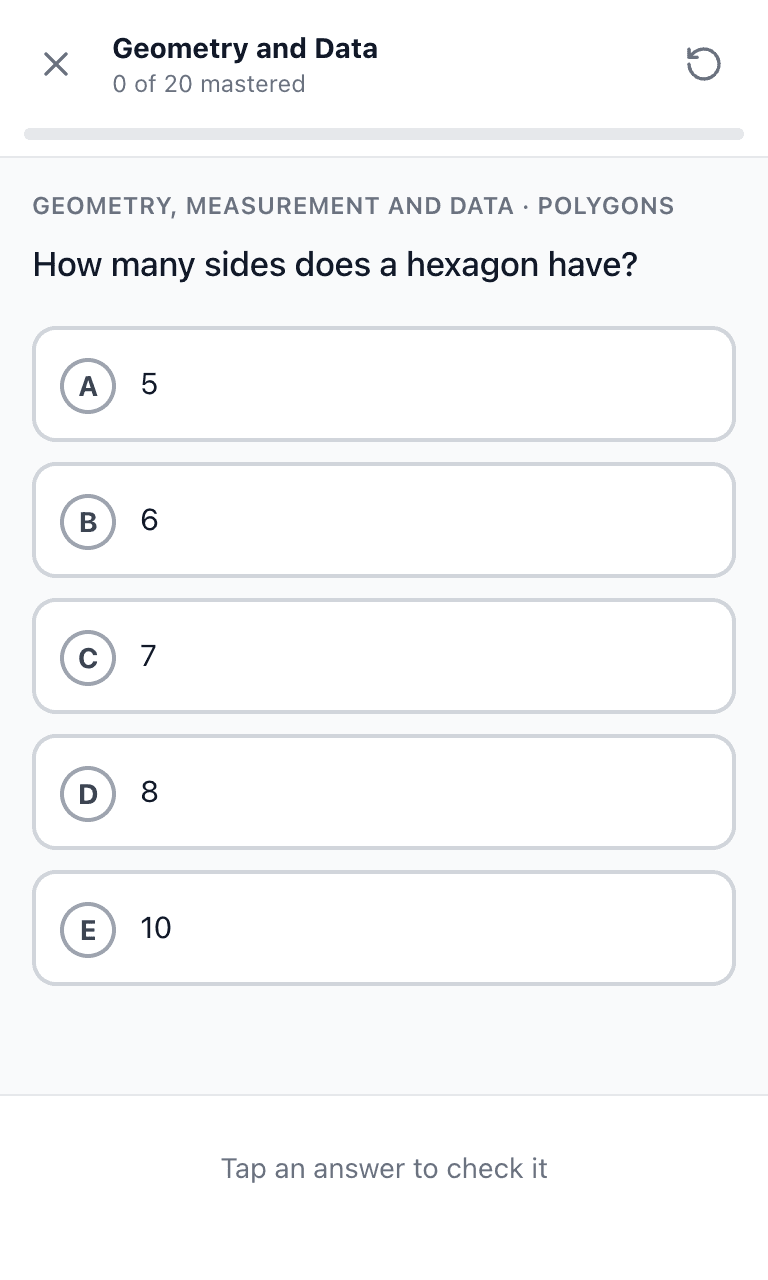
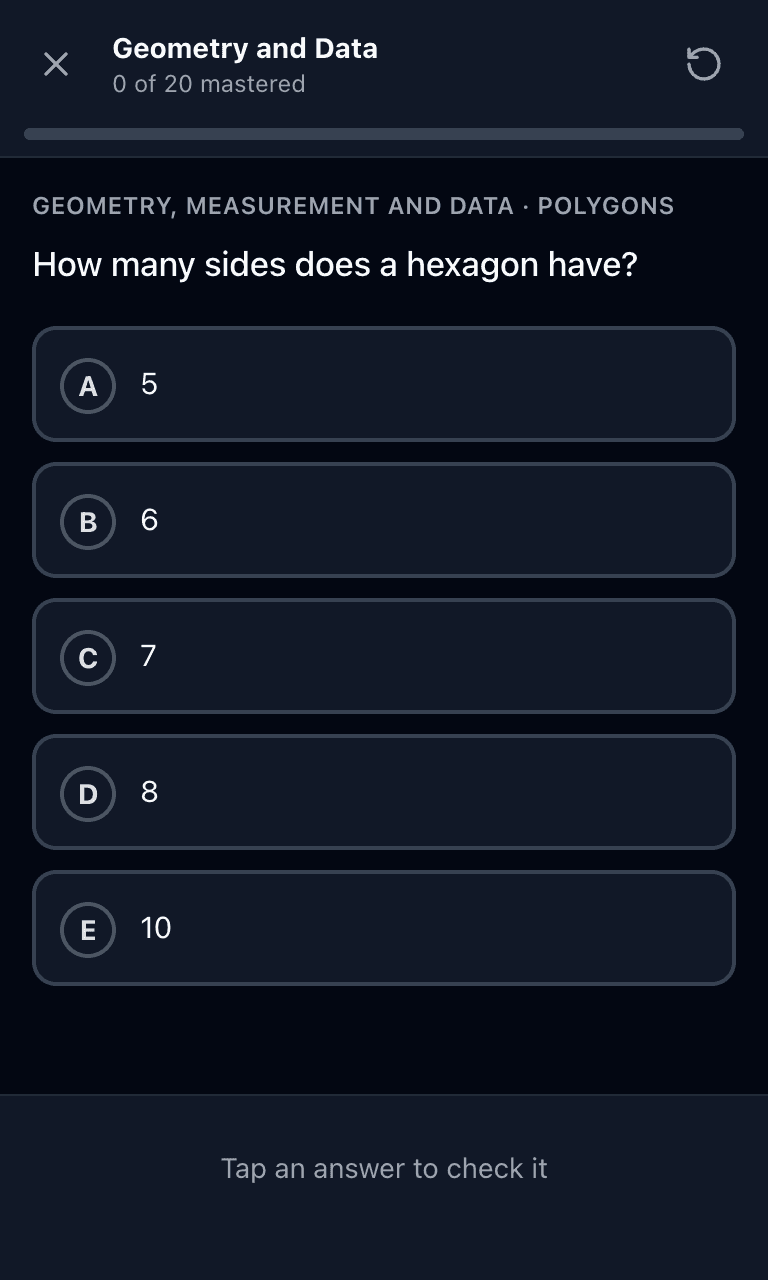
Train on mobile
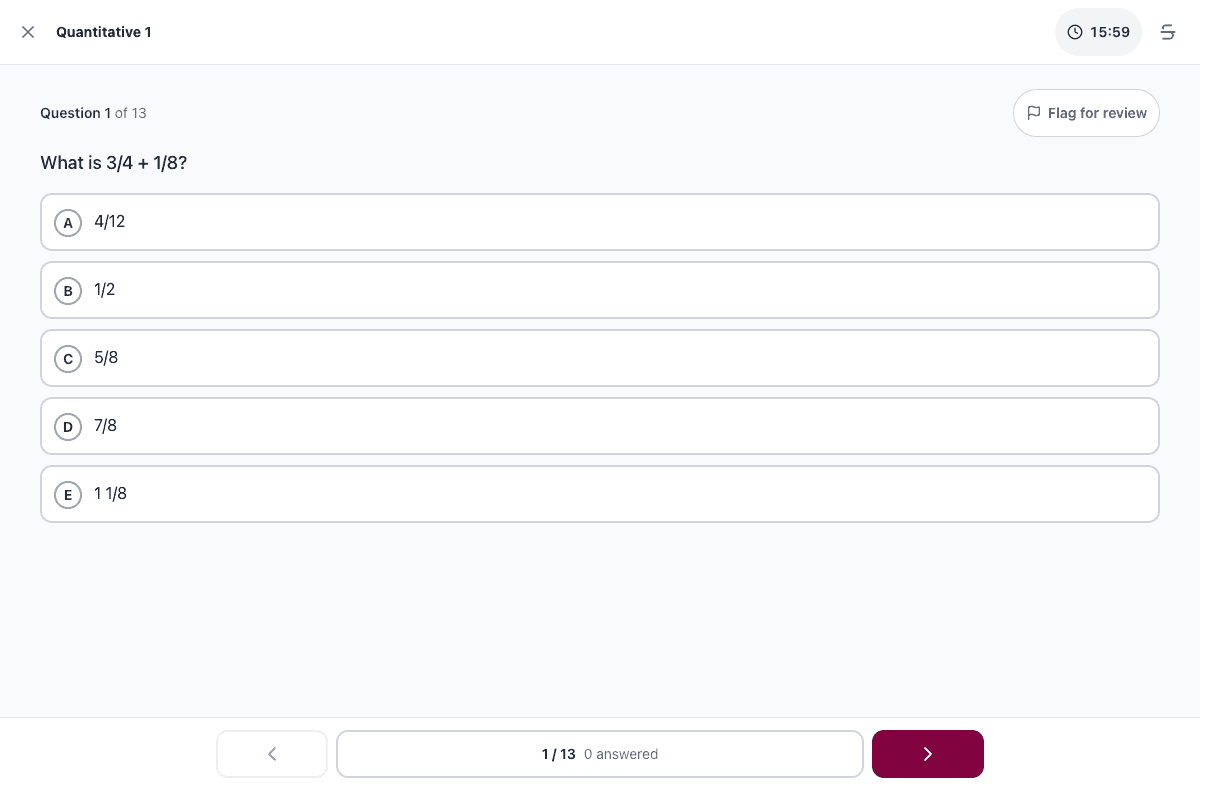
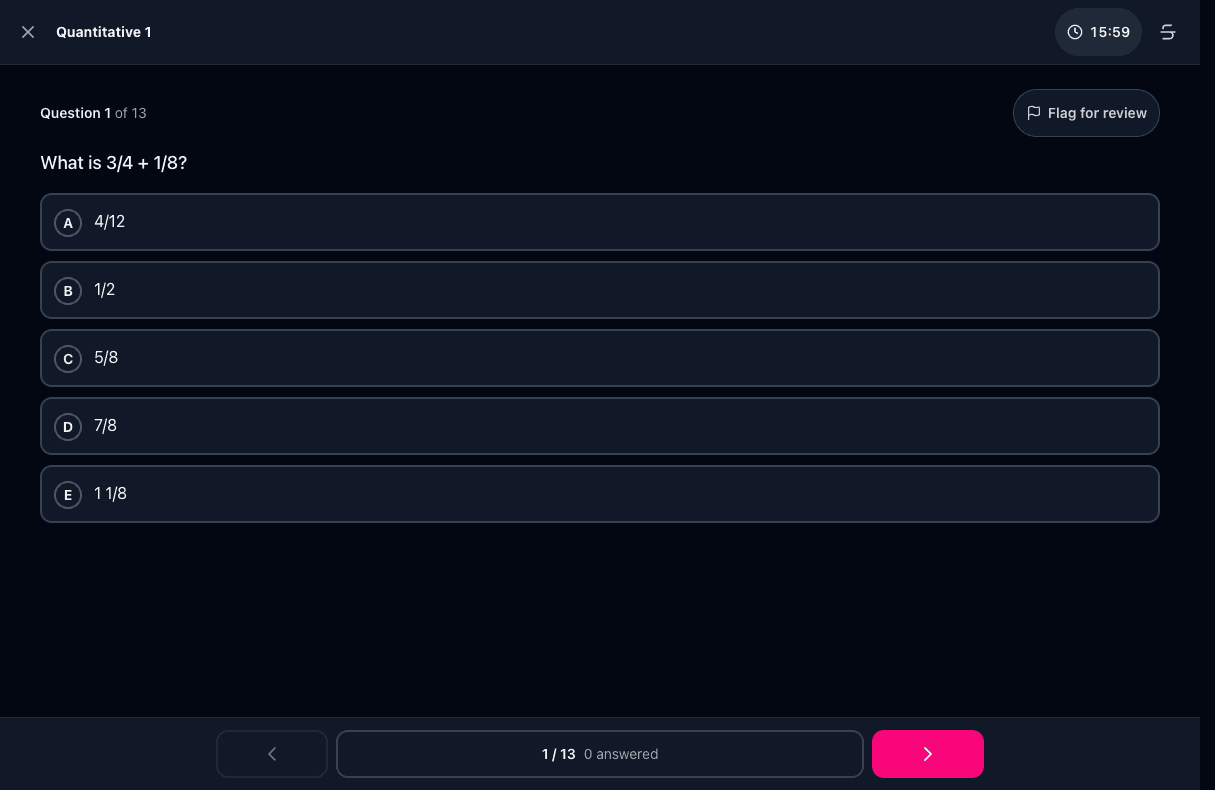
Test on desktop
The SSAT exam at a glance
The SSAT (Secondary School Admission Test) is the admission test many US and international independent schools ask for, run by E3n (admission.org). The Middle Level is for students in grades 5 to 7 applying for grades 6 to 8; the Upper Level, with the same format, is for grades 8 to 11. The Middle Level has an unscored 25-minute writing sample, then five multiple-choice sections: Quantitative (25 questions, 30 minutes), Reading (40 questions, 40 minutes), Verbal (60 questions: 30 synonyms and 30 analogies, 30 minutes), a second Quantitative section (25 questions, 30 minutes) and an unscored 15-minute experimental section, with two 10-minute breaks, 3 hours 10 minutes in all. Each question has five answer choices, calculators are not allowed, and a right answer earns 1 point, a wrong answer loses a quarter point and a blank earns nothing.
Tigertest has two timed Middle Level practice tests with the four scored sections in the real order, each about half the real length at the real pace, five choices per question, and seven drills, three of which teach the basics first. All of it is free with no account required. Scores are percent correct, not SSAT scaled scores, and the writing sample and experimental section are not included.
- Who takes it
- Middle Level: students in grades 5 to 7 applying for grades 6 to 8
- Scored sections
- Quantitative (2 x 25), Reading (40), Verbal (30 synonyms, 30 analogies)
- Unscored parts
- 25-minute writing sample and a 15-minute experimental section
- Time
- 3 hours 10 minutes, with two 10-minute breaks
- Answer choices
- Five per question; no calculator
- Scoring
- 1 point right, minus 1/4 point wrong, 0 for a blank; scaled scores and percentiles
- Pass mark
- None: each school reads the scores in its own way
Updated by the Tigertest team. Practice questions follow E3n's "What's on the Middle Level SSAT?" and Score Reports pages and the SSAT Candidate Handbook for testing year 2026-2027. Exam rules change, so confirm current details with E3n: What's on the Middle Level SSAT?.
How It Works
Drills on a Phone or Tablet
Seven short drills: arithmetic, algebra, geometry, story passages, argument passages, synonyms and analogies. Three open with the basics, a short lesson and two quick questions, before the SSAT-level questions. One tap to check, an explanation straight away, and every miss comes back until it is mastered.
Timed Test on a Computer
The four scored sections in the real order with a clock on each and a break, at the real SSAT pace. Flag questions to come back to, reading passages stay beside their questions, and you finish with a percent score per section and a list of what to drill next.
Built on the Real Exam Format
Each practice test follows E3n's published Middle Level format: two Quantitative sections on arithmetic, elementary algebra and geometry, Reading on narrative and argument passages, and Verbal split evenly between synonyms and analogies, with five choices per question and no calculator. It is about half the real length at the same pace. The real SSAT reports scaled scores and percentiles; this one reports percent correct.

Run an SSAT Prep Class?
Tutors and teachers can set it for a class for free: post one link, students join with just their first name, and you see who practiced, their scores in each section and the questions your class misses most.
Make a class at tigertest.io/teachHow to Prepare for the Middle Level SSAT
1. Take Practice Test 1 first
It shows which section needs the most work. Look at the scores by skill, not just the total.
2. Build vocabulary every day
Verbal is 60 questions in 30 minutes, so words have to come quickly. Ten minutes a day on the synonyms and analogies drills, and naming the relationship in each analogy out loud, adds up fast.
3. Do math without a calculator
Calculators are not allowed, so practice fractions, percents and multi-step problems on scrap paper. The arithmetic and algebra drills start with the basics if they are rusty.
4. Learn when to skip
A wrong answer costs a quarter point on the real test. Skip a question your child cannot narrow down, and guess once two or more choices are ruled out. Then take Practice Test 2: its questions never appear in the drills, so it shows real progress.
SSAT Frequently Asked Questions
What is the SSAT?
The SSAT (Secondary School Admission Test) is the admission test many independent and boarding schools in the US and abroad ask for. It is run by E3n, the non-profit formerly called The Enrollment Management Association, at admission.org. The Middle Level is for students in grades 5 to 7 and the Upper Level, with the same format, for grades 8 to 11. This practice test is for the Middle Level.
What is on the Middle Level SSAT?
An unscored 25-minute writing sample, then five multiple-choice sections: Quantitative (25 questions, 30 minutes), Reading (40 questions, 40 minutes), Verbal (60 questions in 30 minutes: 30 synonyms and 30 analogies), a second Quantitative section (25 questions, 30 minutes) and an unscored 15-minute experimental section. With two 10-minute breaks it takes 3 hours 10 minutes. Every question has five answer choices and calculators are not allowed.
How is the SSAT scored?
Each right answer earns 1 point, each wrong answer loses a quarter of a point and a blank earns nothing. E3n turns the raw score into a scaled score for each section and a percentile that compares your child with other students in the same grade. Tigertest cannot give an SSAT scaled score or percentile: it reports percent correct per section and shows which skills to work on.
Should my child guess on the SSAT?
Because a wrong answer costs a quarter point, a wild guess does not help on average. Once your child can rule out two or more of the five choices, guessing between the rest is worth it. The practice tests here do not take off points, so your child can try every question and then look at which ones were guesses.
How is this practice test laid out?
Each practice test keeps the four scored sections in the real order at about half the length and the same pace: Quantitative 13 questions in 16 minutes, Reading 20 questions on four passages in 20 minutes, Verbal 30 questions (15 synonyms, then 15 analogies) in 15 minutes, a break, then Quantitative 12 questions in 14 minutes. The writing sample and the experimental section are not included.
Is there a passing score on the SSAT?
No. Each school decides how to read the scores alongside grades, recommendations and interviews. Your child's percentiles are compared only with other students in the same grade.
Is the Tigertest SSAT practice free?
Yes, all of it: both practice tests, all seven drills, the basics lessons and every explanation, with no account required. An account saves progress across devices.
I teach an SSAT prep class. Can my students use Tigertest?
Yes, for free. Make a class at tigertest.io/teach, post one link, and students join with just their name. You see who practiced, their test scores and the topics your class misses most.
SSAT sample questions and answers
5 of the 227 practice questions, one from each topic, with the answer explained.
- 1.
If 2x − 7 = 15, what is the value of x?
- A.
4
- B.
8
- C.
11
- D.
22
- E.
26
Answer: C.Add 7 to both sides: 2x = 22. Divide by 2: x = 11. Subtracting 7 instead gives 2x = 8 and x = 4; stopping at 2x gives 22.
- A.
- 2.
A bag holds 4 red, 5 blue and 3 green marbles. One marble is picked without looking. What is the probability that it is blue?
- A.
1/5
- B.
1/3
- C.
5/12
- D.
7/12
- E.
5/7
Answer: C.There are 4 + 5 + 3 = 12 marbles and 5 are blue, so the probability is 5/12. 5/7 compares blue with the 7 marbles that are not blue.
- A.
- 3.
What is −7 + 12 − (−3)?
- A.
-22
- B.
-2
- C.
2
- D.
8
- E.
22
Answer: D.−7 + 12 = 5, and subtracting −3 is the same as adding 3, so 5 + 3 = 8. Treating − (−3) as − 3 gives 2.
- A.
- 4.
Which word means most nearly the same as BENEVOLENT?
- A.
wealthy
- B.
wise
- C.
kind
- D.
brave
- E.
proud
Answer: C.Benevolent means kind and wanting to do good for others. A benevolent person may also be wealthy, but the word is about kindness.
- A.
- 5.
Cautious is to careless as:
- A.
brave is to bold
- B.
quiet is to calm
- C.
generous is to stingy
- D.
happy is to joyful
- E.
tired is to exhausted
Answer: C.Cautious and careless are opposites, and so are generous and stingy. Each of the other pairs is made of two words that mean nearly the same thing.
- A.
Related practice tests
Every test on Tigertest is free to start, with no account needed.
- MAP Growth Practice TestNWEA · grades 2 to 5, Math, Reading and Language Usage
- SHSAT Practice TestNYC Public Schools · Specialized High Schools Admissions Test
- HSPT Practice TestScholastic Testing Service · High School Placement Test, grade 8
- CogAT Practice TestRiverside Insights · CogAT Forms 7 and 8, Levels 9 to 12 (grades 3 to 6), Verbal and Quantitative
- ISEE Middle Level Practice TestE3n (ERB) · ISEE Middle Level, applicants to grades 7 and 8
Ready for Test Day?
Free. No account required. Two practice tests, seven drills and the basics, from fractions to analogies.
Start practicing