
Free IELTS Reading Practice Test 2026
Two full Academic Reading tests and 212 original questions, with a band score estimate. Reading only. Free to start, no account needed.
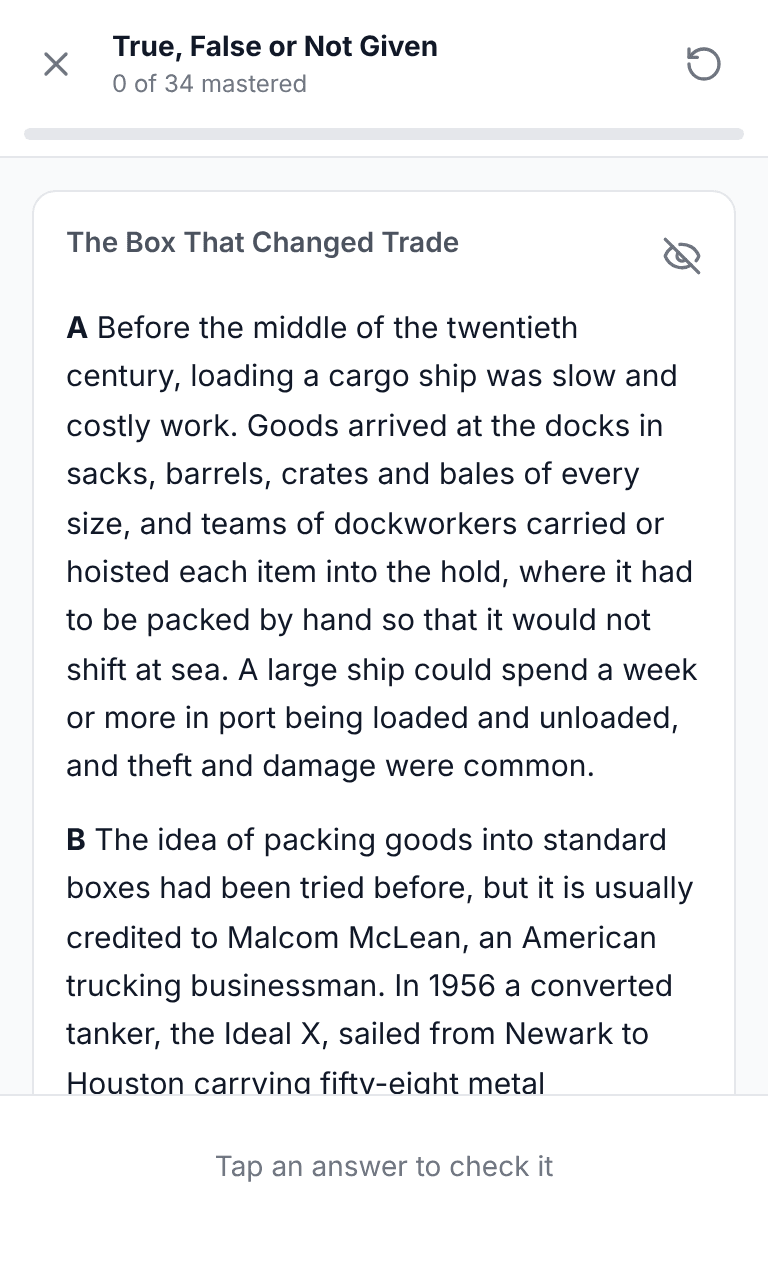
Train on mobile
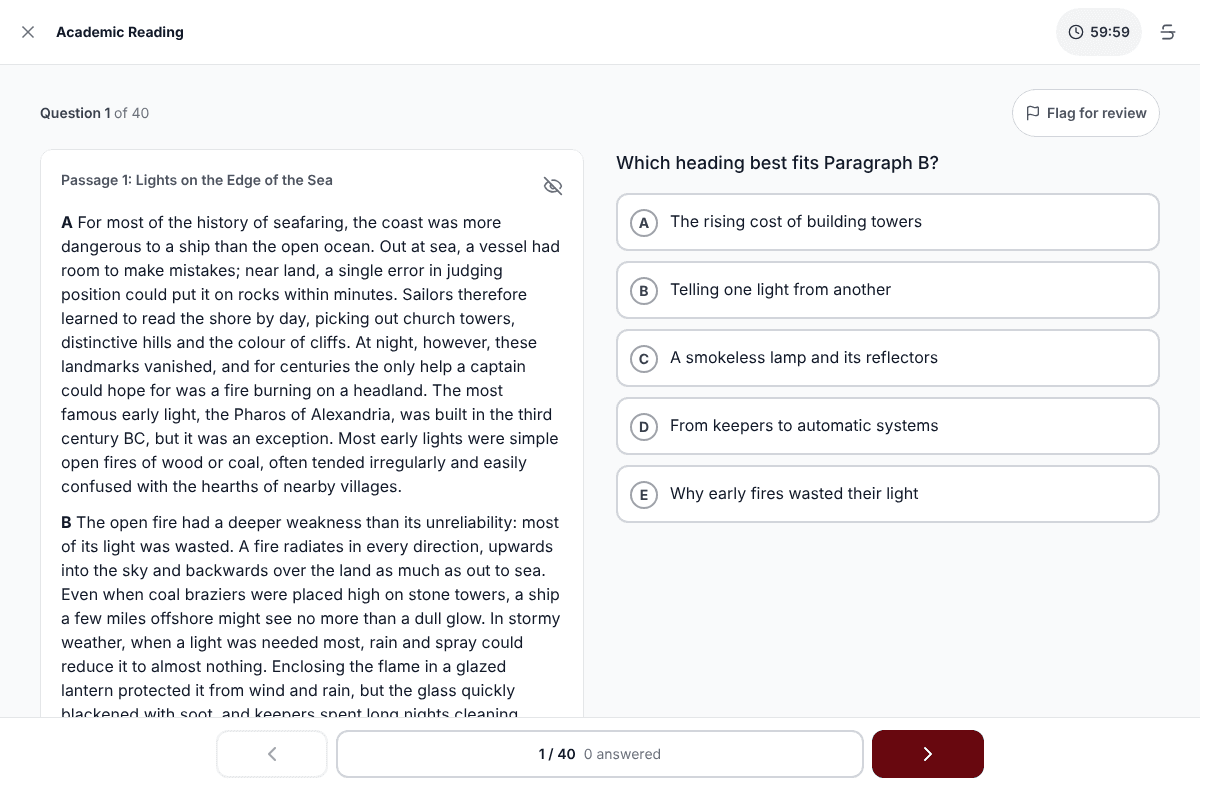
Test on desktop
The IELTS Reading exam at a glance
IELTS Academic Reading lasts 60 minutes and has 40 questions on three passages totalling 2,150 to 2,750 words, taken from books, journals, magazines, newspapers and online sources. Each correct answer earns one mark, wrong answers lose nothing, and the raw score out of 40 becomes a band from 1 to 9 in whole or half bands. On computer, answers are typed on screen and there is no extra transfer time. General Training Reading has the same length and timing but uses everyday and workplace texts and needs more correct answers for the same band.
Tigertest has two full Academic Reading tests and seven drills by question type, with a band score estimate. Only Reading is covered; Listening, Writing and Speaking are not.
- Questions
- 40, one mark each, no penalty for wrong answers
- Time
- 60 minutes, no extra transfer time
- Passages
- 3, 2,150 to 2,750 words in all (Academic)
- Score
- Band 1 to 9; about 23 correct for 6, 30 for 7 (Academic)
- Question types
- 11, from True/False/Not Given to short answers
- Delivery
- On computer (paper IELTS ended from mid-2026)
- Run by
- British Council, IDP IELTS and Cambridge
Updated by the Tigertest team. Practice questions follow the IELTS.org Academic Reading format page and IDP's band score table (as of November 2026). Exam rules change, so confirm current details with IELTS.org.
How It Works
Drills by Question Type
Seven drills on twelve shorter passages: True/False/Not Given, Yes/No/Not Given, multiple choice, matching headings, matching information, matching features and endings, and completion. Questions you miss come back until you have mastered them.
Full Practice Tests
Two full Academic Reading tests: three passages of rising difficulty and 40 questions on a 60-minute clock, with the passage beside the questions as on the computer test. Practice Test 2 is held out of the drills, so it measures readiness, not memory.
Built Like IELTS Academic Reading
Each practice test has three original passages of about 700 words, from a descriptive history to an argument with a clear point of view, and 40 one-mark questions in the real mix of types. Your raw score out of 40 becomes an estimated band. Only Reading is covered: the other three skills are not part of this practice.

Help Make Tigertest Better
Have an idea, a topic you'd like covered, or a question that could be clearer? We read every message and use it to improve every test.
Share FeedbackHow to Raise Your IELTS Reading Band
1. Know the difference between False and Not Given
False means the passage says the opposite. Not Given means it says nothing either way, even if the statement sounds likely. Find the part of the passage the statement is about, then ask: does it contradict it, or is the point simply missing? The same rule applies to No and Not Given for the writer's views.
2. Read headings for the whole paragraph
A wrong heading often repeats a word or a detail from the paragraph. The right one sums up its main point. Read the first and last sentences, decide what the paragraph is mainly doing, and only then look at the list.
3. Watch the grammar of a gap
In completion questions the missing word has to fit the sentence: a plural noun, a verb, an adjective. On the real test you copy words from the passage, so spelling counts and the word limit is strict. Practise finding the exact phrase rather than putting the idea in your own words.
4. Keep to about 20 minutes a passage
The passages get harder and there is no extra time at the end. Skim each passage first, answer the questions you can find quickly, and do not let one difficult question take five minutes. Tigertest shows your accuracy by question type, so drill your weakest type before each full test.
IELTS Reading Frequently Asked Questions
What is the IELTS Academic Reading test like?
IELTS Academic Reading lasts 60 minutes and has 40 questions on three passages, 2,150 to 2,750 words in all. The texts come from books, journals, magazines, newspapers and online sources written for a general audience, and at least one has a detailed argument. On computer the passage and questions sit side by side, you type your answers on screen, and there is no extra time to transfer answers. Each correct answer earns one mark, and wrong answers lose nothing.
Does Tigertest cover the whole IELTS test?
No. Only the Reading module is modelled. Listening needs recorded audio, and Writing and Speaking are marked by trained examiners, so Tigertest does not practise them and cannot estimate your overall band. The band shown here is for Reading only.
How is IELTS Reading scored?
Your raw score out of 40 is converted to a band from 1 to 9, in whole or half bands. IDP publishes the average marks needed: for Academic Reading about 23 correct for band 6, 30 for band 7 and 35 for band 8. The exact numbers vary slightly between test versions. Tigertest uses that Academic table to estimate your band, so treat it as a guide rather than an official score.
What about IELTS General Training Reading?
General Training Reading is also 40 questions in 60 minutes, but its three sections use everyday texts (notices, adverts, timetables), workplace texts and one longer general-interest text, and it needs more correct answers for the same band: about 30 for band 6 and 34 for band 7. The practice tests here use Academic passages. The question types overlap, so the drills still help General Training candidates, but the band estimate is for Academic.
Which question types are included?
All the Academic Reading types: multiple choice, identifying information (True, False or Not Given), identifying the writer's views (Yes, No or Not Given), matching information, matching headings, matching features, matching sentence endings, sentence completion, summary, note, table and flow-chart completion, diagram label completion and short-answer questions. On the real test you write completion and short answers as words from the passage within a word limit; here you choose the word from a list, which is easier, so expect to do a little better here than on the day. Diagrams are described in words.
Is the Tigertest IELTS Reading practice test free?
It is free to start, with no account required. Practice Test 1 and every drill but the last are free; the completion drill and Practice Test 2 are part of Tigertest Premium, one payment with no subscription. The passages and questions are original practice material, not taken from IELTS or Cambridge books. Create a free account if you want your progress saved across your phone and computer.
I teach an IELTS preparation course. Can my students use Tigertest?
Yes, for free. Make a class at tigertest.io/teach, post one link, and students join with just their name. You see who practiced, their test scores and the topics your class misses most.
IELTS Reading sample questions and answers
2 of the 212 practice questions, one from each topic, with the answer explained.
Why Cities Stay Warm at Night
On a still summer evening, the centre of a large city can be several degrees warmer than the countryside around it. Scientists call this the urban heat island effect. Part of the cause lies in the materials cities are built from. Dark roads and roofs absorb sunlight during the day and release the heat slowly after dark, so city streets cool far less at night than open fields. Tall buildings make the problem worse by trapping warm air and blocking the breezes that might carry it away.
Human activity adds further heat. Cars, factories and air conditioners all release warmth into the streets, and in hot weather the extra air conditioning needed to keep buildings cool can itself raise outdoor temperatures. Cities also have fewer plants than the countryside. Trees and grass cool the air around them by releasing water vapour, and they shade the ground beneath them.
Many cities are now trying to reduce the effect. Some paint roofs white or pale colours so that they reflect more sunlight, while others plant trees along streets or cover roofs with plants. These measures matter because high night-time temperatures can be dangerous, especially for elderly people, who may be unable to recover from the heat of the day.
1.The heat island effect is strongest in winter.
Does this agree with the information in the passage: True, False or Not Given?
- A.
True
- B.
False
- C.
Not Given
Answer: C.The passage describes a summer evening but never compares the strength of the effect in different seasons.
- A.
The Humble Pencil
In the sixteenth century, a large deposit of unusually pure graphite was found at Borrowdale, in the north of England. Local people at first used it to mark sheep, but it was soon cut into sticks for writing and drawing. Because pure graphite is soft and brittle, the sticks were wrapped in string or set into wooden holders. For a long time the deposit was so valuable that it was guarded, and supplies were controlled to keep prices high.
Other countries had no such source, and their pencils were often poor. In 1795, during a war that cut France off from English graphite, the French engineer Nicolas-Jacques Conté found a solution. He ground graphite into powder, mixed it with clay and baked the mixture. By changing the amount of clay, he could make leads that were harder or softer, so that one material could serve both artists and engineers.
The same basic method is still used today. Leads with more clay are harder and make paler lines, while those with more graphite are softer and darker. Ordinary pencils contain no lead at all; the name survives from an old belief that graphite was a form of the metal.
2.Which kind of lead makes the palest line?
- A.
One made of pure graphite
- B.
One that contains more graphite
- C.
One that contains more clay
- D.
One that was baked for longer
Answer: C.The last paragraph says leads with more clay are harder and make paler lines, while more graphite gives softer, darker lines.
- A.
Related practice tests
Every test on Tigertest is free to start, with no account needed.
Ready for IELTS Reading?
Start for free. No account required. 212 questions on 18 passages.
Start practicing