
Free TOEFL Reading Practice Test 2026
Two full TOEFL iBT Reading sections in the 2026 format and 194 original questions. Reading only. Free to start, no account needed.
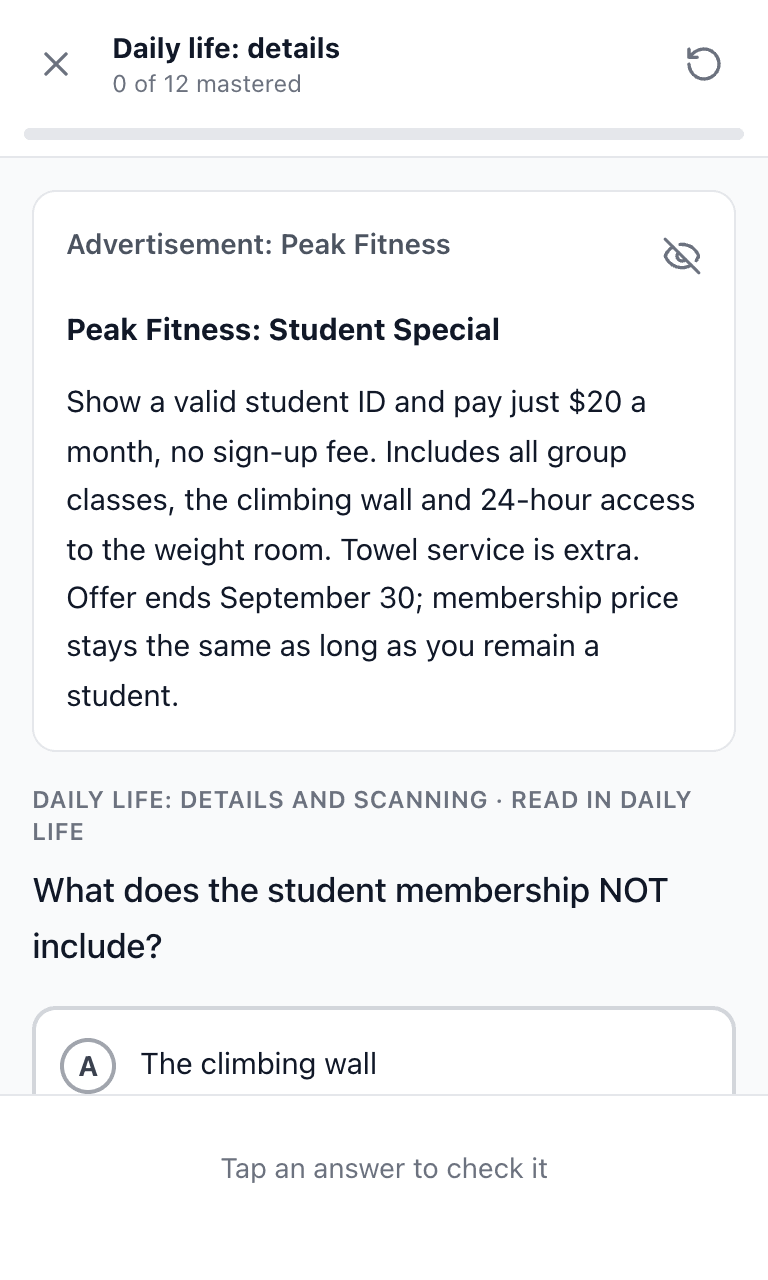
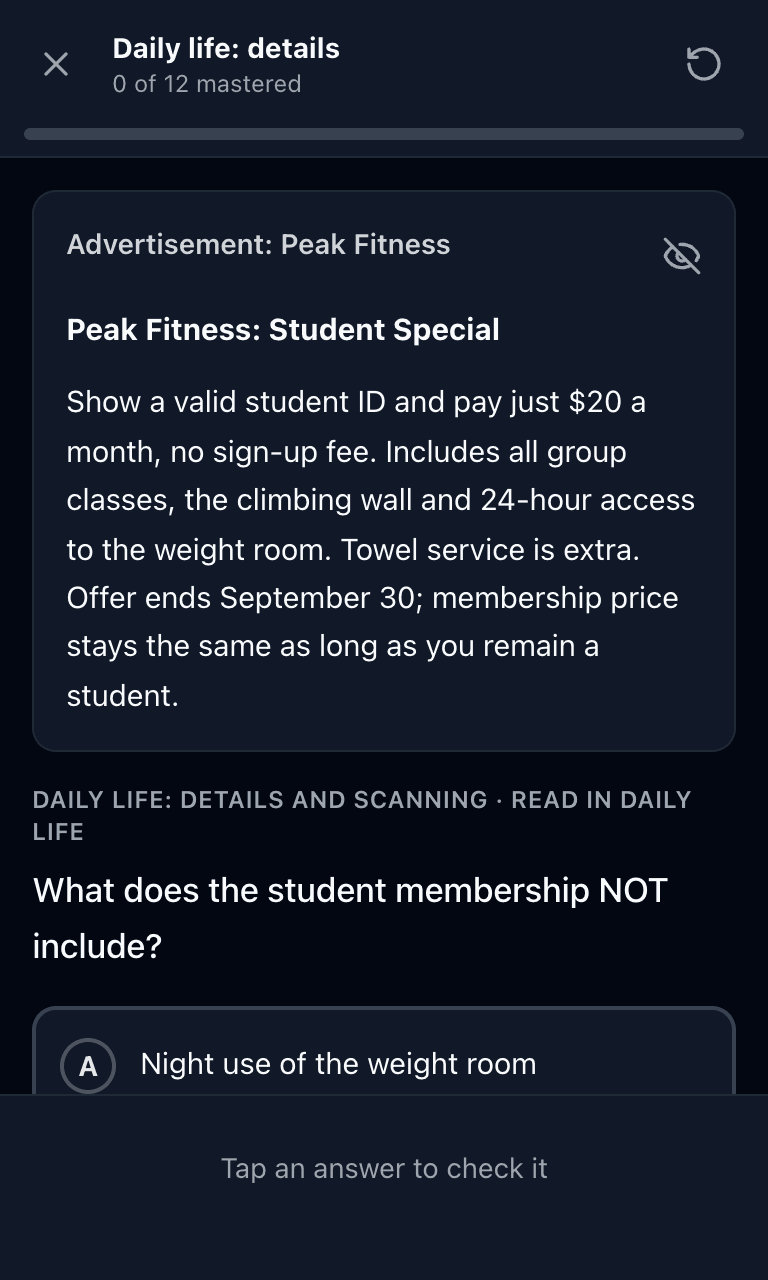
Train on mobile
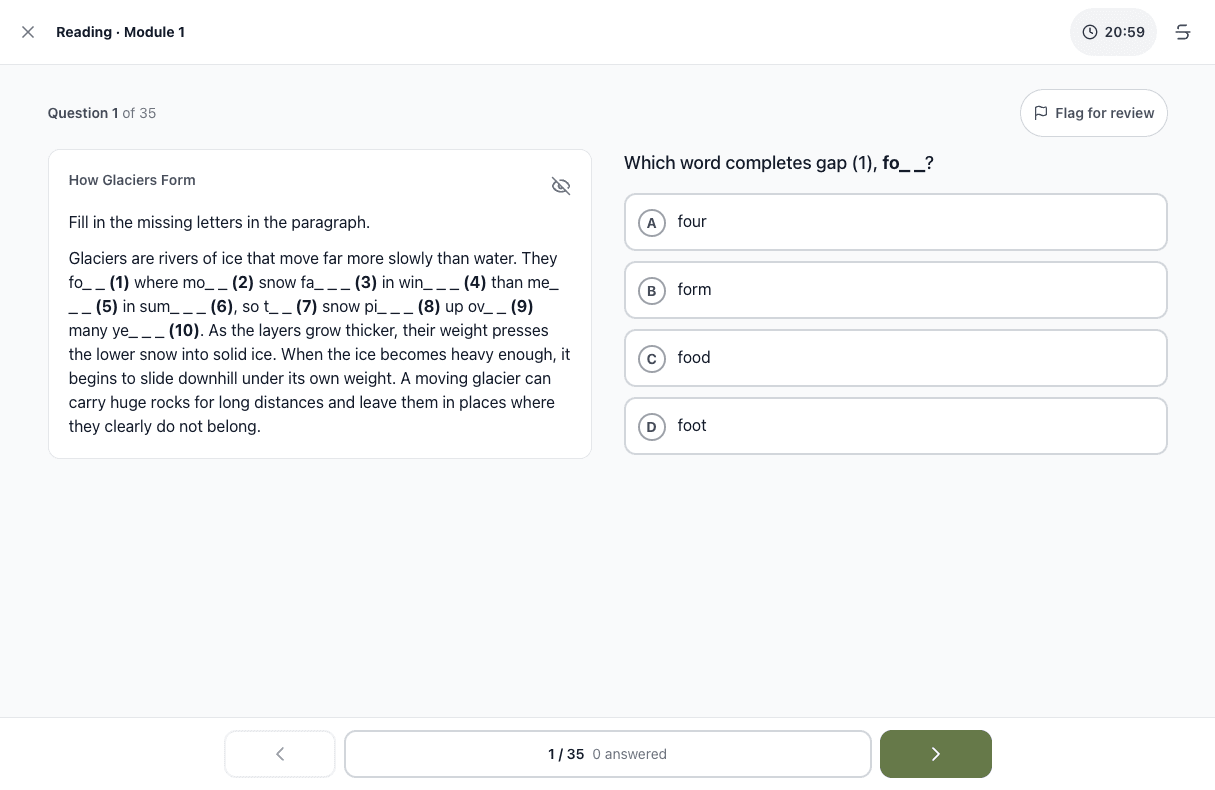
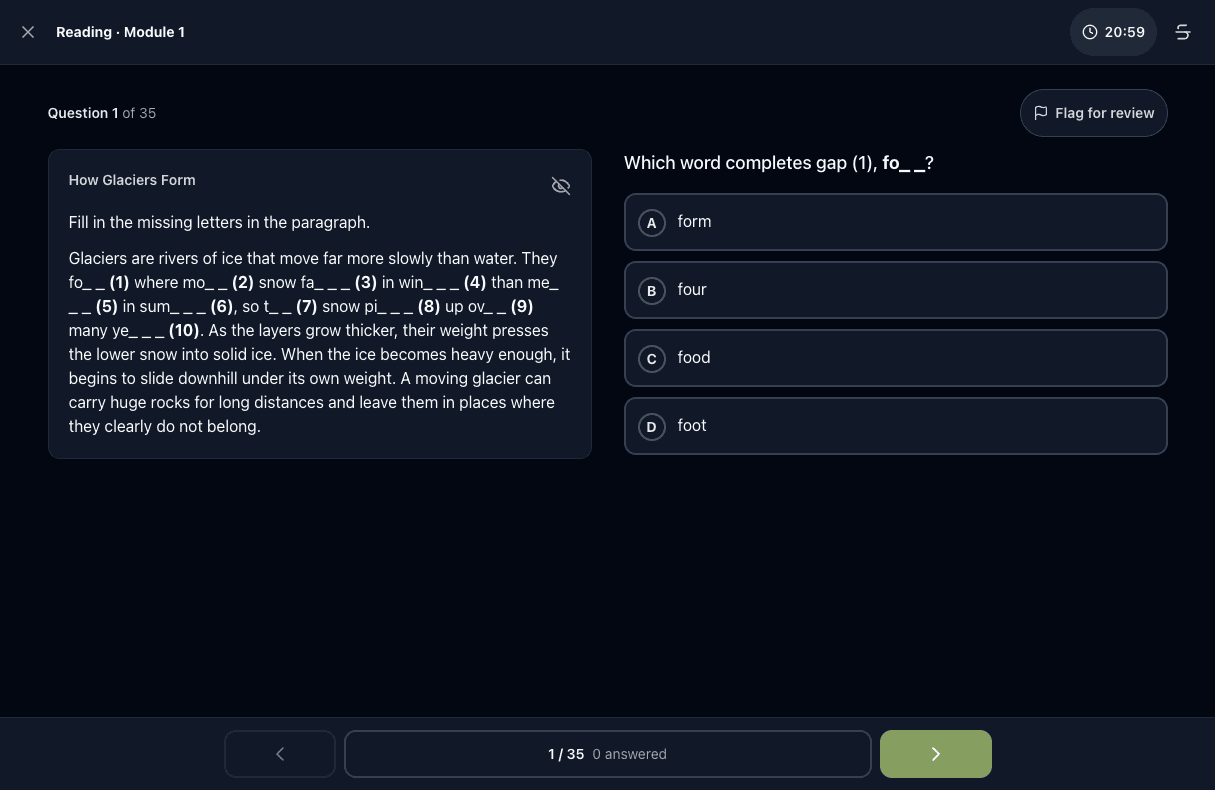
Test on desktop
The TOEFL Reading exam at a glance
Since January 21, 2026, the TOEFL iBT Reading section comes first and has 50 items in about 30 minutes, some of them unscored. It is two-stage adaptive: a first stage, then an easier or harder second stage of about 9 minutes, with no going back. There are three task types: Complete the Words (about 30 items: short academic paragraphs where you type the missing second half of every second word), Read in Daily Life (notices, emails, messages and menus of 15 to 150 words with two or three questions each) and Read an Academic Passage (about 200 words with five questions). Reading is scored on a 1 to 6 scale in half bands, like the other three sections.
Tigertest has two full Reading sections in the 2026 format with an adaptive second stage, and seven drills by task type, free to start. Only Reading is covered; Listening, Writing and Speaking are not.
- Items
- 50 (including unscored items), 1 point each
- Time
- About 30 minutes
- Task types
- Complete the Words, Read in Daily Life, Read an Academic Passage
- Design
- Two-stage adaptive, no going back between stages
- Score
- 1 to 6 in half bands (a 0 to 120 total too, for two years from January 2026)
- Order
- First section, then Listening, Writing, Speaking
- Run by
- ETS
Updated by the Tigertest team. Practice questions follow the ETS TOEFL iBT 2026 test blueprint and specifications and the updated test overview (as of November 2026). Exam rules change, so confirm current details with ETS.
How It Works
Drills by Task Type
Seven drills: grammar words and content words in Complete the Words, details and implied meaning in daily-life texts, and facts, vocabulary and inference in academic passages. Questions you miss come back until you have mastered them.
Full Practice Tests
Two full Reading sections: 35 questions in 21 minutes, then an easier or harder second stage of 15 questions in 9 minutes, with no going back, as on the real test. Practice Test 2 is held out of the drills, so it measures readiness, not memory.
Built Like the 2026 TOEFL Reading Section
Each practice test has three Complete the Words paragraphs, four short daily-life texts and two academic passages of about 200 words, 50 questions in all, all original. Your result is a percent correct, not a TOEFL band, since ETS publishes no conversion. Only Reading is covered: the other three sections are not part of this practice.

Help Make Tigertest Better
Have an idea, a topic you'd like covered, or a question that could be clearer? We read every message and use it to improve every test.
Share FeedbackHow to Raise Your TOEFL Reading Score
1. Use the grammar around each gap
In Complete the Words the number of missing letters is shown, and the words on either side tell you what kind of word it is: an article before a noun, a verb after a subject, a plural after "many". Decide the kind of word first, then the meaning. Read the first sentence carefully; it tells you the topic.
2. Practise spelling, not just recognising
On the real test you type the missing letters, so a word you recognise but cannot spell still costs a point. Common academic words (process, structure, release, produce) and small grammar words are the ones that come up most. When you finish a drill, write out the words you missed.
3. Scan daily-life texts for the question first
Notices, schedules, menus and emails are short, and most questions ask for one time, place, price or reason. Read the question, then look for it in the text. Questions about purpose ask why the text was written: look at the opening lines and what the reader is asked to do.
4. Do the first stage well
Your first-stage accuracy decides whether the second stage is harder, and the harder stage is the way to the top scores. Do not rush the first 35 questions: there is time to read each text once properly. Tigertest shows your accuracy by task type, so drill your weakest one before each full test.
TOEFL Reading Frequently Asked Questions
What is the new TOEFL iBT Reading section like?
Since January 21, 2026, Reading is the first section of the TOEFL iBT. It has 50 items in about 30 minutes, including some unscored ones, and three task types: Complete the Words, Read in Daily Life and Read an Academic Passage. The long passages of the old test are gone; texts now run from about 15 words up to about 200. Every text stays on screen while you answer, and everything you need is in the text.
How does Complete the Words work?
You see a short academic paragraph of about 70 to 100 words. The first sentence is complete. After that, the second half of every second word is missing, ten words in all, and you type the missing letters. It tests vocabulary, grammar and spelling as well as reading. Here each gap shows one underscore per missing letter and you choose the word that fits from four of the same length, so practise spelling the words as well.
What does adaptive mean for TOEFL Reading?
Reading is a two-stage adaptive section. Everyone takes the same kind of first stage; how well you do decides whether your second stage, about 9 minutes long, is easier or harder. You cannot go back to the first stage. Your score counts the questions you get right in both stages and how hard they are. Tigertest's practice tests work the same way, with an easier or harder second stage chosen from your first-stage accuracy.
How is TOEFL Reading scored?
Since January 2026 each section, Reading included, is reported on a 1 to 6 scale in half bands, and your overall score is the average of the four sections rounded to the nearest half band. For two years ETS also reports a comparable total on the old 0 to 120 scale. ETS does not publish a table from raw Reading points to a band, so Tigertest shows your percent correct, capped at 80 when your second stage was the easier one. It is a guide to your progress, not a TOEFL score.
Does Tigertest cover the whole TOEFL test?
No. Only the Reading section is modelled. Listening needs recorded audio, and Writing and Speaking responses are scored from what you write and say, so Tigertest does not practise them and cannot estimate your overall TOEFL score.
Is the Tigertest TOEFL Reading practice test free?
It is free to start, with no account required. Practice Test 1 and every drill but the last are free; the inference and purpose drill and Practice Test 2 are part of Tigertest Premium, one payment with no subscription. The texts and questions are original practice material, not taken from ETS. Create a free account if you want your progress saved across your phone and computer.
I teach a TOEFL preparation course. Can my students use Tigertest?
Yes, for free. Make a class at tigertest.io/teach, post one link, and students join with just their name. You see who practiced, their test scores and the topics your class misses most.
TOEFL Reading sample questions and answers
6 of the 194 practice questions, one from each topic, with the answer explained.
Comparative Advantage
Fill in the missing letters in the paragraph.
Economists use the idea of comparative advantage to explain why countries trade. A cou_ _ _ _ (1) need n_ _ (2) be t_ _ (3) best prod_ _ _ _ (4) of a go_ _ (5) before i_ (6) can pro_ _ _ (7) from sel_ _ _ _ (8) that pro_ _ _ _ (9) abroad. Wh_ _ (10) matters is the cost of what it gives up, measured in the other goods it could have made instead. If each country concentrates on the products it sacrifices least to make, total output rises, and both partners can consume more than they could alone, even when one of them is more efficient at everything.
1.Which word completes gap (10), Wh_ _?
- A.
Whip
- B.
Whey
- C.
What
- D.
Whim
Answer: C."What" fits. "What matters is the cost" needs a pronoun that can be a subject.
- A.
Why Sleep Matters
Fill in the missing letters in the paragraph.
Most people need between seven and nine hours of sleep each night. During de_ _ (1) sleep, yo_ _ (2) body rep_ _ _ _ (3) tired mus_ _ _ _ (4) while t_ _ (5) brain sto_ _ _ (6) lessons fr_ _ (7) the d_ _ (8). Students w_ _ (9) sleep t_ _ (10) little often find it hard to focus in class. They may also feel hungry more often, because tiredness changes the hormones that control appetite. Going to bed at the same time every night is one simple way to sleep better and wake up feeling rested.
2.Which word completes gap (8), d_ _?
- A.
dug
- B.
dig
- C.
dry
- D.
day
Answer: D."day" fits. "The day" is the time just lived through; only a noun of time fits.
- A.
Text messages
Priya: Still on for studying tonight? Library, 7?
Marco: Can we push it to 7:30? My lab is running over.
Priya: Sure. I'll grab a table on the second floor. The first floor is way too loud during exams.
Marco: Perfect. I'll bring the notes from Tuesday since you missed it.
Priya: Lifesaver!
3.Why does Marco want to change the time?
- A.
The library opens at 7:30
- B.
Priya missed the last class
- C.
His lab will end late
- D.
He has to find his notes
Answer: C.Marco says "My lab is running over", meaning it will last longer than planned.
- A.
Poster: Fix-It Saturday
FIX-IT SATURDAY
Is your bike making strange noises? Is a chair wobbling? Bring it to the Riverside Community Center, Room 4, on the first Saturday of every month, 10 a.m. to 2 p.m.
- Volunteer repairers will show you how to fix it yourself.
- Small parts (screws, bike tubes, glue) cost $1 each.
- No large furniture or electrical appliances, please.
No appointment needed, but arrive before 1 p.m. to be sure of a turn.
4.What does the poster suggest about the volunteers?
- A.
They need an appointment first
- B.
They charge for every repair
- C.
They work only on bicycles
- D.
They show you how to fix it
Answer: D.Volunteers "will show you how to fix it yourself", so visitors learn to do the repair. Only small parts cost money.
Paint in a Tube
For centuries, European painters prepared their own colors in the studio. They ground pigments into powder and mixed them with oil shortly before use, because the paint dried quickly once exposed to air. Prepared paint could be stored for a short time in pieces of animal bladder tied with string, but these leaked, burst and were awkward to carry. Painting a landscape therefore usually meant sketching outdoors and finishing the picture indoors.
In 1841 the American portrait painter John Goffe Rand patented a small, squeezable metal tube with a screw cap. The tube kept paint fresh for long periods and could be closed after each use. Color manufacturers soon adopted it, and by the middle of the century a painter could buy a full range of ready-made colors and pack them in a box.
The tube did not create a new style by itself, but it removed a practical obstacle. The French Impressionists of the 1870s, who wanted to record how light and weather changed from hour to hour, could now complete entire canvases in the open air. Some of them later acknowledged that their way of working would have been difficult, if not impossible, without paint that traveled well.
5.Which statement about the Impressionists is supported by the passage?
- A.
They wanted to record changing light
- B.
They preferred to paint portraits indoors
- C.
They ground their own pigments
- D.
They worked mainly before 1841
Answer: A.They "wanted to record how light and weather changed from hour to hour"; the other options contradict the passage.
- A.
Why Leaves Change Color
In many parts of the world, the leaves of trees turn yellow, orange or red in autumn. The colors do not appear suddenly. Most of them are in the leaf all summer, but they are hidden.
During the growing season, leaves are full of chlorophyll, the green substance that plants use to turn sunlight into food. There is so much chlorophyll that its green covers the other colors. As the days grow shorter and cooler in autumn, the tree stops making new chlorophyll. The green slowly breaks down, and the yellow and orange colors that were there all along begin to show.
Red is different. Some trees, such as certain maples, make new red substances in their leaves in autumn. Bright, sunny days and cool nights help them make more, so the reds are usually strongest in autumns with that kind of weather.
After the colors appear, the tree forms a thin layer of cells where each leaf joins its branch. This layer cuts the leaf off from the tree, and the leaf falls. The tree can then rest through the winter without losing water through its leaves.
6.The word "suddenly" in the passage is closest in meaning to
- A.
Brightly
- B.
Slowly
- C.
All at once
- D.
In the evening
Answer: C."The colors do not appear suddenly" means they do not show up all at once.
- A.
Related practice tests
Every test on Tigertest is free to start, with no account needed.
Ready for TOEFL Reading?
Start for free. No account required. 194 questions on 35 texts.
Start practicing