
Free NAPLAN Year 7 Practice Test
Reading, spelling, grammar and punctuation, and numeracy, in tailored testlets like the real online NAPLAN, plus six drills that teach the basics first. Everything is free, no account needed.
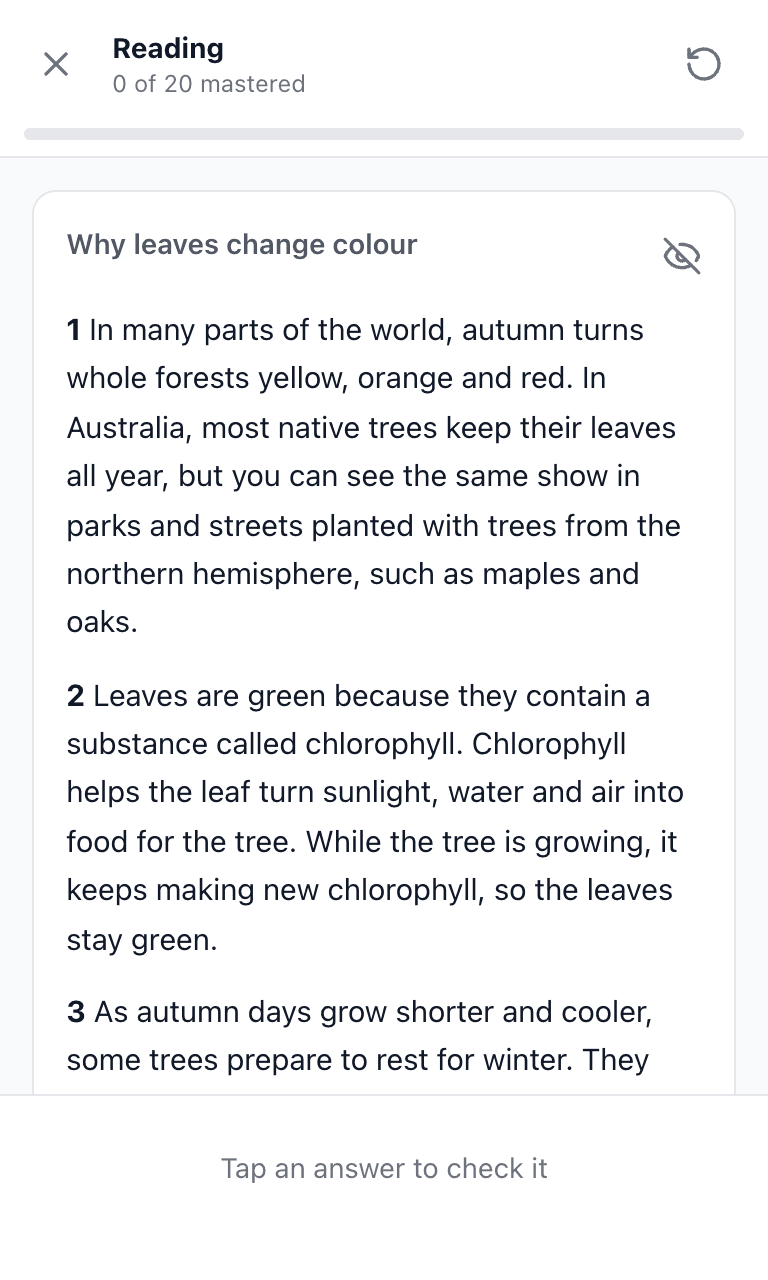
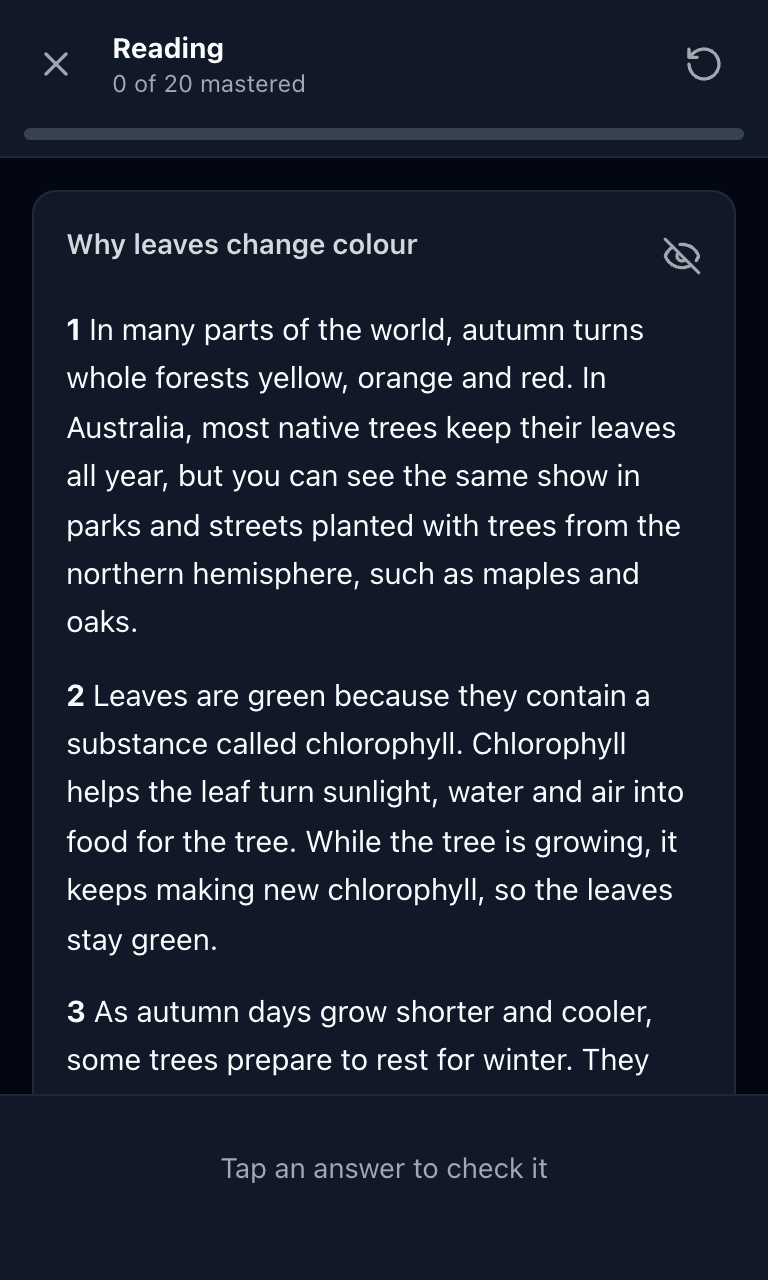
Train on mobile
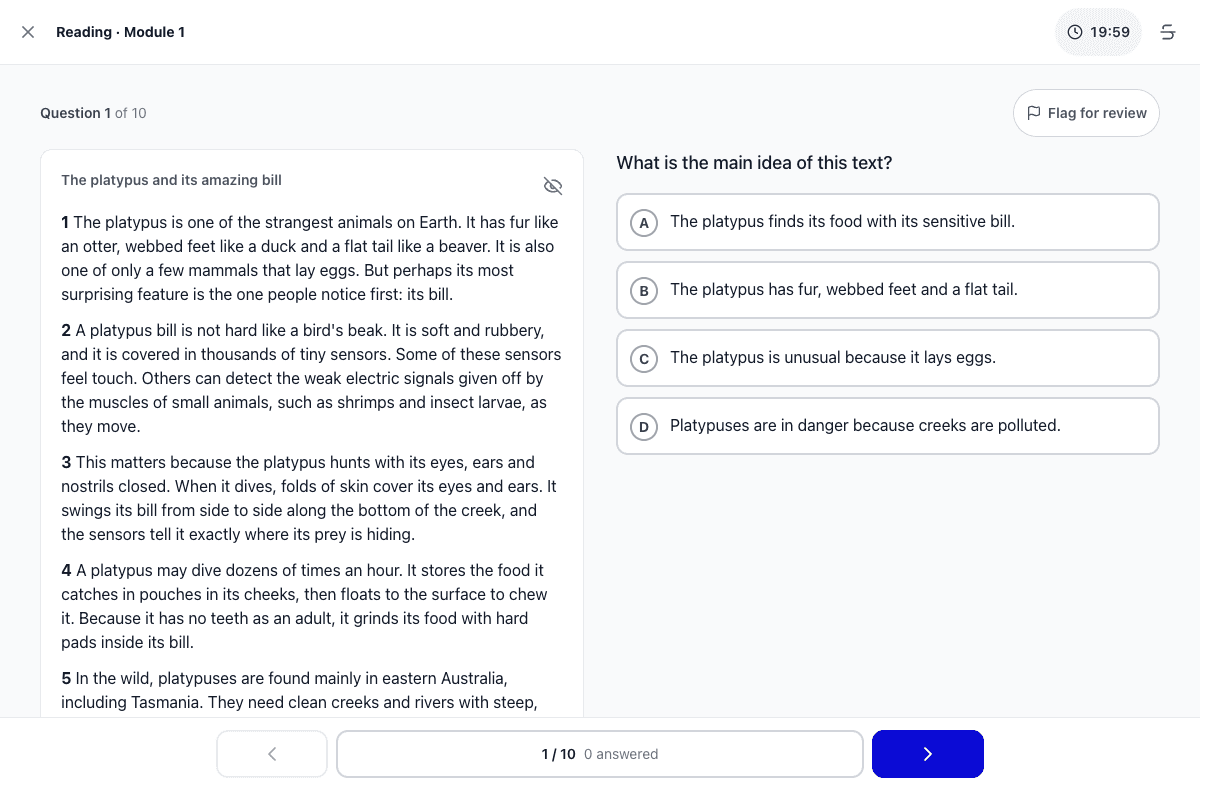
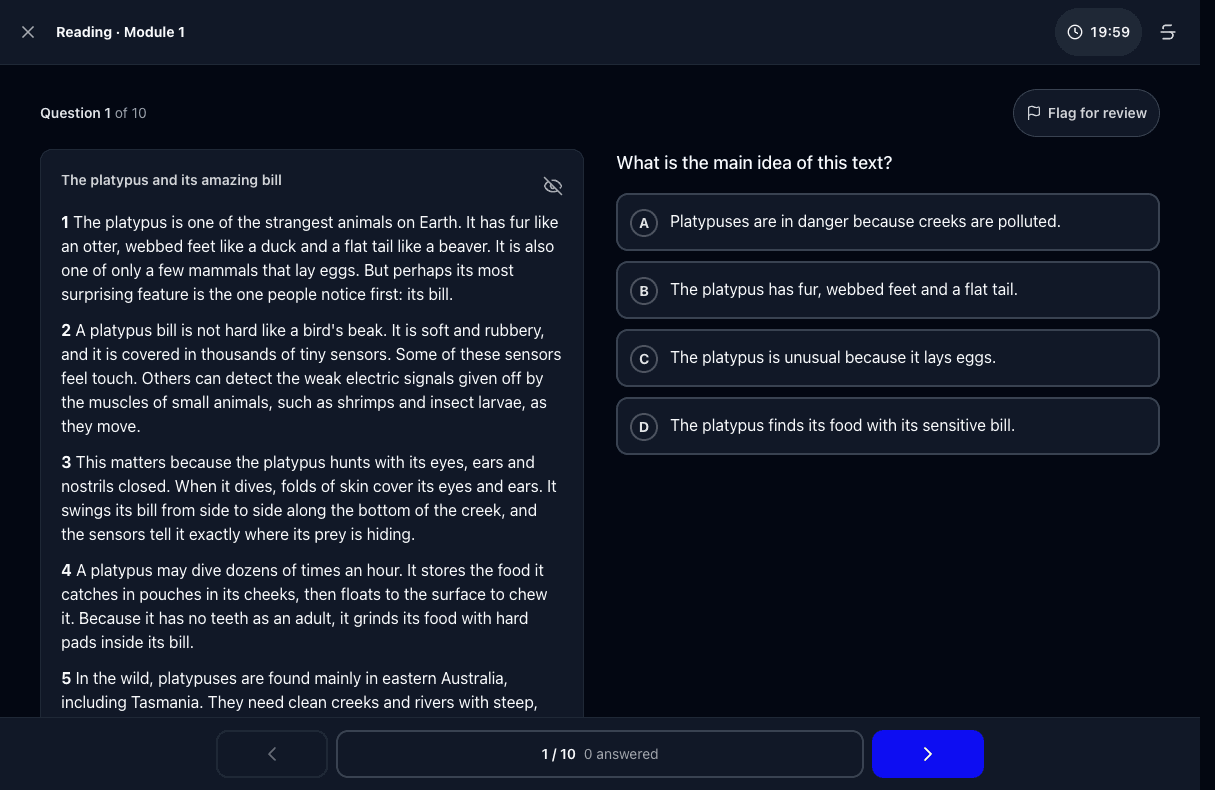
Test on desktop
The NAPLAN Year 7 exam at a glance
NAPLAN (the National Assessment Program, Literacy and Numeracy) is sat online by Australian students in Years 3, 5, 7 and 9 each March. Year 7 sits four tests in a set order: Writing (42 minutes), Reading (65 minutes), Conventions of Language (45 minutes, spelling then grammar and punctuation) and Numeracy (65 minutes, a short non-calculator section, then an online calculator). The tests are tailored: how a student does on the first set of questions decides whether the next set is harder or easier. Since 2023 each domain is reported as one of four proficiency levels: Exceeding, Strong, Developing or Needs additional support. There is no pass mark.
Tigertest has two NAPLAN Year 7 practice tests covering Reading, Conventions of Language and Numeracy in tailored parts, an estimated scale score per domain against the Year 7 proficiency levels, and six drills that teach the basics first. All of it is free with no account required; Writing and the spelling dictation are not modelled.
- Who takes it
- Students in Years 3, 5, 7 and 9 across Australia, in March
- Year 7 tests
- Writing 42 min, Reading 65 min, Conventions of Language 45 min, Numeracy 65 min
- Calculator
- Numeracy only, after a short non-calculator section that is locked once left
- Format
- Online, tailored: later testlets are harder or easier depending on earlier answers
- Results
- Exceeding, Strong, Developing or Needs additional support per domain; no pass mark
- Year 7 Strong from
- Reading 500, Spelling 497, Grammar and punctuation 513, Numeracy 500
- Given by
- The student's school, on ACARA's national assessment platform
Updated by the Tigertest team. Practice questions follow ACARA's published NAPLAN test design, tailored test structure and 2023 proficiency standards, and the Year 7 Australian Curriculum (Version 9.0). Exam rules change, so confirm current details with ACARA: NAPLAN results and reports.
How It Works
Drills on a Phone
Six drills: reading, spelling, grammar and punctuation, non-calculator, number and algebra, and measurement with statistics. The reading, grammar and number drills open with the basics, a rule card and two quick questions on things like apostrophes, fractions or finding the main idea. One tap to check, an explanation straight away, and every miss comes back until it is mastered.
Full Test on a Computer
Reading, Conventions of Language and Numeracy in timed parts, with the non-calculator section locked once you move on, the calculator for the rest, and tap-to-answer question types: choose two, put in order, tap the misspelled word and pick from a dropdown. Finish with an estimated scale score per domain and the drill to do next.
What Each Practice Test Covers
Each practice test follows the NAPLAN domains and the Year 7 content of the Australian Curriculum (Version 9.0), with original questions in Australian spelling and metric units. The real test's Writing task and spelling dictation are not modelled.

For Teachers
Set it for your Year 7 class for free: post one link, students join with just their name, and you see who practised, their estimated scores per domain and the questions your class misses most. Useful in the weeks before March, or for homework all year.
Make a class at tigertest.io/teachHow to Get Ready for Year 7 NAPLAN
1. Get used to the format
Most nerves come from the unfamiliar: a clock in the corner, a section you cannot go back to, a question that asks you to tap a word. One practice test takes that away. Sit Practice Test 1 with the timer on, then look at which domain is lowest.
2. Fix the basics first
Year 7 questions build on things taught in primary school: fractions, decimals and percentages, negative numbers, apostrophes, subject and verb agreement. If one of those is shaky, the basics inside each drill teach it in a minute with an example and two quick questions.
3. In reading, prove it from the text
The right answer is always supported by something in the text. Before choosing, find the words that back it up. The wrong choices usually sound reasonable but go further than the text does, or mix up who said what.
4. Do not rush the first part
In the tailored test, the first set of questions decides which path you take next, and the harder path can lead to higher scores. Careful, accurate work early matters more than speed.
NAPLAN Year 7 Frequently Asked Questions
What is on the Year 7 NAPLAN test?
Four tests, sat online in March in a set order: Writing (42 minutes, one narrative or persuasive piece), Reading (65 minutes), Conventions of Language (45 minutes, spelling first, then grammar and punctuation) and Numeracy (65 minutes, a short non-calculator section, then an online calculator). For most students it is the first NAPLAN in secondary school. The Tigertest practice test covers Reading, Conventions of Language and Numeracy in shorter timed parts; Writing is not included.
How does the tailored test work?
The online NAPLAN uses tailored test design. Everyone starts with the same set of questions, and how you go on that set decides whether the next set is harder, about the same or easier. Students on the harder path can reach higher scores. Tigertest models this with two parts per domain: the second part is harder or easier depending on how you did on the first.
What are the NAPLAN proficiency levels for Year 7?
Since 2023, results are reported as one of four levels for each domain: Exceeding, Strong, Developing and Needs additional support. Each level is a band on the NAPLAN scale. For Year 7 Reading, for example, Developing starts at 430, Strong at 500 and Exceeding at 603. Tigertest gives an estimated scale score per domain on the same kind of scale, so a student can see roughly where they sit. It is an estimate, not an official result.
Can you use a calculator in Year 7 NAPLAN numeracy?
For most of it. In Years 7 and 9, the numeracy test starts with a short non-calculator section that checks arithmetic. Once a student moves on to the main section, an online calculator is available, and they cannot go back to the non-calculator questions. Tigertest has the same two parts: a non-calculator section first, then a section with a calculator one tap away.
How should a Year 7 student prepare for NAPLAN?
NAPLAN tests skills built up over years of school, so cramming does little. A short, steady routine helps more: ten minutes on a drill a few times a week, starting with the basics for anything shaky (fractions, percentages, negative numbers, apostrophes, finding the main idea), and one full practice test to get used to the format and the clock. Practice Test 2 is held out of the drills, so it shows real progress.
Is the Tigertest NAPLAN Year 7 practice test free?
Yes, all of it: both practice tests, all six drills, the basics lessons and every explanation, with no account required. An account saves progress across devices. The questions are original and written to the Australian Curriculum; Tigertest is not affiliated with ACARA.
I teach a Year 7 class. Can my students use Tigertest?
Yes, for free. Make a class at tigertest.io/teach, post one link, and students join with just their name. You see who practiced, their test scores and the topics your class misses most.
Related practice tests
Every test on Tigertest is free and needs no account to start.
- NAPLAN Year 9 Practice TestACARA · Year 9 Reading, Conventions, Numeracy
- OC Test PracticeNSW Department of Education · Year 4 for Year 5 OC entry
- NSW Selective Test PracticeNSW Department of Education · Year 6 for Year 7 entry
- Victorian Selective Entry PracticeVictorian Department of Education · Year 8 for Year 9 entry
- HSC Maths Standard 2 Practice TestNESA (NSW) · Year 12 HSC
Ready for Year 7 NAPLAN?
Free. No account required. Two practice tests, six drills and the basics, for Reading, Conventions of Language and Numeracy.
Start practicing