
Free NSW Selective Test Practice
Reading, Mathematical Reasoning and Thinking Skills in two full timed practice tests, plus five drills that teach the basics first. Everything is free, no account needed.
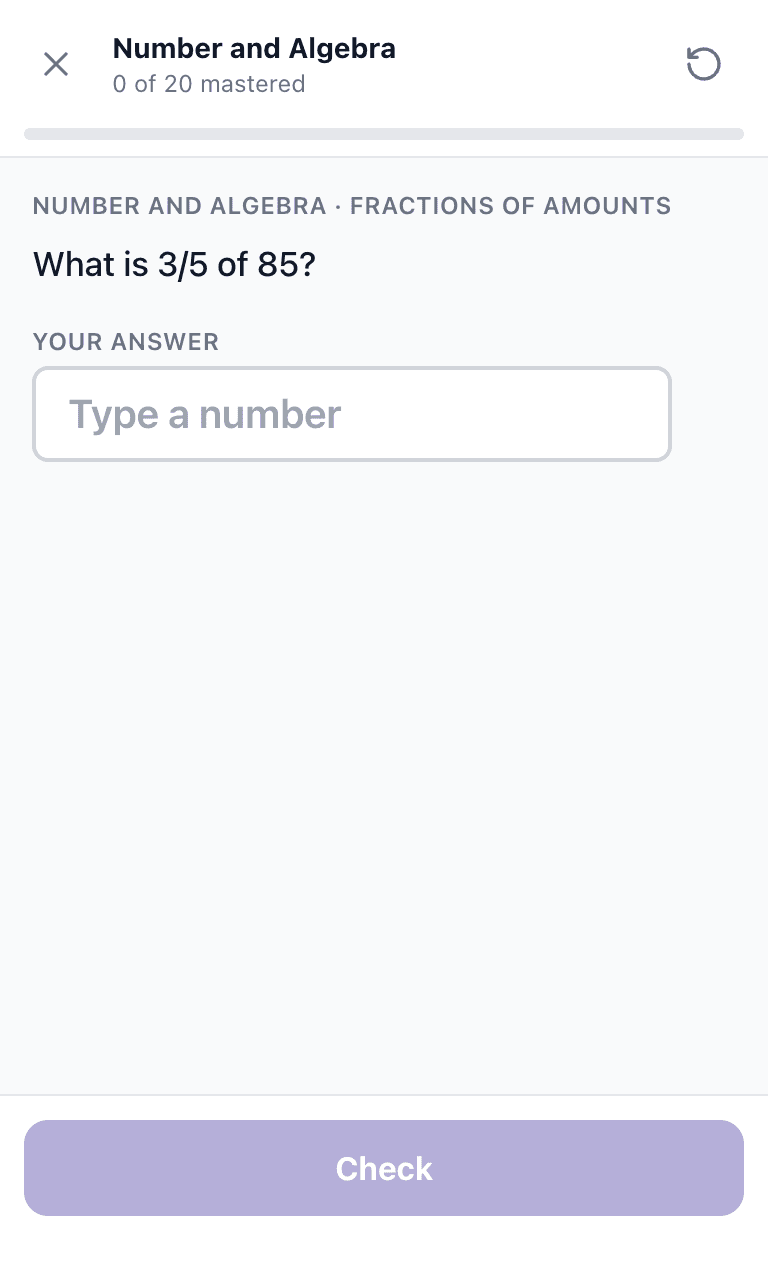
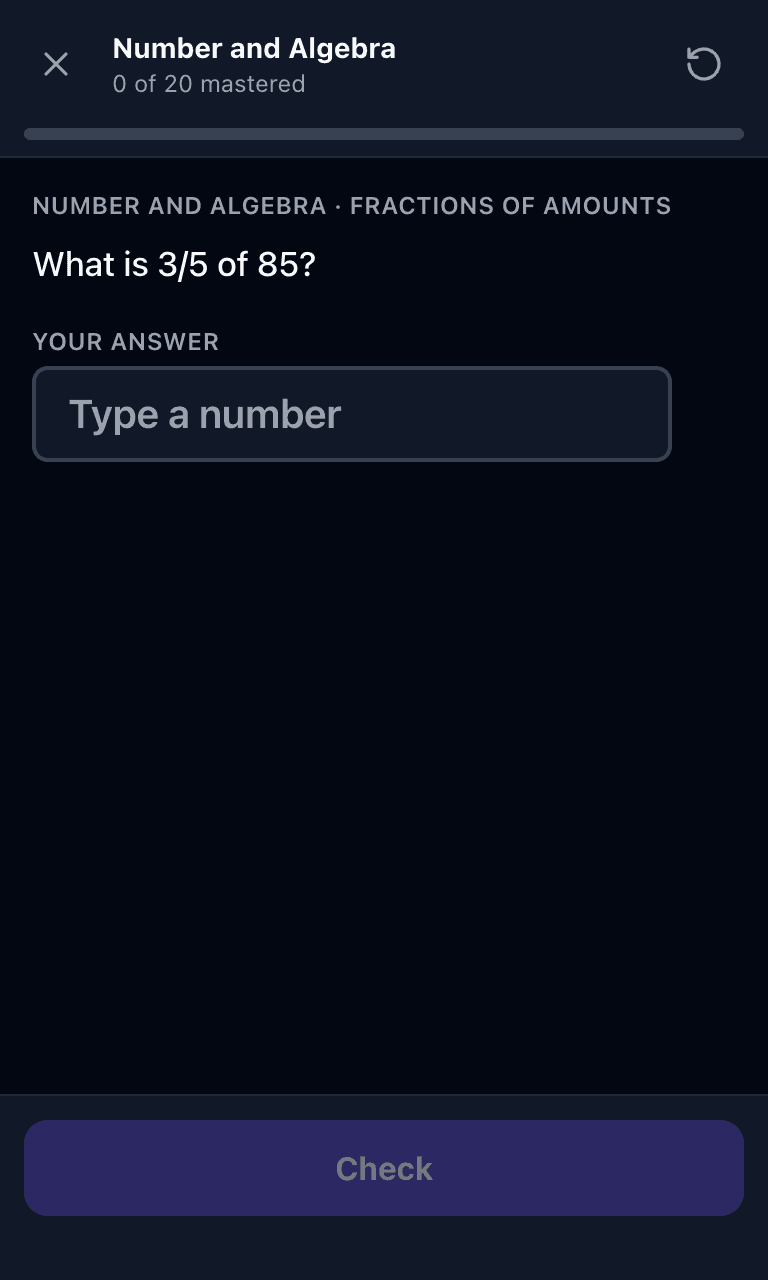
Train on mobile
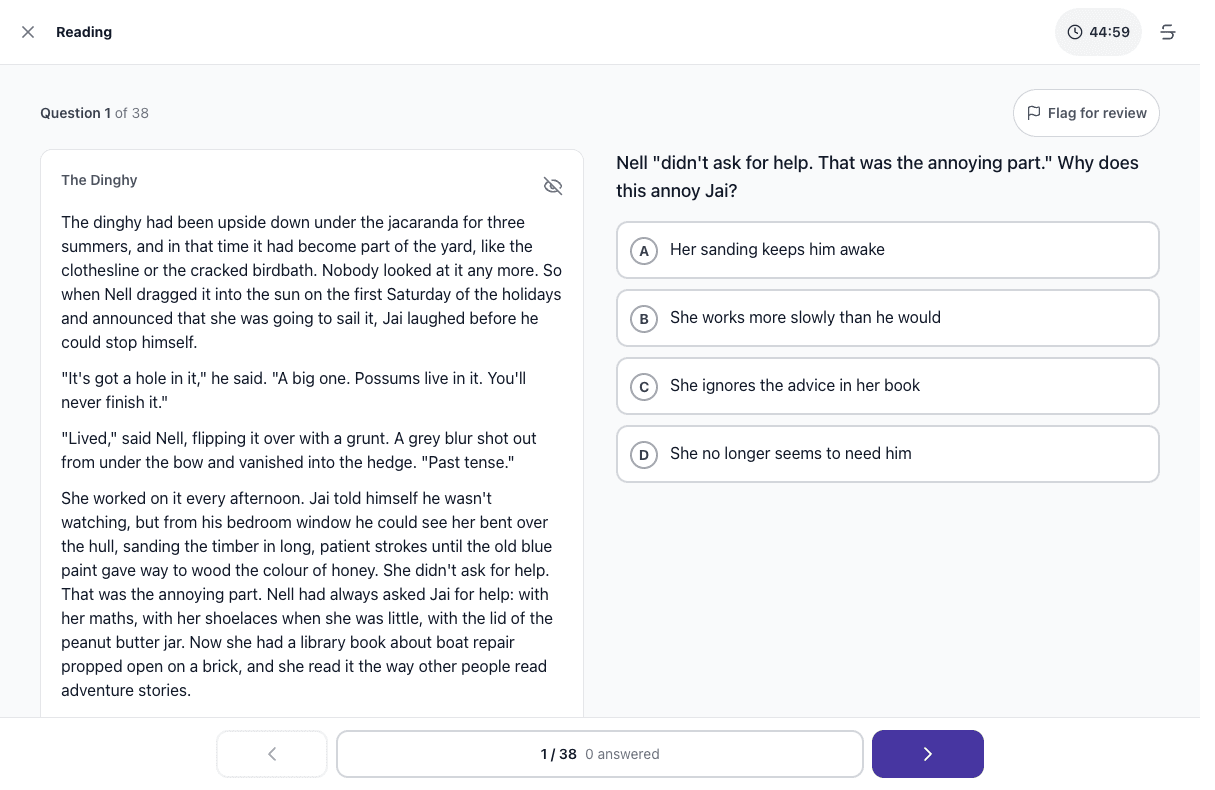
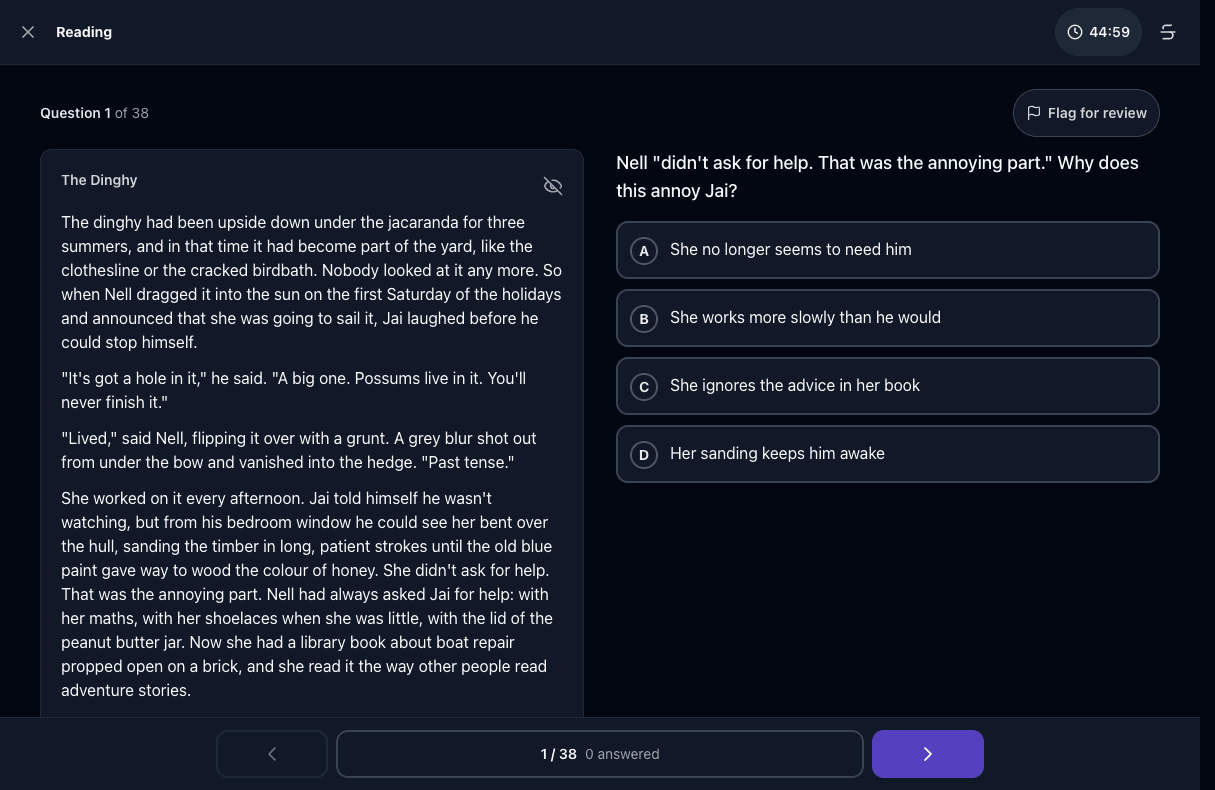
Test on desktop
The NSW Selective exam at a glance
The Selective High School Placement Test is the NSW Department of Education's entry test for Year 7 places in selective high schools, sat on a computer in Year 6. It has four tests, each weighted 25 percent: Reading (17 questions with 38 answers in 45 minutes), Mathematical Reasoning (35 questions in 40 minutes, five options each, no calculator), Thinking Skills (40 questions in 40 minutes, four options each) and Writing (one task in 30 minutes). There is no pass mark: results are scaled and combined into a placement score, places are offered in order of merit, and each school's minimum entry score changes every year.
Tigertest has two full practice tests covering Reading, Mathematical Reasoning and Thinking Skills at the real lengths and times, a percent score per section, and five drills that teach the basics first. All of it is free with no account required; Writing is not modelled.
- Who takes it
- Year 6 students in NSW applying for Year 7 at a selective high school
- Reading
- 17 questions, 38 answers, 45 minutes, multiple choice
- Mathematical Reasoning
- 35 questions, 40 minutes, five options, no calculator
- Thinking Skills
- 40 questions, 40 minutes, four options
- Writing
- 1 open response, 30 minutes
- Weighting
- Each test 25 percent
- Passing score
- No pass mark; places offered in order of merit
- Given by
- NSW Department of Education, on computers at test centres
Updated by the Tigertest team. Practice questions follow the NSW Department of Education's published test format for the Selective High School Placement Test. Exam rules change, so confirm current details with NSW Department of Education: get ready for the Selective High School Placement Test.
How It Works
Drills on a Phone or Tablet
Five drills: reading, number and algebra, measurement and data, critical thinking and problem solving. Most open with the basics, a short lesson and two quick questions on ideas like ratio, area or finding the evidence, before the test-level questions. One tap to check, an explanation straight away, and every miss comes back until it is mastered.
Full Test on a Computer
The real test is sat on a computer, so the practice test is too: three timed sections with short breaks, a countdown clock, flag for review, passages beside the questions, and no calculator. Finish with a percent score per section and a list of what to drill next.
Built on the Real Test Format
Each practice test follows the NSW Department of Education's published format: the same number of answers and the same time in each section, five options in maths and four in thinking skills. The drills are split the same way, so results show which part is holding a student back. Writing is not included.

Run a Selective Test Class?
Year 6 teachers and tutors can set it for a class for free: post one link, students join with just their name, and you see who practised, their section scores and the questions your class misses most.
Make a class at tigertest.io/teachHow to Prepare for the Selective Test
1. Work on pace, not just accuracy
Thinking Skills gives about a minute a question and Maths a little more. Strong students lose marks by spending five minutes on one puzzle. Practise moving on, flagging the hard one and coming back with the time left at the end.
2. Learn the argument questions
Critical thinking questions look new at first but follow a few patterns: what strengthens or weakens a claim, what was assumed, what must be true. Once a student can name the pattern, these become some of the most reliable marks on the paper.
3. Read for the clue in multi-part sets
In a sentences-removed text, the right sentence links to the words on either side of the gap: a pronoun, a connective, a question answered in the next line. In the extract sets, find the words in the extract that prove the match. Guessing from the general topic is how marks slip away.
4. Sit a full practice test before test day
Sit Practice Test 1 with the timer on to see where you stand, drill the weakest section, then sit Practice Test 2. Its questions never appear in the drills, so it is an honest readiness check.
NSW Selective Test Frequently Asked Questions
What is on the NSW Selective High School Placement Test?
Four tests taken on a computer in one sitting, each worth 25 percent: Reading (17 questions with 38 answers in 45 minutes, because three questions have several parts), Mathematical Reasoning (35 questions in 40 minutes, five options each, no calculator), Thinking Skills (40 questions in 40 minutes, four options each) and Writing (one task in 30 minutes). The Tigertest practice test covers Reading, Mathematical Reasoning and Thinking Skills at full length and runs about 2 hours 15 minutes with short breaks.
What score do you need to get into a selective school?
There is no pass mark. Results from the tests are scaled and combined into a placement score, places are offered in order of merit, and each school's minimum entry score changes from year to year with demand. Tigertest reports percent correct per section and an overall average, so treat it as a readiness check: aim for 75 percent or better across all three sections, and higher for the most competitive schools.
What kinds of questions are in the Reading test?
Texts include story extracts, poems, articles and reports. Some questions are single multiple-choice questions about one text. Others have several parts: choosing which removed sentence fits each gap in a text, matching statements to one of four short extracts, and comparing two texts on the same theme. The Tigertest Reading section has all of these, one answer per item.
What is Thinking Skills?
Thinking Skills tests reasoning rather than anything learned in class. Critical thinking questions ask which statement strengthens or weakens an argument, what mistake or assumption someone has made, what must be true, and whose reasoning is correct. Problem-solving questions are puzzles: ordering clues, codes, time and calendar problems, counting and number puzzles. Tigertest's version is all text; the real test also includes some shape and pattern puzzles.
Is the Writing test included?
No. Writing is one open response marked by trained markers, which a practice test cannot score fairly. Practise it separately with timed 30-minute pieces on a range of prompts, and ask a teacher or tutor to mark them against purpose and audience, structure, and grammar, punctuation and vocabulary.
How should my child prepare for the selective test?
Start with the drills on a phone: each opens with short lessons on the basics (fractions, ratio, area, main idea, finding the evidence) before the test-level questions, and every miss comes back until it is right. Sit Practice Test 1 with the timer on, drill the weakest section for a few weeks, then sit Practice Test 2, which is held out of the drills so it gives an honest score. Little and often beats long cramming sessions.
Is the Tigertest selective test practice free?
Yes, all of it: both full practice tests, all five drills, the basics lessons and every explanation, with no account required. An account saves progress across devices.
I teach a selective test coaching class. Can my students use Tigertest?
Yes, for free. Make a class at tigertest.io/teach, post one link, and students join with just their name. You see who practiced, their test scores and the topics your class misses most.
Related practice tests
Every test on Tigertest is free and needs no account to start.
- NAPLAN Year 7 Practice TestACARA · Year 7 Reading, Conventions, Numeracy
- NAPLAN Year 9 Practice TestACARA · Year 9 Reading, Conventions, Numeracy
- OC Test PracticeNSW Department of Education · Year 4 for Year 5 OC entry
- Victorian Selective Entry PracticeVictorian Department of Education · Year 8 for Year 9 entry
- HSC Maths Standard 2 Practice TestNESA (NSW) · Year 12 HSC
Ready for Test Day?
Free. No account required. Two full practice tests, five drills and the basics, Reading, Maths and Thinking Skills.
Start practicing