
Free New York Real Estate Practice Exam 2026
75 questions checked against New York law and weighted like the state exam. Free to start, no account needed.
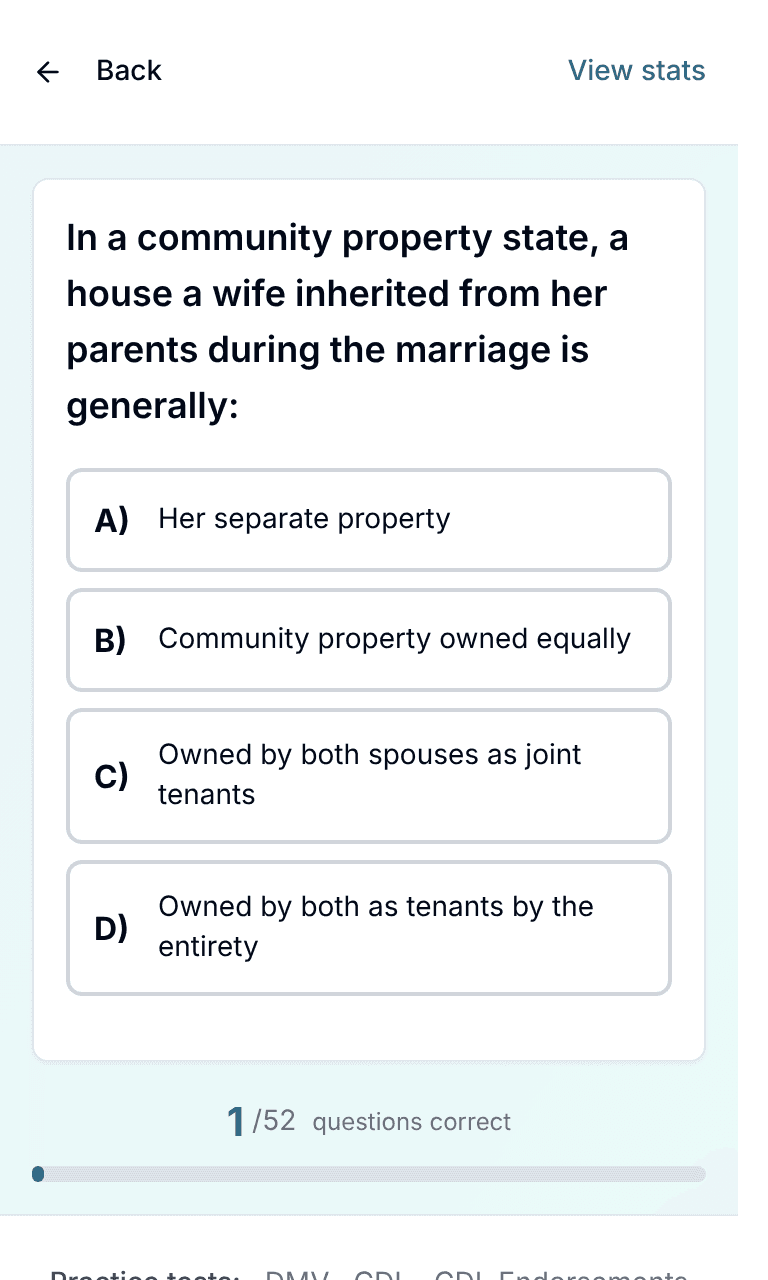
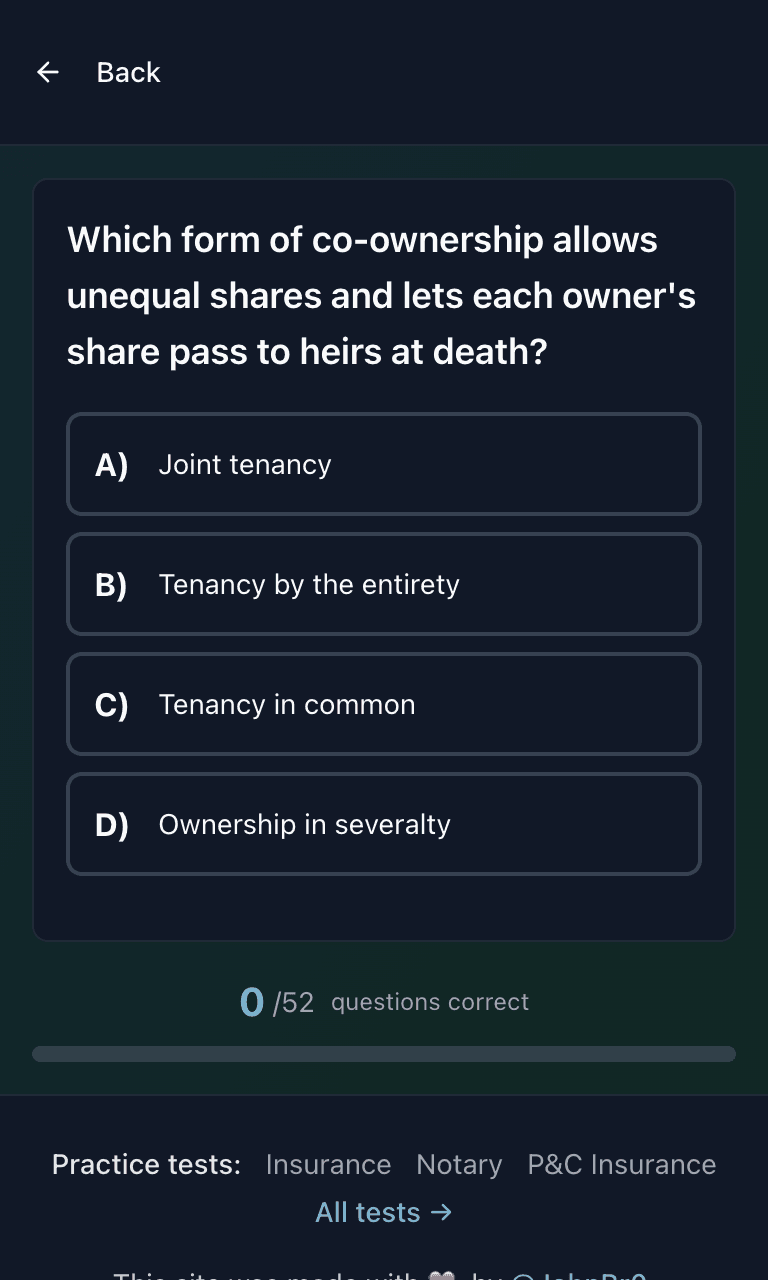
Train on mobile
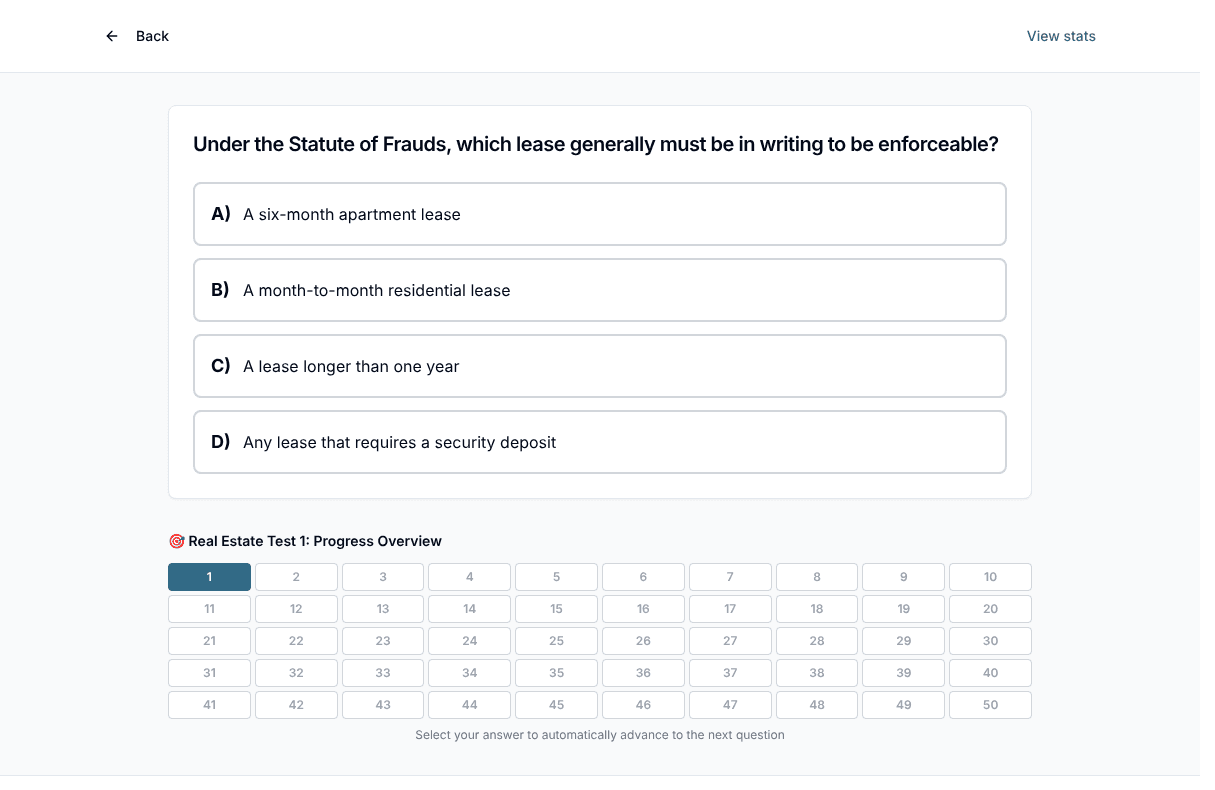
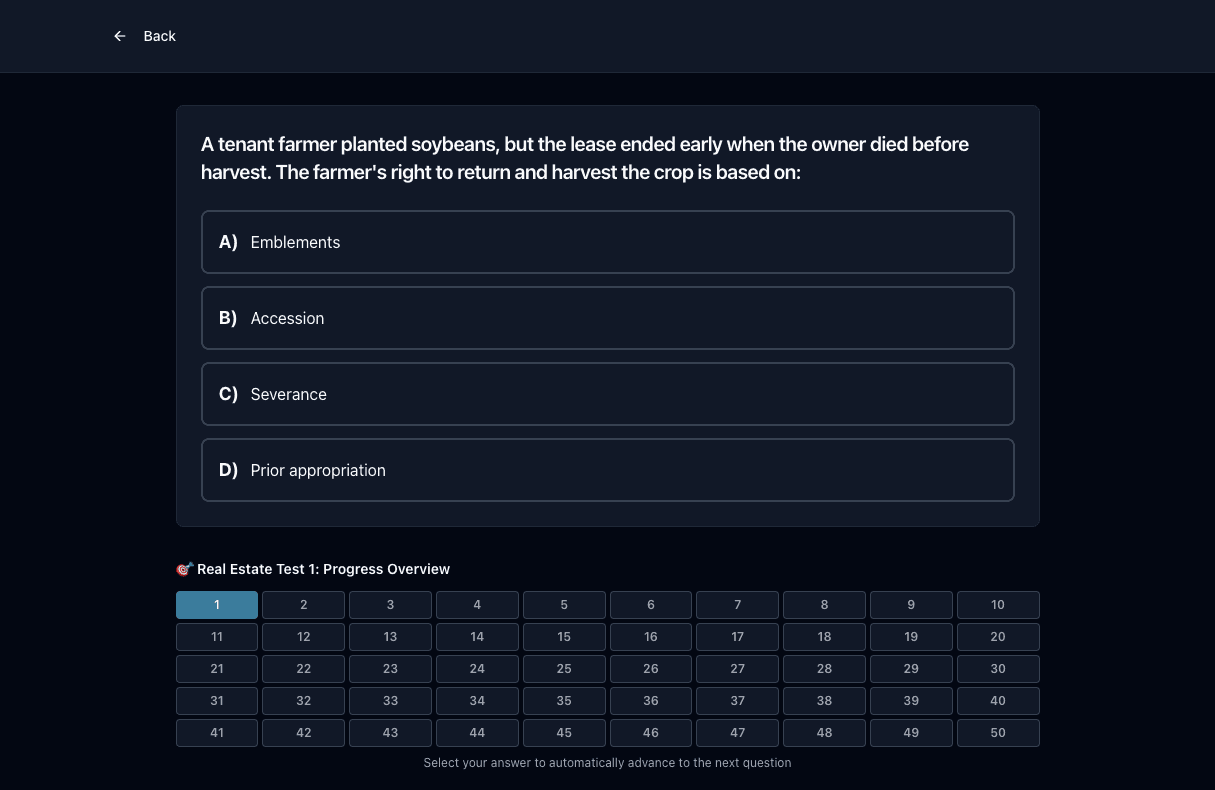
Test on desktop
The New York real estate exam at a glance
Tigertest's New York practice has 75 questions with explanations: one full-length practice exam and 4 training sets, free to start with no account required.
- Who gives the exam
- NY Department of State, Division of Licensing Services, at DOS exam sites, scheduled through eAccessNY. No outside vendor.
- Format
- Multiple choice, "based on the 77-hour pre-licensing curriculum"
- Time
- 1 1/2 hours (90 minutes), starting after the instructions
- Scoring
- Reported only as passed or failed, with no numerical score. A pass is valid for two years.
- National vs state split
- None. One exam on the DOS 77-hour syllabus, which mixes general and NY-specific topics.
- Number of questions
- 75 (not published by DOS; every course provider and prep source reports 75)
- Pass mark
- 70% (about 53 of 75). DOS does not publish it because it reports pass/fail only.
- Eligibility
- Age 18; 77-hour approved course plus the school's own proctored final; sponsoring broker; pass the state exam
- Continuing education
- 22.5 hours each 2-year term: 3 fair housing, 2.5 ethics, 2 implicit bias, 2 cultural competency, 1 recent legal matters, 1 agency (2 in a salesperson's first term)
Facts checked against official sources on 2026-10-17. Source-checked practice weighted to the NY DOS 77-hour salesperson course. Not affiliated with NY DOS; confirm rules in official DOS materials. Official source
How the New York practice works
Four sets with 75 source-checked questions for New York, including license law, agency disclosure and the Human Rights Law. Missed questions come back until you master them.
Set 1: Property, Ownership & Title
17 questions · 23% of the practice exam
Set 2: Contracts & Agency
14 questions · 19% of the practice exam
Set 3: Practice & Disclosures
26 questions · 35% of the practice exam
Set 4: Valuation, Financing & Math
18 questions · 24% of the practice exam
Full-length practice exam: 75 questions, 70% to pass
- Real Estate Practice15
- Contracts & Agency14
- Ownership, Transfer & Title11
- Disclosures & Environmental Issues11
- Financing & Settlement7
- Property Characteristics, Descriptions & Use6
- Property Value & Appraisal6
- Real Estate Math5
New York real estate exam sample questions and answers
6 of the 75 practice questions, one from each topic, with the answer explained.
1. For an exclusive listing of a New York home, 19 NYCRR 175.24 requires the broker to:
- A.Limit the listing to 90 days
- B.Attach the DOS explanation, owner-signed
- C.Record the listing with the county
- D.Register the listing with DOS
Answer: B. Section 175.24 requires every exclusive listing of residential property to carry the DOS explanation of exclusive right to sell versus exclusive agency, signed or initialed by the homeowner. No term limit is set, but section 175.15 bans automatic renewal past the fixed end date.
2. A New York salesperson meets a prospective tenant for a retail space. Under 19 NYCRR 175.28, the salesperson must provide:
- A.The property condition statement
- B.No notice, since it is commercial
- C.The section 443 agency form
- D.The Human Rights Law disclosure
Answer: D. Section 175.28 requires licensees to give the DOS notice on the New York State Human Rights Law at first substantive contact with any prospective buyer, tenant, seller or landlord, for every property type including commercial space and vacant land. Oral notice is not enough, and a hardcopy notice needs a signed acknowledgment kept three years.
3. A buyer pays $1,200,000 for a one-family home in New York. How much is the additional 1% "mansion tax," and who pays it?
- A.$12,000, paid by the buyer
- B.$12,000, paid by the seller
- C.$2,000, paid by the buyer
- D.$4,800, paid by the seller
Answer: A. Tax Law section 1402-a imposes 1% of the whole consideration on a residential conveyance of $1 million or more, so $1,200,000 x 0.01 = $12,000, paid by the grantee. Taxing only the $200,000 above $1 million gives $2,000, and $4,800 is the regular state transfer tax paid by the seller.
4. An investor bought a lot for $120,000 and sold it 5 years later for $150,000. What was the average annual appreciation rate, based on the purchase price?
- A.4%
- B.6.25%
- C.5%
- D.25%
Answer: C. The gain is $150,000 - $120,000 = $30,000; $30,000 / $120,000 = 25% total; 25% / 5 years = 5% per year. Dividing by the $150,000 sale price uses the wrong base and gives 4%, and stopping at 25% forgets to spread the gain over 5 years.
5. A possessor openly occupies a fenced parcel for 6 years, then sells to a buyer who occupies it for 5 more. New York's statutory period is 10 years. The buyer:
- A.Must restart the 10-year period
- B.Gains only an easement by prescription
- C.May claim title by tacking the two periods
- D.Has no claim, since 5 years is too short
Answer: C. Successive adverse possessors in privity may tack their periods, so 6 + 5 = 11 years exceeds New York's 10-year period (CPLR 212), assuming the other elements of adverse possession are met. Prescription yields only a right of use, while exclusive occupancy like this supports title by adverse possession.
6. A building has a no-pets policy. A tenant with a disability requests to keep an emotional support animal. The landlord generally:
- A.Must make a reasonable accommodation
- B.May charge a pet deposit
- C.May refuse because it is not a service dog
- D.May require trainer certification
Answer: A. An assistance animal is not a pet, so the landlord must waive the no-pets rule as a reasonable accommodation and may not charge a pet deposit. Fair housing covers emotional support animals even though they are not trained service dogs.
New York real estate exam practice: common questions
How many questions are in the New York practice exam?
75. They make one full-length practice exam and 4 training sets by content area. Full-length practice exam: 75 questions weighted to the 77-hour course.
What score do I need on the New York practice exam?
The practice exam passes at 70 percent, the line Tigertest uses for New York. A practice score does not predict your result on the real exam, so use it to find the content areas to drill.
Does this cover New York law?
Yes. National questions were checked against New York law, and the New York-only questions cover the state's own statutes and rules. Source-checked practice weighted to the NY DOS 77-hour salesperson course. Not affiliated with NY DOS; confirm rules in official DOS materials.
Is the New York real estate exam practice free?
It is free to start with no account. The full-length practice exam and every training set but the last are free; the final set, Valuation, Financing & Math, is part of Tigertest Premium, a one-time purchase with no subscription that also covers every other exam on Tigertest.
I am testing in another state. What should I use?
Tigertest has 16 state versions of this exam. For any other state, use the national practice, which covers the general portion that is the same wherever you test.
Other states and the national practice
- Real Estate Practice Test (national)
- New York life and health insurance exam
- New York property and casualty insurance exam
- Arizona
- California
- Florida
- Georgia
- Illinois
- Louisiana
- Michigan
- New Jersey
- North Carolina
- Ohio
- Pennsylvania
- Tennessee
- Texas
- Virginia
- Washington
Practice only. Not affiliated with any state regulator, PSI, Pearson VUE or Prometric, and a practice score does not predict your exam result.
Ready for the New York real estate exam?
Start for free. No account required. 75 questions checked against New York law.
Start practicing