
Free North Carolina Real Estate Practice Exam 2026
140 questions checked against North Carolina law and weighted like the state exam. Free to start, no account needed.
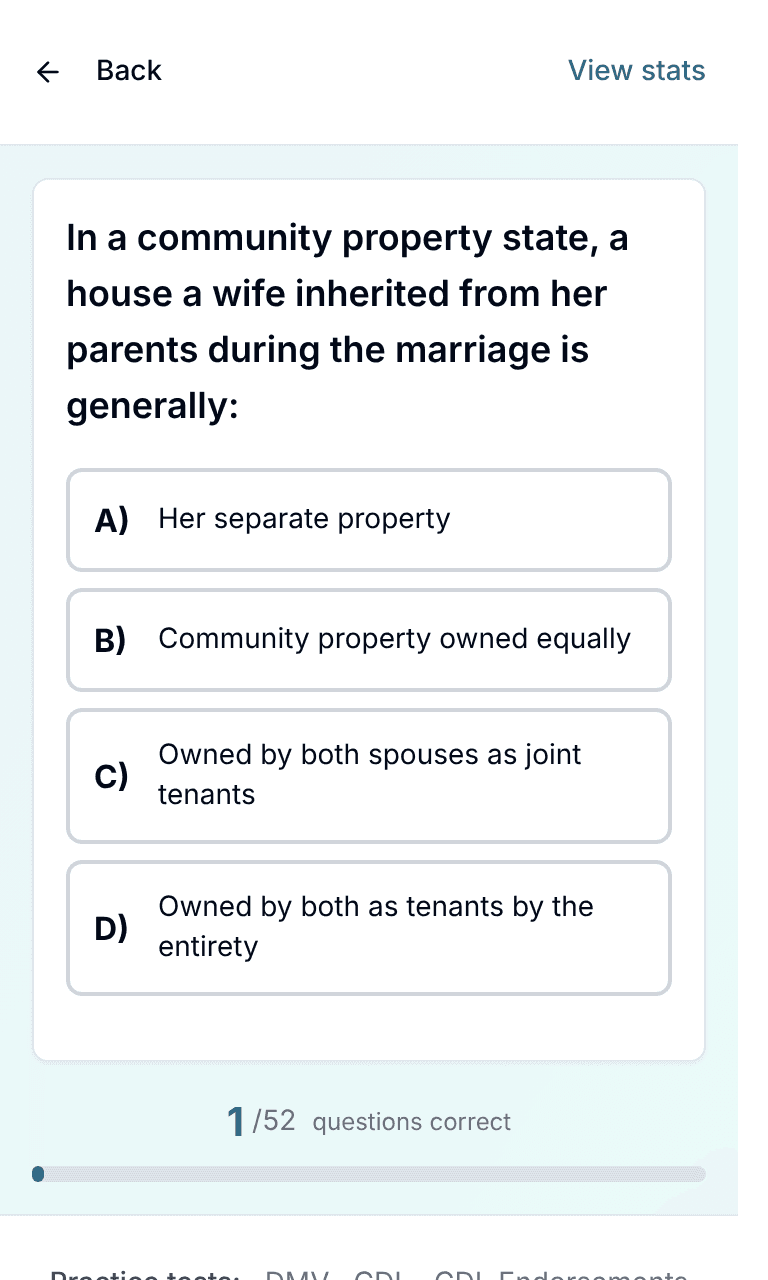
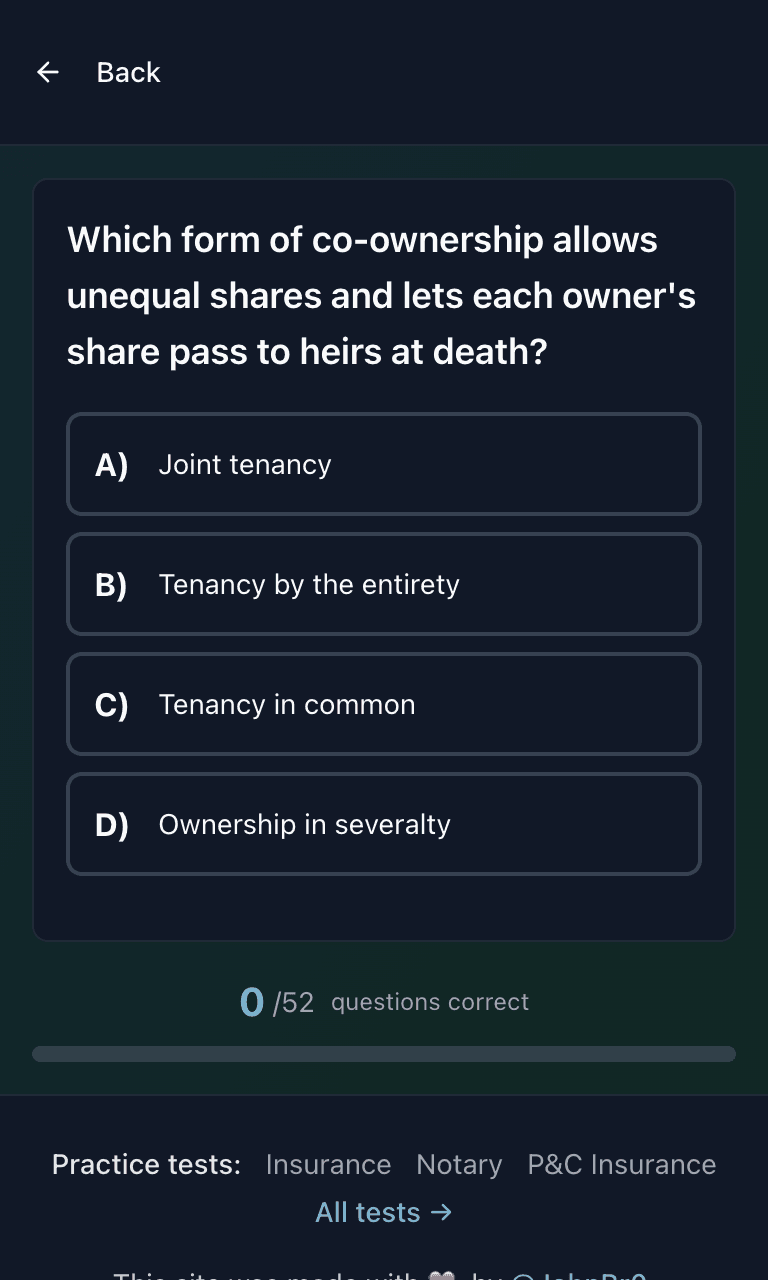
Train on mobile
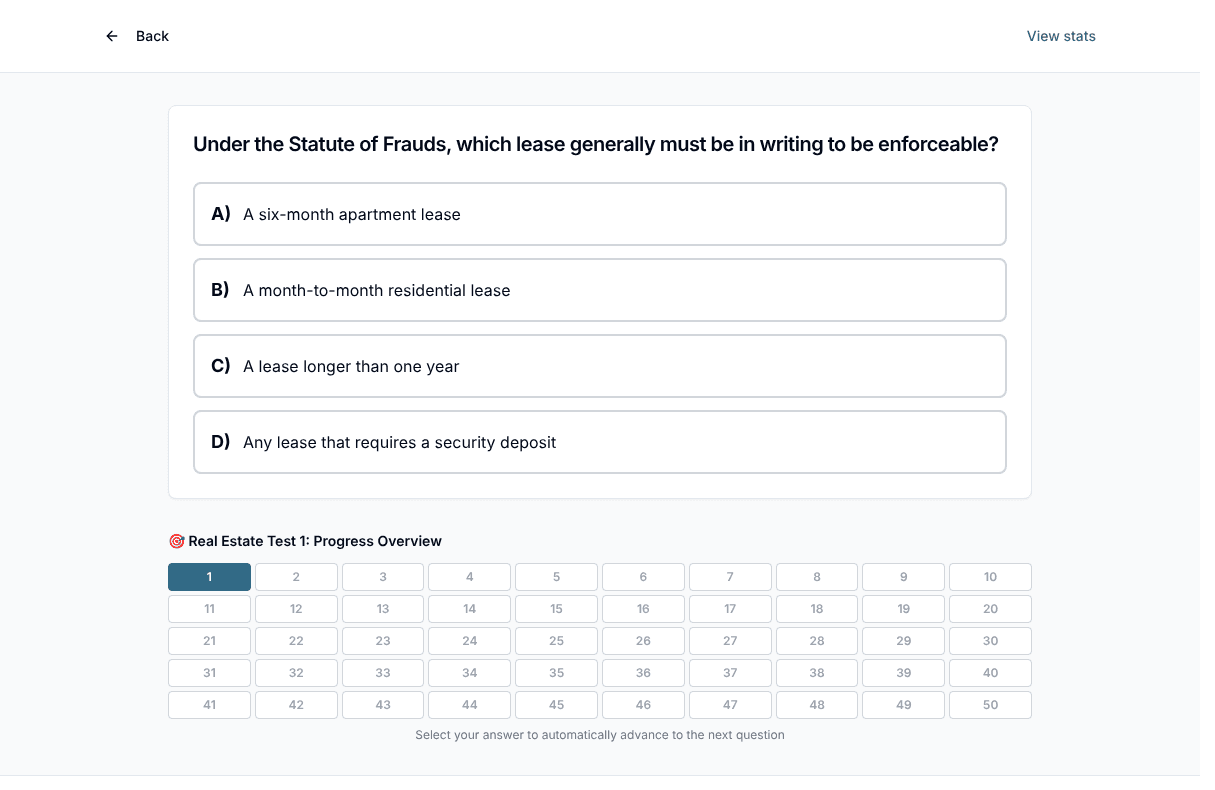
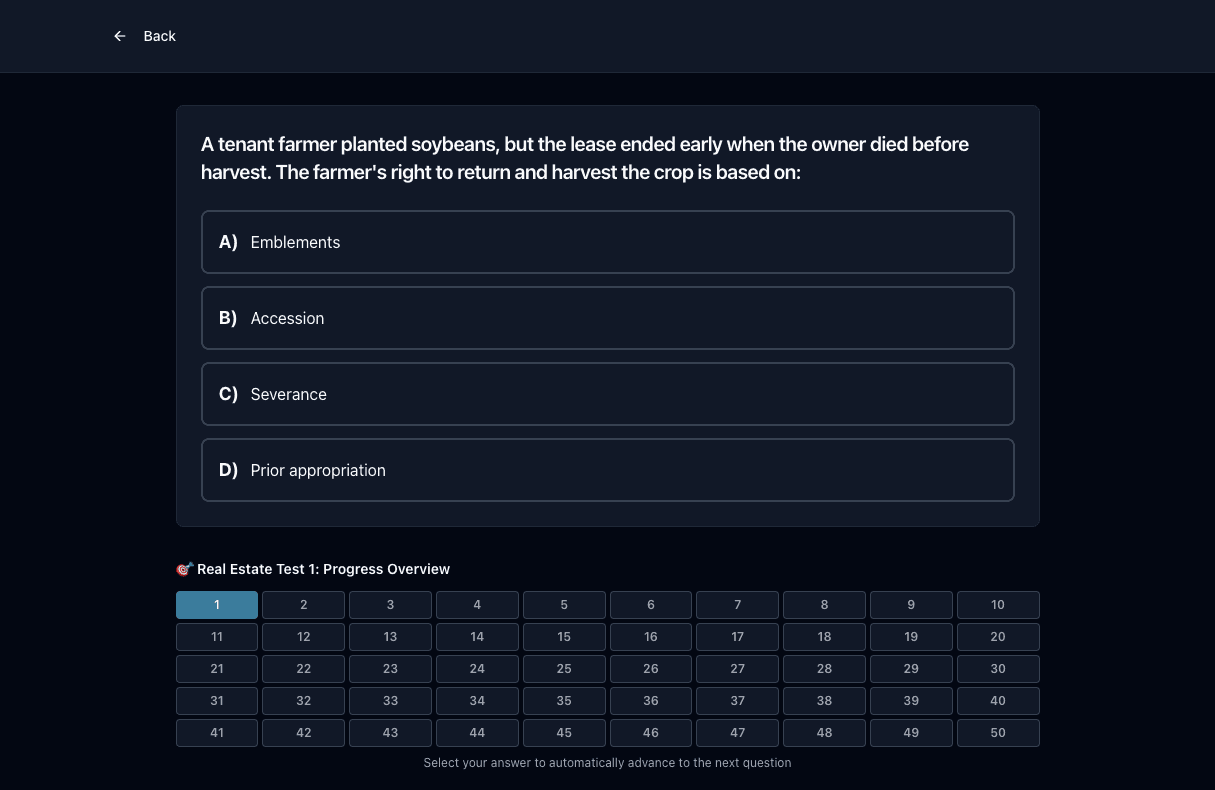
Test on desktop
The North Carolina real estate exam at a glance
Tigertest's North Carolina practice has 140 questions with explanations: one full-length practice exam and 4 training sets, free to start with no account required.
- Regulator
- North Carolina Real Estate Commission (NCREC)
- Vendor
- Pearson VUE ("The Real Estate Commission contracts with the professional testing service Pearson")
- Sections
- National (developed by Pearson) and State (developed by NCREC), separately timed and scored, reported separately
- National section
- 80 scored + 5 pretest, 2.5 hours
- State section
- 60 scored + 5 pretest, 2.0 hours
- Pass mark
- 75 on each section, computed separately; both sections must be passed in the same 180-day Exam Eligibility Period
- Retakes
- Retake only the failed section after refiling the application (single-section exam fee)
- Prelicensing
- 75-hour NC Broker Prelicensing Course within 3 years before application
- Postlicensing
- 90 hours (Post 301, 302, 303) within 18 months of initial licensure
- CE
- 8 hours a year (4-hour Update plus 4 hours elective) from the second renewal
Facts checked against official sources on 2026-10-18. Source-checked practice on the NCREC RELINC bulletin (April 2026). Not affiliated with NCREC or Pearson VUE; confirm rules in official NCREC materials. Official source
How the North Carolina practice works
Four sets with 140 source-checked questions for North Carolina, national topics and North Carolina law. Missed questions come back until you master them.
Set 1: Property, Ownership & Title
24 questions · 17% of the practice exam
Set 2: Contracts & Agency
37 questions · 26% of the practice exam
Set 3: Practice & Disclosures
47 questions · 34% of the practice exam
Set 4: Valuation, Financing & Math
32 questions · 23% of the practice exam
Full-length practice exam: 140 questions, 75% to pass
- Contracts & Agency37
- Real Estate Practice34
- Ownership, Transfer & Title15
- Property Value & Appraisal15
- Disclosures & Environmental Issues13
- Financing & Settlement10
- Property Characteristics, Descriptions & Use9
- Real Estate Math7
North Carolina real estate exam sample questions and answers
6 of the 140 practice questions, one from each topic, with the answer explained.
1. A builder offers a buyer's agent a $2,000 bonus if her buyer purchases one of its homes. The agent may accept it only if she:
- A.Reports it to the Commission
- B.Discloses it to her buyer in writing
- C.Receives it only after closing
- D.Rebates half of it to the buyer
Answer: B. Rule 58A .0109(c)(2) and (d) bar a broker from taking consideration of more than nominal value from anyone other than the principal without full and timely disclosure to the principal, including its value and who pays it; an oral disclosure must be confirmed in writing before the principal makes or accepts an offer.
2. A listing broker learns that a previous occupant of the listed home died there of natural causes. Under G.S. 39-50, this fact:
- A.Must be disclosed in writing
- B.Must be on the disclosure form
- C.Must be disclosed to every buyer
- D.Is not deemed a material fact
Answer: D. G.S. 39-50 provides that a prior occupant's death or serious illness while occupying the property is not a material fact, though no seller may knowingly make a false statement about it. A broker asked directly still may not misrepresent it.
3. A North Carolina home sells for $312,000. Who pays the state excise tax on the deed, and how much is it?
- A.Seller (grantor), $624
- B.Buyer (grantee), $624
- C.Seller (grantor), $312
- D.Buyer (grantee), $1,248
Answer: A. G.S. 105-228.30(a) levies $1 per $500 of consideration, paid by the transferor before the deed is recorded: $312,000 / 500 = 624 units x $1 = $624. The $312 answer wrongly uses $1 per $1,000.
4. An investor buys a residential rental for $400,000, of which $70,000 is land value. Using straight-line depreciation over 27.5 years, what is the annual depreciation?
- A.$8,461.54
- B.$14,545.45
- C.$12,000
- D.$2,545.45
Answer: C. Land is not depreciated, so the building basis is $400,000 - $70,000 = $330,000, and $330,000 / 27.5 = $12,000 per year. Depreciating the full $400,000 gives $14,545.45, which wrongly includes the land.
5. Two brokers agree that one will take listings only east of Main Street and the other only west. This antitrust violation is:
- A.A tie-in agreement
- B.Price fixing
- C.Market allocation
- D.A group boycott
Answer: C. Dividing territories or customers among competitors is market allocation, which the Sherman Act prohibits. Price fixing is agreeing on commission rates, which must instead be set by negotiation between each broker and client.
6. Buyer 1 receives a deed but never records it. Later the seller deeds the same lot to Buyer 2, who pays value, has no knowledge, and records. Who generally prevails?
- A.Buyer 2, under the recording acts
- B.Both buyers, as tenants in common
- C.Buyer 1, because the first deed controls
- D.The seller, since both deeds are void
Answer: A. Under North Carolina's Conner Act (G.S. 47-18) an unrecorded deed is not valid against a later purchaser for value, and priority follows the order of recording, so Buyer 2 prevails. Buyer 1's deed still binds the seller who signed it.
North Carolina real estate exam practice: common questions
How many questions are in the North Carolina practice exam?
140. They make one full-length practice exam and 4 training sets by content area. Full-length practice exam: 140 questions, 80 national and 60 North Carolina.
What score do I need on the North Carolina practice exam?
The practice exam passes at 75 percent, the line Tigertest uses for North Carolina. A practice score does not predict your result on the real exam, so use it to find the content areas to drill.
Does this cover North Carolina law?
Yes. National questions were checked against North Carolina law, and the North Carolina-only questions cover the state's own statutes and rules. Source-checked practice on the NCREC RELINC bulletin (April 2026). Not affiliated with NCREC or Pearson VUE; confirm rules in official NCREC materials.
Is the North Carolina real estate exam practice free?
It is free to start with no account. The full-length practice exam and every training set but the last are free; the final set, Valuation, Financing & Math, is part of Tigertest Premium, a one-time purchase with no subscription that also covers every other exam on Tigertest.
I am testing in another state. What should I use?
Tigertest has 16 state versions of this exam. For any other state, use the national practice, which covers the general portion that is the same wherever you test.
Other states and the national practice
- Real Estate Practice Test (national)
- North Carolina life and health insurance exam
- North Carolina property and casualty insurance exam
- Arizona
- California
- Florida
- Georgia
- Illinois
- Louisiana
- Michigan
- New Jersey
- New York
- Ohio
- Pennsylvania
- Tennessee
- Texas
- Virginia
- Washington
Practice only. Not affiliated with any state regulator, PSI, Pearson VUE or Prometric, and a practice score does not predict your exam result.
Ready for the North Carolina real estate exam?
Start for free. No account required. 140 questions checked against North Carolina law.
Start practicing