
Free STAAR Algebra I Practice Test
Two full 50-question Texas Algebra I EOC practice tests on TEA's blueprint, plus seven topic drills from factoring to exponential growth. Everything is free, no account needed.
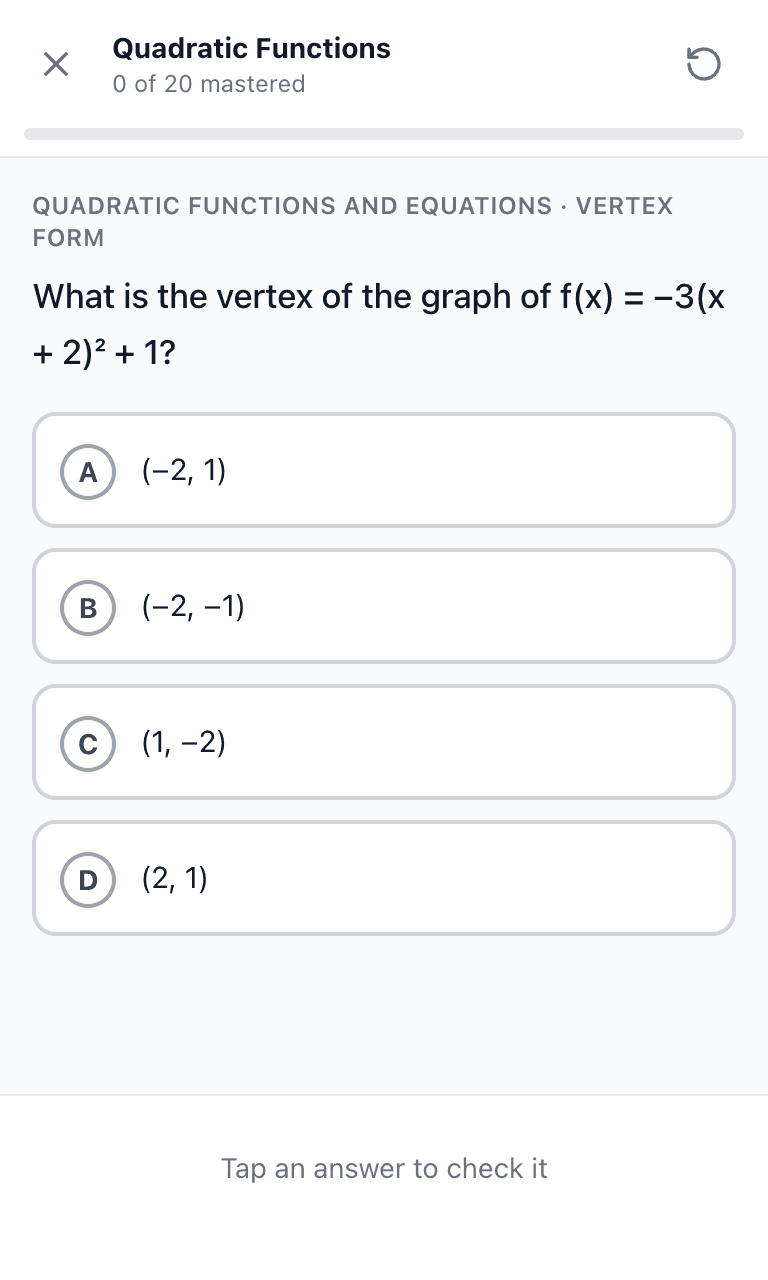
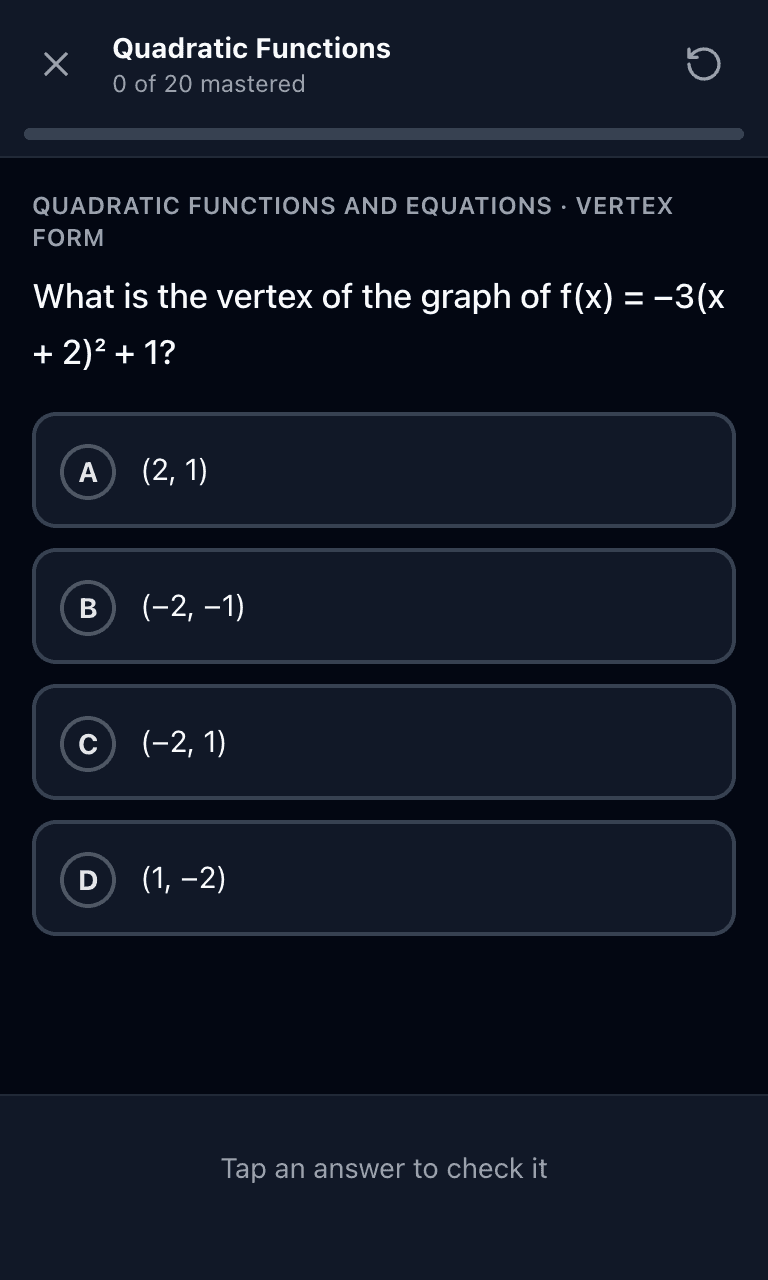
Train on mobile
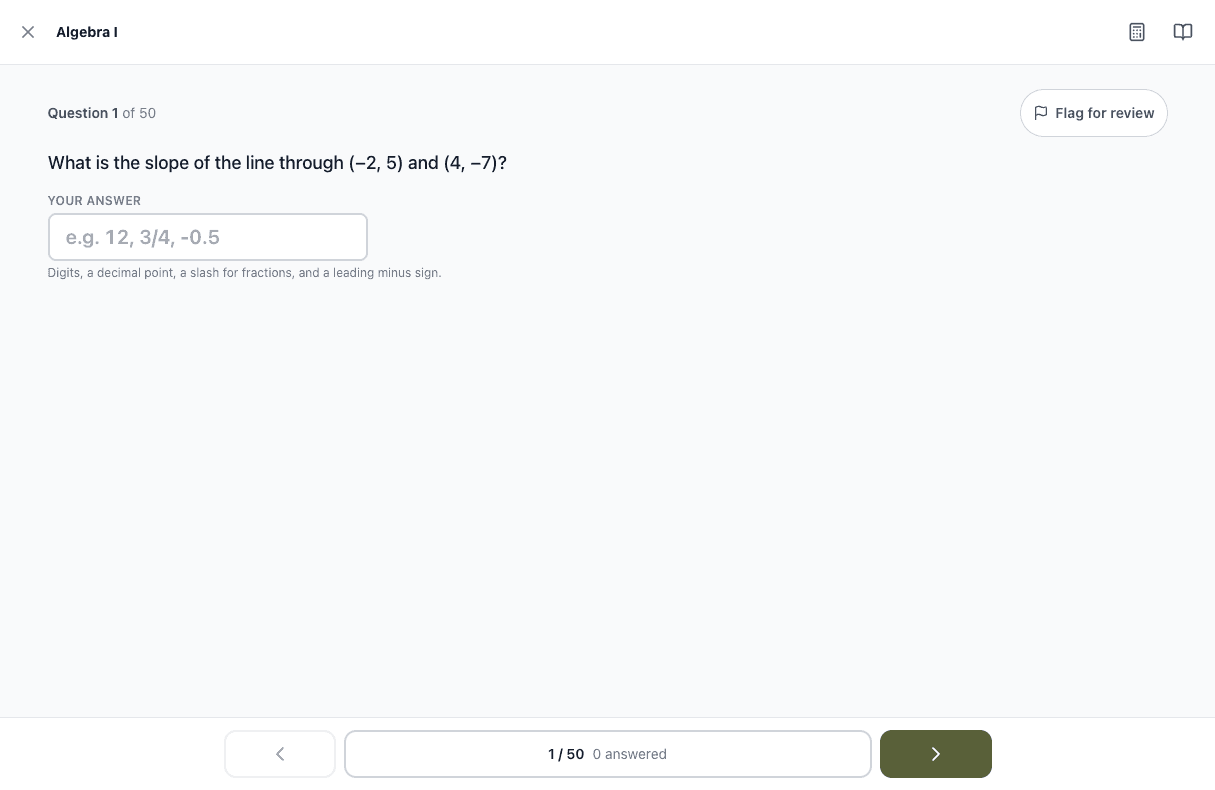
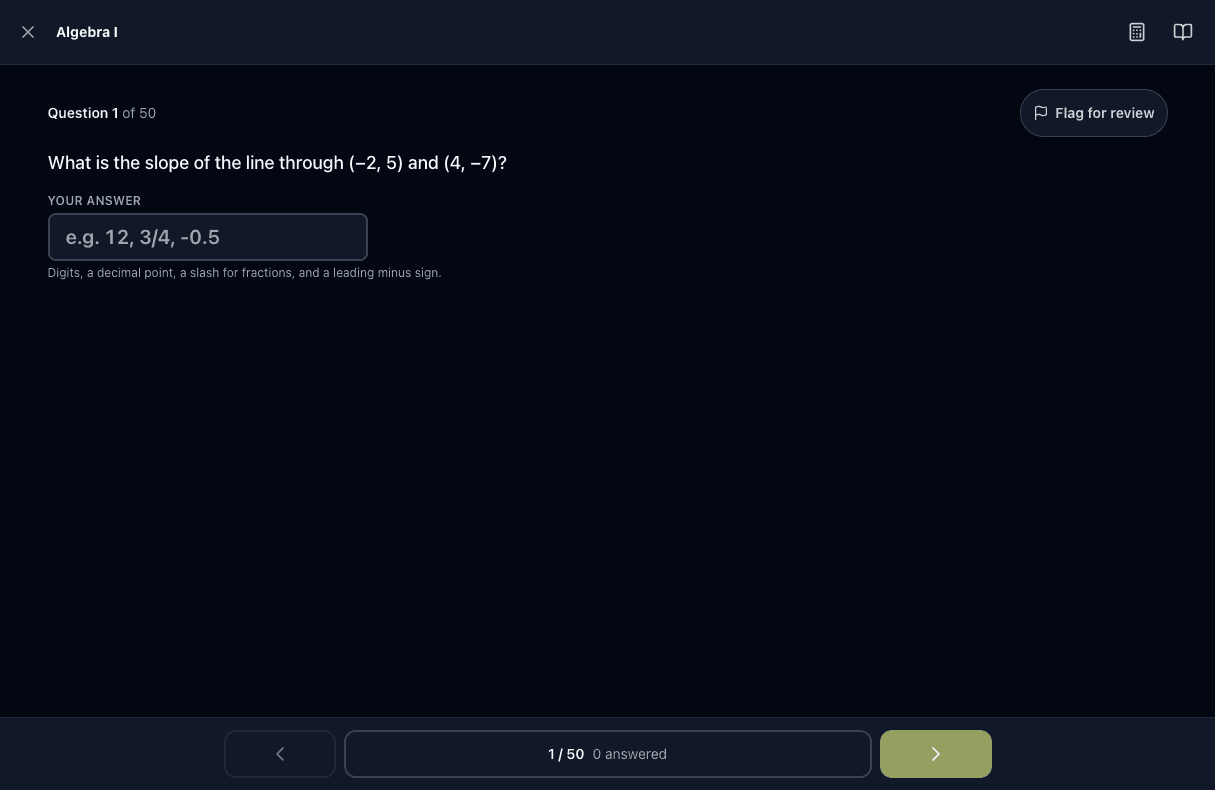
Test on desktop
The STAAR Algebra I exam at a glance
The STAAR Algebra I end-of-course assessment is the Texas Education Agency's state test for students who finish Algebra I, whether in high school or in middle school. It has 50 questions worth 59 points: 41 one-point questions and 9 two-point questions that can earn partial credit, and since the 2022-23 redesign at most 75% are multiple choice, the rest being typed answers, graphing, number lines, drop-down menus, hot spots, drag and drop, match tables and multiselect. It covers five reporting categories: Number and Algebraic Methods, Describing and Graphing Linear Functions, Equations and Inequalities, Writing and Solving Linear Functions, Equations and Inequalities, Quadratic Functions and Equations, and Exponential Functions and Equations. TEA expects three to four hours; the test must be finished the same school day, with at most seven hours of working time. A graphing calculator and the Algebra I reference materials are provided. Passing is Approaches Grade Level, a scale score of 3550 (19 of 59 points on the Spring 2026 test).
Tigertest has two full 50-question practice tests on TEA's blueprint and the assessed Algebra I TEKS, untimed like the real test, with a calculator and the reference sheet on every question and a mix of multiple choice, typed answers, multiselect, match tables and drop-downs. Seven topic drills, three of which teach the basics first, cover every reporting category. All of it is free with no account required. Every question is worth one point and graphs are described in words, so the score is percent correct, not a STAAR scale score.
- Who takes it
- Texas students who complete Algebra I, in high school or middle school
- Questions
- 50 questions, 59 points (9 are worth 2 points)
- Question types
- At most 75% multiple choice; the rest typed answers, graphing, drop-downs, match tables, multiselect and others
- Reporting categories
- Number and algebraic methods; graphing linear; writing and solving linear; quadratics; exponentials
- Time
- 3 to 4 hours expected; same school day, up to 7 hours
- Calculator
- A graphing calculator is required for the whole test, plus the reference materials
- Pass mark
- Approaches Grade Level, scale score 3550 (19 of 59 points in Spring 2026)
- Coming change
- HB 8 replaces STAAR with the Student Success Tool from 2027-28
Updated by the Tigertest team. Practice questions follow TEA's STAAR Algebra I Blueprint (effective 2022-23), the Algebra I assessed curriculum, the STAAR calculator policy and the Spring 2026 raw score conversion table. Exam rules change, so confirm current details with TEA: STAAR Mathematics Resources.
How It Works
Drills on Your Phone
Seven short drills, one for each part of the course, from polynomials and factoring to quadratics and exponential functions. Three open with the basics, such as solving for x and the laws of exponents. One tap to check, an explanation straight away, and every miss comes back until it is mastered.
Full Test on a Computer
50 questions with no clock, like the real EOC, a calculator and the Algebra I reference sheet on every question, and a mix of multiple choice, typed answers, drop-downs and match tables. Flag questions to come back to, then see your score by reporting category and what to drill next.
Built on the Real Exam Format
Each practice test has 50 questions spread across TEA's five reporting categories in the ranges the STAAR Algebra I blueprint sets, written from the assessed Algebra I TEKS. Every question here is worth one point and graphs are described in words or tables; the real test has nine two-point questions and asks you to draw some graphs, and it reports a scale score.

Teach Algebra I?
Set it for your class for free: post one link, students join with just their name, and you see who practiced, their scores by reporting category and the questions your class misses most.
Make a class at tigertest.io/teachHow to Prepare for STAAR Algebra I
1. Know the reference sheet
The slope formula, the forms of a line, the quadratic formula, the axis of symmetry and the exponent rules are all on the reference materials. Practice with the sheet open so you know where each formula is and spend your memory on how to use it.
2. Put the linear categories first
Graphing, writing and solving linear functions, equations and inequalities make up about half of the test. Slope, rate of change, systems and domain and range come up again and again, so master those drills before the rest.
3. Check answers by substituting
Most Algebra I answers can be checked: put a solution back into the equation, multiply factors back out, or test a point in an inequality. On an untimed test, a quick check is the cheapest way to catch a sign error.
4. Practice the graphing calculator you will use
The real test needs a graphing calculator for tables, intersections and lines of fit. Use the one built into the testing platform, or the one your school provides, while you practice, so it is familiar on test day.
STAAR Algebra I Frequently Asked Questions
What is on the STAAR Algebra I EOC?
The test covers the Algebra I TEKS in five reporting categories: Number and Algebraic Methods (polynomials, factoring, exponents, radicals, functions and sequences), Describing and Graphing Linear Functions, Equations and Inequalities, Writing and Solving Linear Functions, Equations and Inequalities, Quadratic Functions and Equations, and Exponential Functions and Equations. TEA's blueprint gives the third category the most questions, 12 to 14.
How many questions are on the STAAR Algebra I test?
50 questions worth 59 points: 41 one-point questions and 9 two-point questions, which can earn partial credit. Since the 2022-23 redesign no more than 75% of the questions are multiple choice; the rest are question types such as typed answers, graphing, number lines, drop-down menus, hot spots, drag and drop, match tables and multiselect.
How long is the STAAR Algebra I test, and can I use a calculator?
There is no set clock for each question. TEA expects most students to finish in three to four hours; the test must be finished the same school day, and a student who needs more time can keep working to the end of the school day, up to seven hours. A graphing calculator is required: every student must have one for the whole test, and one is built into the online platform. The STAAR Algebra I reference materials, with the factoring, exponent, linear and quadratic formulas, are provided too.
What score do you need to pass STAAR Algebra I?
Passing is Approaches Grade Level, a scale score of 3550. The number of points that takes changes a little with each test: on the Spring 2026 test it was 19 of 59 points, with Meets Grade Level from 31 points and Masters Grade Level from 41.
Is STAAR changing?
Yes. House Bill 8, passed in 2025, replaces STAAR with a new program, the Student Success Tool, starting in the 2027-28 school year, with an end-of-course Algebra I test still required. Until then, students take STAAR Algebra I on the current blueprint, which is what this practice follows.
Is the Tigertest STAAR Algebra I practice free?
Yes, all of it: both full practice tests, all seven drills, the basics lessons and every explanation, with no account required. An account saves progress across devices.
I teach an Algebra I class. Can my students use Tigertest?
Yes, for free. Make a class at tigertest.io/teach, post one link, and students join with just their name. You see who practiced, their test scores and the topics your class misses most.
STAAR Algebra I sample questions and answers
6 of the 190 practice questions, one from each topic, with the answer explained.
- 1.
Which is the factored form of x² − 2x − 24?
- A.
(x + 6)(x − 4)
- B.
(x − 8)(x + 3)
- C.
(x − 6)(x + 4)
- D.
(x − 12)(x + 2)
Answer: C.You need two numbers that multiply to −24 and add to −2: −6 and 4. (x + 6)(x − 4) multiplies back to x² + 2x − 24, with the wrong middle sign.
- A.
- 2.
Which set of ordered pairs represents a function?
- A.
{(1, 2), (1, 3), (2, 4), (3, 5)}
- B.
{(0, 1), (2, 3), (2, 5), (4, 7)}
- C.
{(5, 1), (6, 2), (5, 3), (7, 4)}
- D.
{(1, 4), (2, 4), (3, 5), (4, 6)}
Answer: D.A function gives each input exactly one output. In {(1, 4), (2, 4), (3, 5), (4, 6)} no x-value repeats; two inputs sharing the output 4 is allowed. Each other set repeats an x-value with two outputs.
- A.
- 3.
Which equation describes the line through (6, −1) that is perpendicular to y = 3x + 4?
- A.
y = 3x − 19
- B.
y = −(1/3)x − 3
- C.
y = −(1/3)x + 1
- D.
y = (1/3)x − 3
Answer: C.A perpendicular slope is the opposite reciprocal of 3, which is −1/3. Then −1 = −(1/3)(6) + b gives b = 1. y = 3x − 19 is the parallel line through the point.
- A.
- 4.
What is the range of f(x) = −2(3)ˣ?
- A.
y > 0
- B.
y > −2
- C.
y < 0
- D.
All real numbers
Answer: C.3ˣ is always positive, so −2(3)ˣ is always negative and gets close to 0 from below: y < 0. It passes −2 at x = 0 and keeps falling, so y > −2 is wrong.
- A.
- 5.
What is the solution of the system y = 2x + 3 and 3x + y = 18?
- A.
(9, 3)
- B.
(3, 3)
- C.
(5, 13)
- D.
(3, 9)
Answer: D.Substitute y = 2x + 3: 3x + 2x + 3 = 18, so 5x = 15 and x = 3. Then y = 2(3) + 3 = 9. (9, 3) swaps the coordinates.
- A.
- 6.
Which is f(x) = −2(x − 1)² + 8 written in standard form?
- A.
f(x) = −2x² + 4x + 6
- B.
f(x) = −2x² − 4x + 6
- C.
f(x) = −2x² + 4x + 10
- D.
f(x) = −2x² + 2x + 9
Answer: A.(x − 1)² = x² − 2x + 1, so −2(x² − 2x + 1) + 8 = −2x² + 4x − 2 + 8 = −2x² + 4x + 6. Taking −2 times 1 as +2 gives + 10.
- A.
Related practice tests
Every test on Tigertest is free to start, with no account needed.
Ready for the Algebra I EOC?
Free. No account required. Two full practice tests and seven drills, from factoring to exponential growth.
Start practicing