
Free STAAR Biology Practice Test 2027
202 original questions across all four strands of the Texas Biology EOC, with data sets and choose-two questions. Free, tuned for mobile, no account needed.
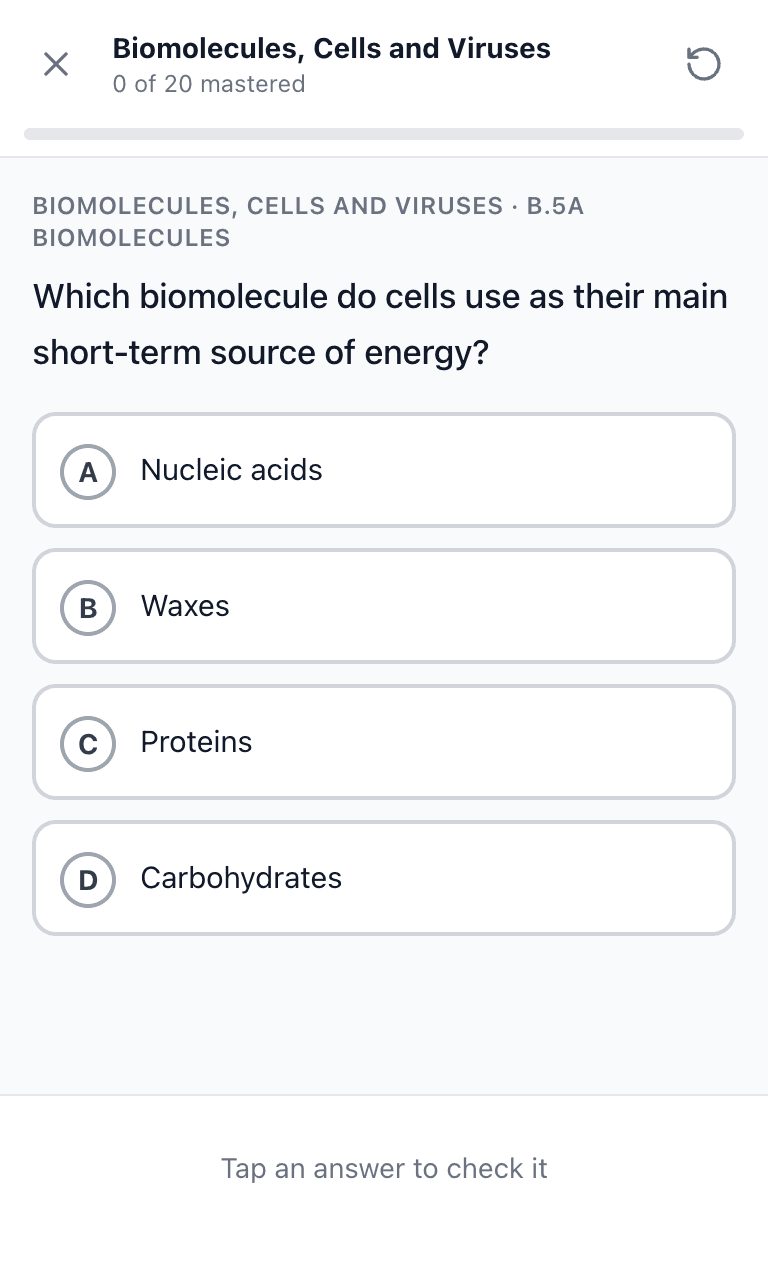
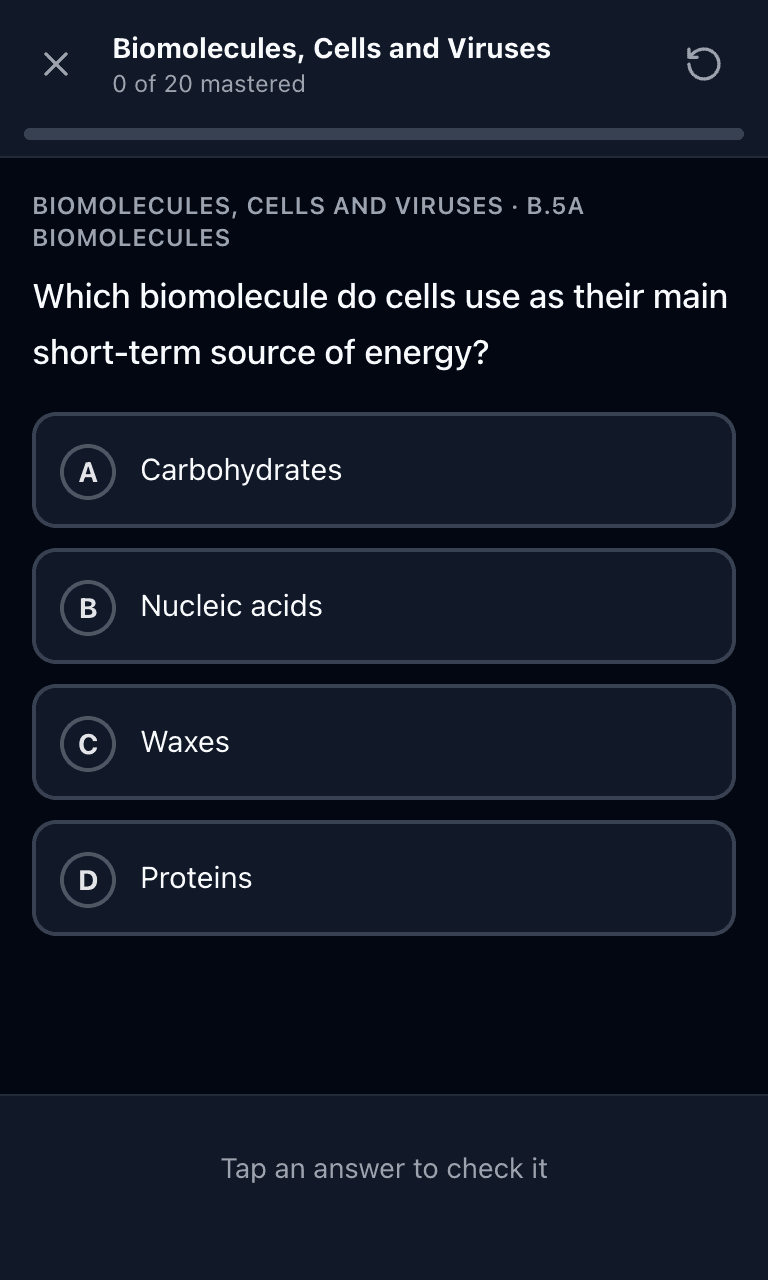
Train on mobile
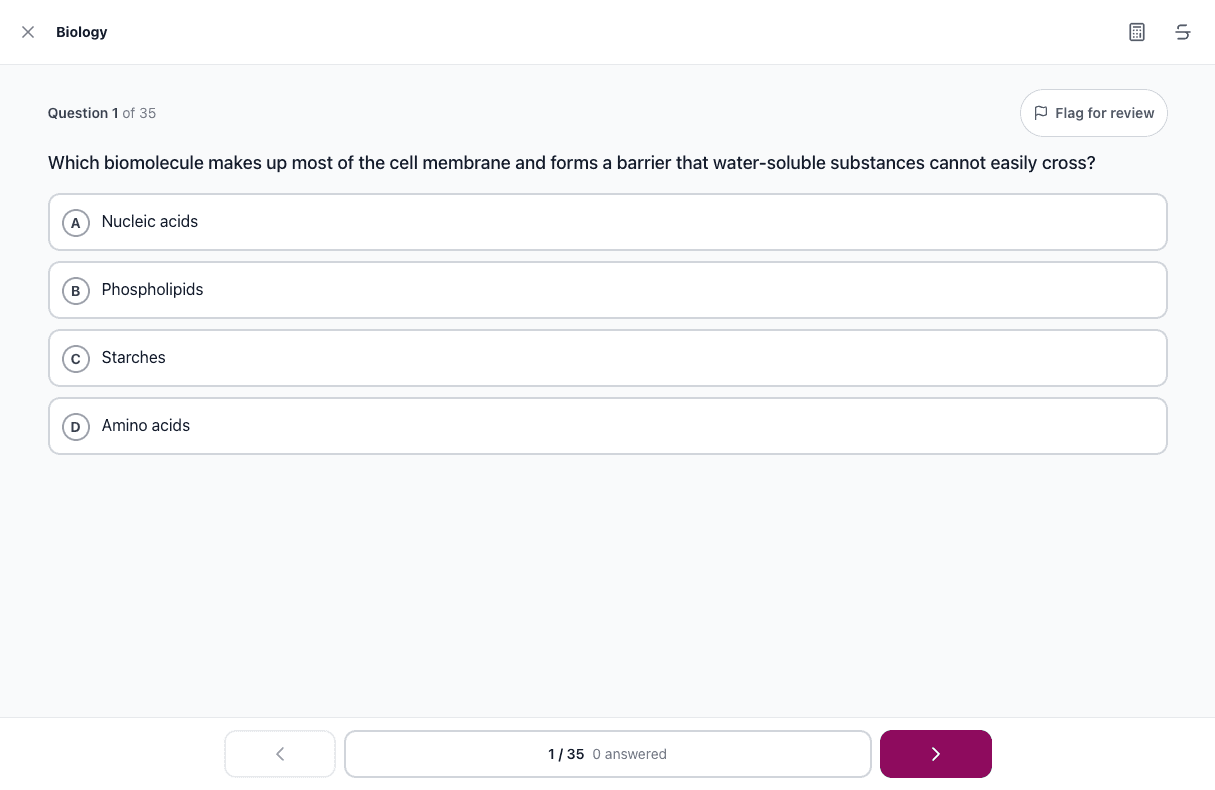
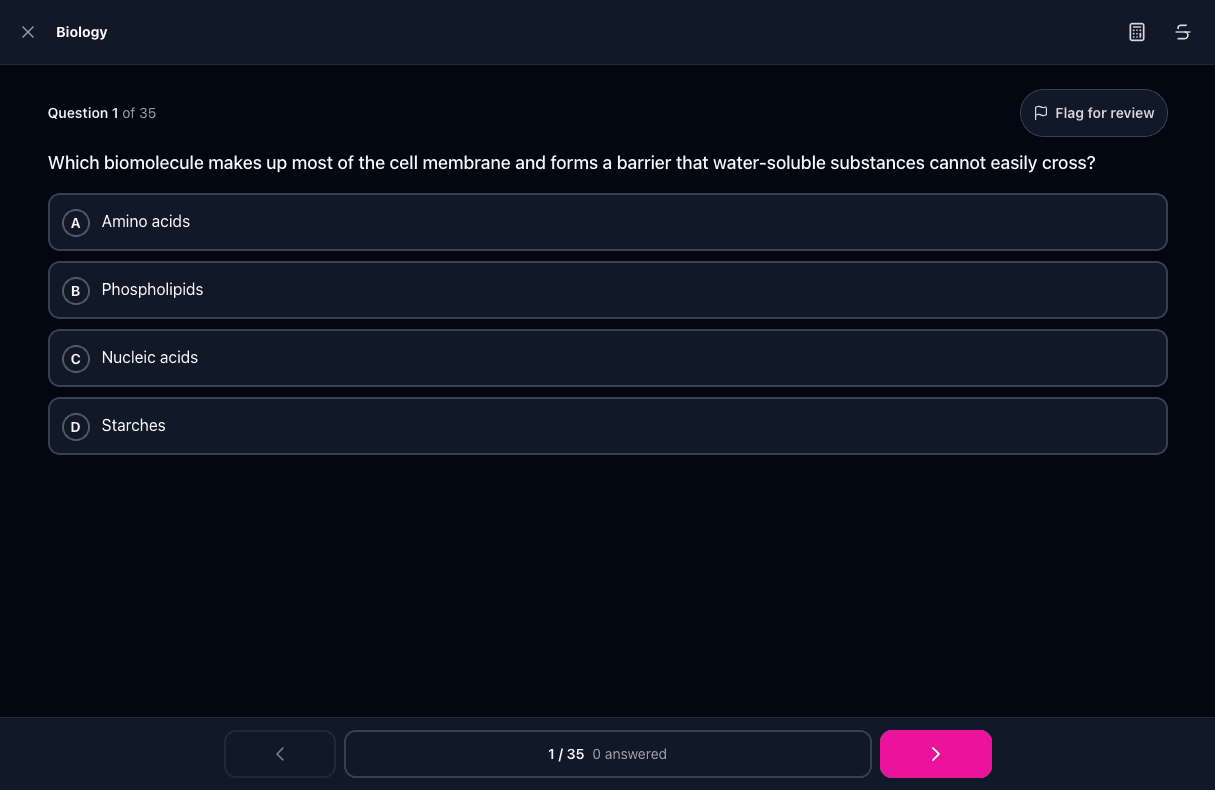
Test on desktop
The STAAR Biology exam at a glance
STAAR Biology is the Texas end-of-course test for high school Biology, given by the Texas Education Agency. On the blueprint effective beginning with the Spring 2026 administration it has 33 to 35 questions worth 40 points in four strands: Biological Structures, Functions, and Processes (12 to 14 questions), Mechanisms of Genetics (7 to 9), Biological Evolution (7 to 9) and Interdependence within Environmental Systems (5 to 7). Question types include multiple choice, multiselect, drag and drop, hot spot, inline choice, match table grid, text entry and short constructed response, and some come in cluster sets that share a scenario. There is no fixed time limit: students are expected to finish in about three to four hours, within the school day. A calculator is required. On the Spring 2026 test, Approaches Grade Level began at a scale score of 3550, Meets at 4000 and Masters at 4570.
Tigertest has two full 35-question STAAR Biology practice tests, untimed and split by strand like the real blueprint, and nine drills by tested standard, all free with no account required. Only multiple choice and choose-two questions are included.
- Questions
- 33 to 35, worth 40 points
- Strands
- Structures and processes 12-14, Genetics 7-9, Evolution 7-9, Interdependence 5-7
- Time
- Untimed; about 3 to 4 hours, up to 7 in one school day
- Calculator
- Required (built-in tool online)
- Score
- Scale score; Approaches 3550, Meets 4000, Masters 4570 (Spring 2026)
- Given by
- Texas Education Agency
Updated by the Tigertest team. Practice questions follow TEA's Biology STAAR Blueprint (effective Spring 2026), the Biology assessed curriculum (2025-2026), the 2026-2027 STAAR Test Administrator Manual and the Spring 2026 Biology raw score conversion table. Exam rules change, so confirm current details with Texas Education Agency.
How It Works
Drills by Topic
Nine drills, one for each group of tested Biology standards. Questions you miss come back until you have mastered them, so a weak topic gets the practice it needs.
Practice Tests
Two full practice tests of 35 questions with no clock, like the real test, a built-in calculator and a score by topic at the end. Practice Test 2 is held out of the drills, so it measures readiness.
Weighted Like the Real Test
TEA's blueprint gives each strand a range of questions, shown below. Every Tigertest practice test takes the middle of each range, 13, 8, 8 and 6 questions, and includes three cluster sets of three or four questions that share a scenario and data table.

Help Make Tigertest Better
Have an idea, a topic you'd like covered, or a question that could be clearer? We read every message and use it to improve every test.
Share FeedbackHow to Raise Your STAAR Biology Score
1. Read the scenario before the questions
In a cluster set, every question comes back to one scenario. Before you answer, say what was changed, what was measured and what the data table shows in one sentence. The questions in the set usually ask about exactly those things.
2. Know the processes, not just the words
Many questions ask what happens next or why: why an enzyme slows down when heated, why a frameshift changes a protein more than a substitution, why fewer predators can mean fewer trees. Say the cause and effect in your own words, then why the closest wrong answer fails.
3. Practice Punnett squares and the 10% rule
Expect monohybrid and dihybrid crosses with incomplete dominance, codominance, multiple alleles and sex-linked traits, and energy passed up a food chain. Work each kind until it is quick, and use the calculator for the arithmetic.
4. Answer every question and use your time
There is no clock, so read slowly, check each data table twice and flag anything you are unsure of. Structures, Functions, and Processes has the most questions, so drill its four topics first if they are weak.
STAAR Biology Frequently Asked Questions
What is on the STAAR Biology test?
The STAAR Biology end-of-course test has 33 to 35 questions worth 40 points in four strands: Biological Structures, Functions, and Processes (12 to 14 questions), Mechanisms of Genetics (7 to 9), Biological Evolution (7 to 9), and Interdependence within Environmental Systems (5 to 7). The questions cover the Biology TEKS that TEA lists as eligible for assessment, from biomolecules, cells and viruses to genetic crosses, natural selection and ecosystems. Sub-scores are not reported for the strands.
What kinds of questions are on STAAR Biology?
Besides multiple choice, the test uses multiselect, drag and drop, hot spot, inline choice, match table grid, multipart, text entry and short constructed response questions. 26 to 30 questions are worth one point and 5 to 7 are worth two points. Some questions come in cluster sets: a scenario with a graphic or data display followed by 3 to 5 questions, each scored on its own.
How long is the STAAR Biology test, and can I use a calculator?
There is no fixed time limit. TEA expects students to finish in about three to four hours; a student who needs more time may keep working until the end of the school day, up to seven hours, and the test must be finished the same day. A calculator is required for Biology: the online test has a built-in calculator tool, and an allowed handheld calculator may also be used.
What score do I need on STAAR Biology?
STAAR reports a scale score and a performance level. On the Spring 2026 Biology test, Approaches Grade Level started at a scale score of 3550 (10 of 40 raw points on that form), Meets Grade Level at 4000 (17 points) and Masters Grade Level at 4570 (26 points). The raw points needed can change from one test form to the next, so check the conversion table TEA publishes for your administration.
Is the Tigertest STAAR Biology practice test like the real one?
It follows TEA's 2026 blueprint: each practice test has 35 questions split across the four strands like the real test, three cluster sets with data tables, and no clock. It uses multiple choice and choose-two questions only, every question is worth one point, and figures are described in words or tables, so your result is a percent correct, not a scale score. The questions are original. Tigertest is not affiliated with the Texas Education Agency. Under House Bill 8, TEA plans to replace STAAR with a new assessment program beginning in the 2027-28 school year.
I teach high school Biology. Can my students use Tigertest?
Yes, for free. Make a class at tigertest.io/teach, post one link, and students join with just their name. You see who practiced, their test scores and the topics your class misses most.
STAAR Biology sample questions and answers
6 of the 202 practice questions, one from each topic, with the answer explained.
- 1.
Why are antibiotics not used to treat the common cold, which is caused by a virus?
- A.
Viruses lack the cell parts antibiotics target
- B.
Viruses have cell walls that block antibiotics
- C.
Viruses only infect cells of plants
- D.
Viruses are too large for antibiotics to enter
Answer: A.Antibiotics act on structures and processes of bacterial cells, such as cell walls and bacterial ribosomes. A virus is a protein coat around genetic material with no cell parts of its own, so there is nothing for an antibiotic to act on.
- A.
- 2.
A mutation stops a protein that normally halts the cell cycle when DNA is damaged. Which outcome is most likely?
- A.
The cell stops making DNA
- B.
Damaged cells keep dividing
- C.
The cell becomes a stem cell
- D.
Cells divide more slowly
Answer: B.Checkpoint proteins pause the cycle so damage can be repaired or the cell can die. Without that brake, cells with damaged DNA divide and pass errors on, which can lead to a tumor.
- A.
- 3.
Without enzymes, most reactions in cells would:
- A.
be far too slow for life
- B.
happen too fast to control
- C.
make no products ever
- D.
release no energy at all
Answer: A.Many cell reactions have a high activation energy and would take far too long at body temperature without enzymes lowering that barrier.
- A.
- 4.
Water absorbed by the roots of a tall tree reaches the leaves through:
- A.
the flowers
- B.
xylem tissue
- C.
phloem tissue
- D.
the stomata
Answer: B.Xylem is the vascular tissue that carries water and minerals up from the roots. Phloem carries sugars made in the leaves to other parts of the plant.
- A.
- 5.
A substitution changes one base in a gene, but the protein made from the gene is unchanged. Which explanation is most likely?
- A.
The cell stopped making the protein
- B.
Substitutions never affect proteins
- C.
Both codons code for one amino acid
- D.
The base was replaced in an RNA molecule
Answer: C.Most amino acids have more than one codon, so some substitutions are silent. Other substitutions do change an amino acid or create a stop codon.
- A.
- 6.
Two plants that are both heterozygous for two genes on different chromosomes are crossed. What phenotype ratio is expected?
- A.
1:1:1:1
- B.
9:3:3:1
- C.
3:1
- D.
1:2:1
Answer: B.A dihybrid cross of two heterozygotes gives 9 with both dominant traits, 3 and 3 with one of each, and 1 with both recessive traits.
- A.
Related practice tests
Every test on Tigertest is free to start, with no account needed.
Ready for STAAR Biology?
Free, with no account required. 202 questions across all four strands.
Start practicing