
Free STAAR English I Practice Test
Reading and revising and editing for the Texas English I end-of-course test, on original passages and student drafts at TEA's blueprint mix, plus nine drills. Everything is free, no account needed.
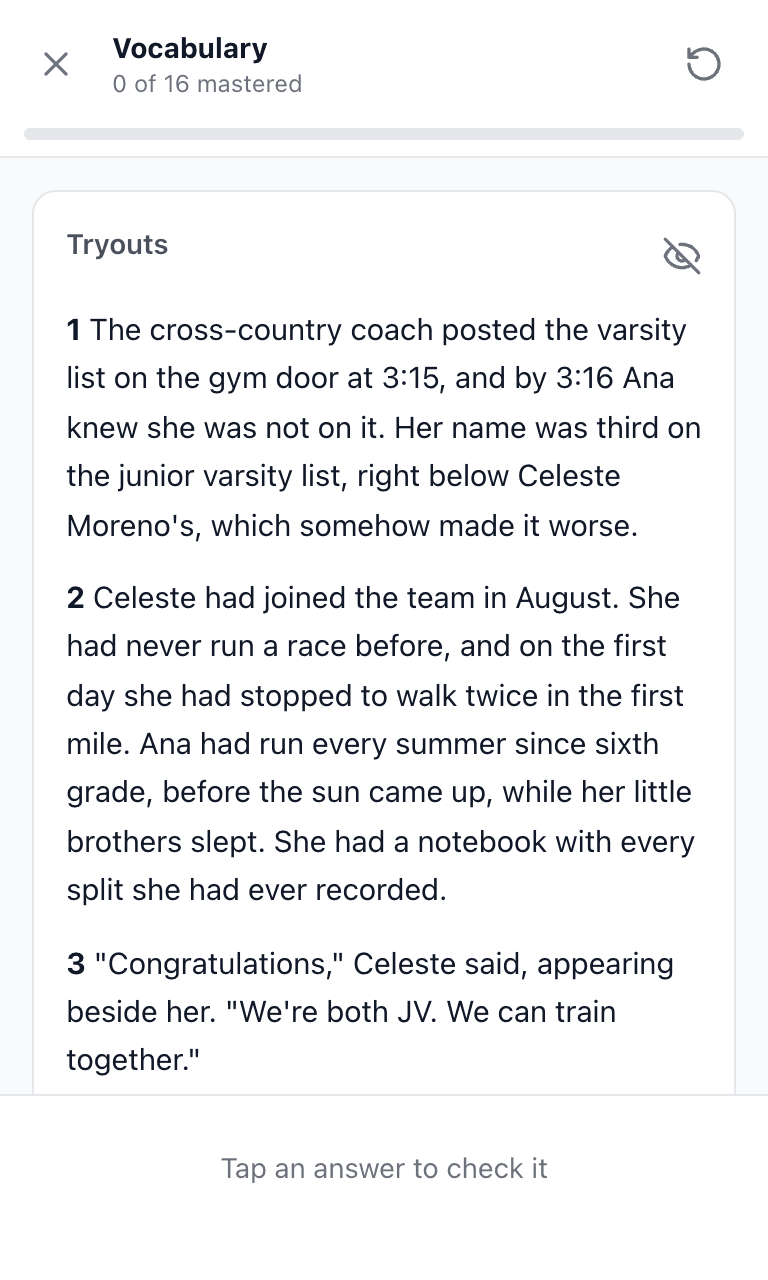
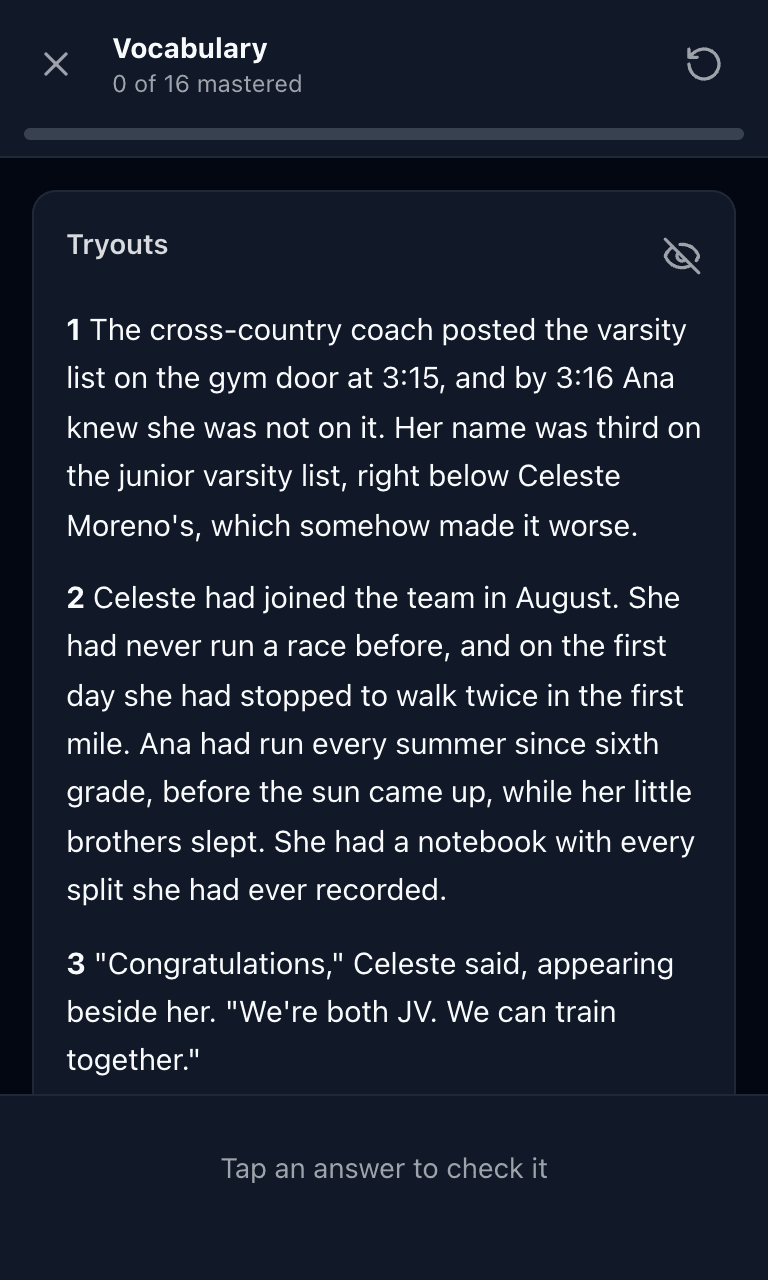
Train on mobile
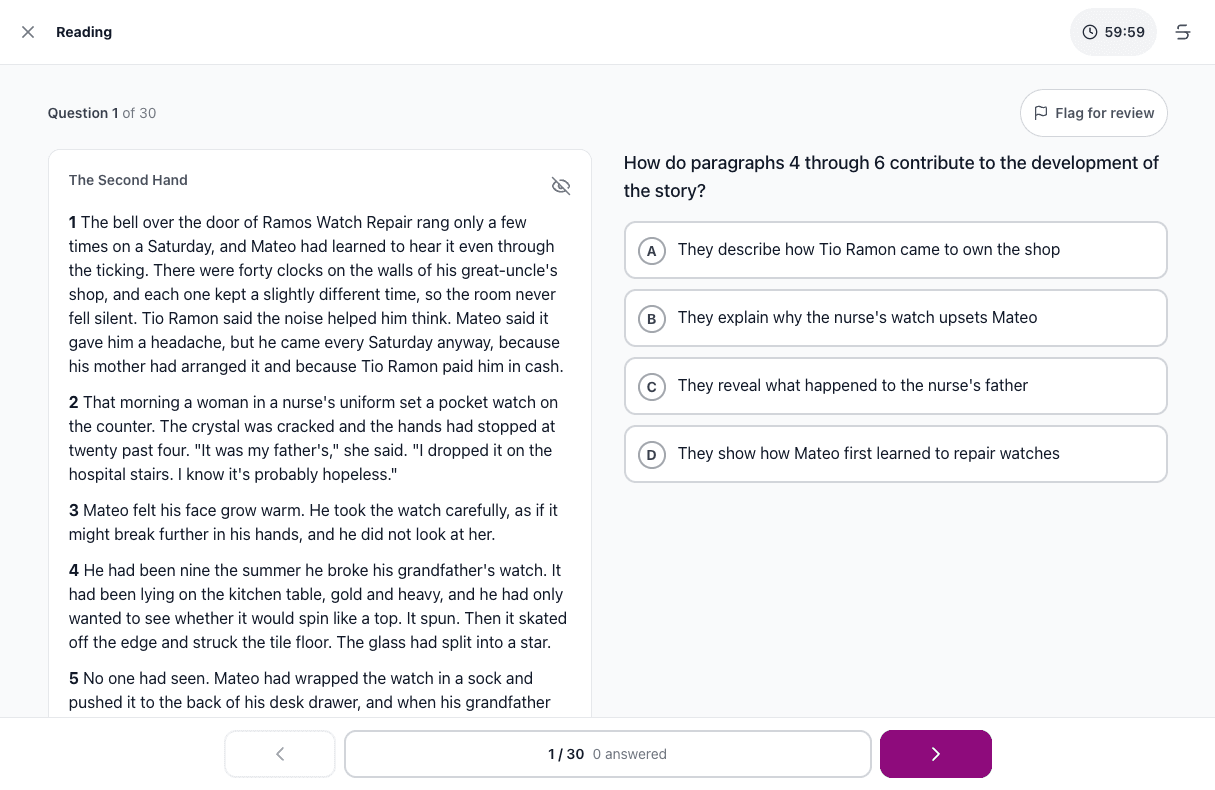
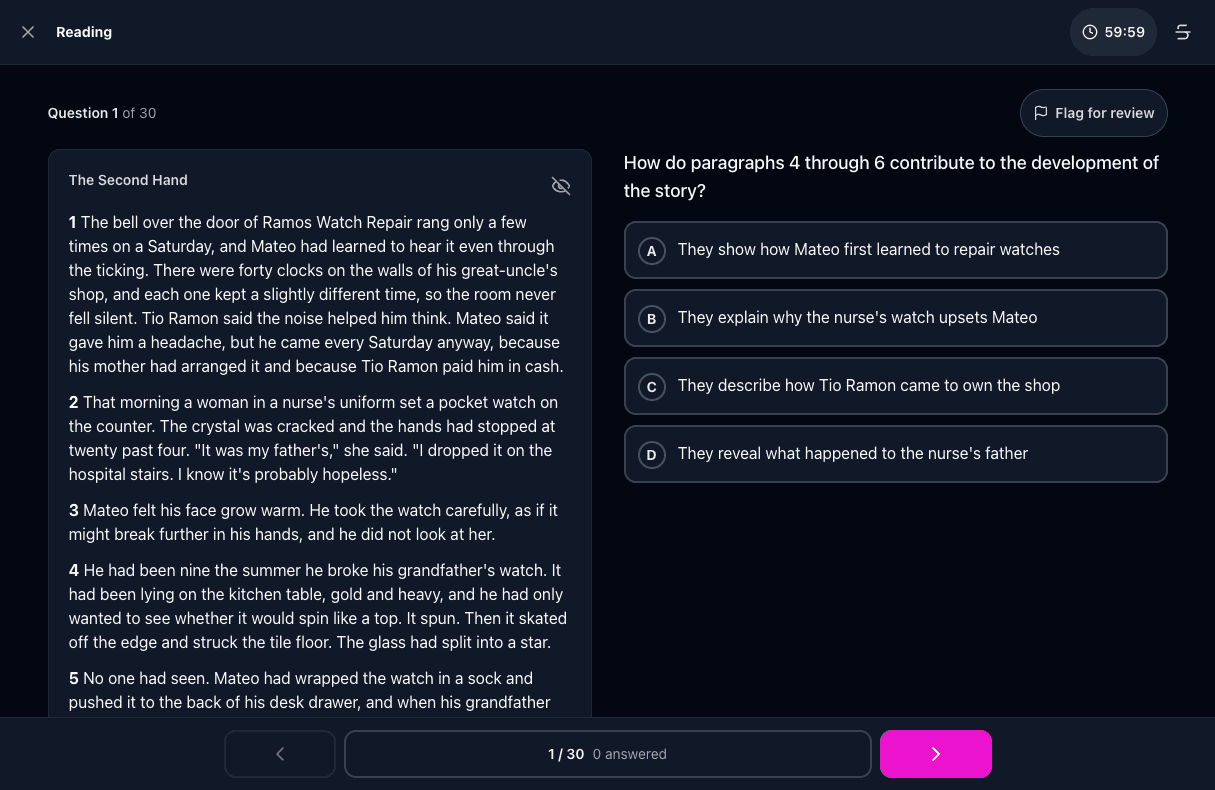
Test on desktop
The STAAR English I exam at a glance
STAAR English I is the Texas end-of-course test for the high school English I course. Under TEA's blueprint in force since spring 2023 it has 52 questions worth 64 points: a reading section of 29 to 31 questions on two single passages and one paired passage, and a writing section of 21 to 23 questions on two revising passages and two editing passages plus one extended constructed response, a written response to a reading passage worth 10 points. Most questions are worth 1 point and three are worth 2. It is taken online, and the raw score becomes a scale score: Approaches Grade Level is 3775, Meets 4000 and Masters 4606.
Tigertest has two practice tests of the reading and the revising and editing questions at the blueprint's mix, 51 questions each on original passages and student drafts, with multiple choice, dropdown, choose-two and select-a-sentence items, and nine drills, one per skill area. The essay is not included and every question is worth one point. All of it is free with no account required.
- Who takes it
- Texas students taking the high school English I course
- Questions
- 52 on the base test (plus unscored field-test items)
- Points
- 64: Reading 32 to 34, Writing 30 to 32
- Reading
- 29 to 31 questions on two single passages and one paired passage
- Writing
- 21 to 23 questions on revising and editing passages, plus one 10-point extended constructed response
- Question types
- Multiple-choice and non-multiple-choice items
- Pass mark
- Approaches Grade Level, scale score 3775 (27 of 64 raw points on the summer 2026 form)
- What's next
- TEA plans to bring in the Student Success Tool from fall 2027; its draft English I blueprint starts with the spring 2028 test
Updated by the Tigertest team. Practice questions follow TEA's STAAR English I Blueprint and Test Design (effective spring 2023), the English I assessed curriculum and the summer 2026 raw score conversion table. Exam rules change, so confirm current details with TEA: STAAR English I Blueprint.
How It Works
Drills on a Phone or Tablet
Nine short drills, one for each skill area, from inference and theme to comma splices and colons. Each passage or draft stays above its questions. One tap to check, an explanation straight away, and every miss comes back until it is mastered.
Full Test on a Computer
Reading, then revising and editing, in one sitting. Flag questions to come back to, passages and drafts stay beside their questions, and you finish with a percent score for each section and a list of what to drill next. The clock is Tigertest's practice pace, not TEA's.
Built on the Real Exam Format
Each practice test follows TEA's STAAR English I blueprint: two single reading passages and one paired passage with 30 questions, then two revising drafts and two editing drafts with 21 questions, spread across the eligible English I standards. The real test also has a written composition worth 10 of its 64 points, which is not included here, so the score is percent correct, not a STAAR scale score.

Teach English I?
Teachers can set it for a class for free: post one link, students join with just their first name, and you see who practiced, their scores in each section and the questions your class misses most.
Make a class at tigertest.io/teachHow to Prepare for STAAR English I
1. Read the questions with the passage in view
Most reading questions point to a paragraph or a line. Go back to that spot before you choose, and look for the answer the text supports, not the one that only sounds true.
2. Treat paired passages as a conversation
Some questions ask how two texts are alike or different. As you read the second one, note where it agrees with the first and where it adds something new.
3. Learn the editing rules that come up again and again
Comma splices, fragments, verb tense shifts, pronoun agreement, apostrophes and capital letters make up much of the editing work. Drill them until you spot them at a glance.
4. Practice the essay separately
The extended constructed response is worth 10 of the 64 points and is not covered here. Write timed responses to a passage in class, and use Tigertest for the reading and revising and editing questions.
STAAR English I Frequently Asked Questions
What is on the STAAR English I test?
STAAR English I is the Texas end-of-course test for the English I course. Under TEA's blueprint it has 52 questions worth 64 points. The reading section asks about two single passages and one paired passage, chosen from fiction, poetry, drama, literary nonfiction and informational and argumentative texts. The writing section has questions on two revising passages and two editing passages, plus an extended constructed response: a written response to a reading passage, worth 10 points.
How is STAAR English I scored?
Most questions are worth 1 point, three are worth 2 points and the extended constructed response is worth 10, for 64 points. TEA converts the raw score to a scale score. Approaches Grade Level is 3775, Meets Grade Level is 4000 and Masters Grade Level is 4606. On TEA's summer 2026 conversion table those took 27, 35 and 53 raw points, and the raw score needed changes slightly from one form to the next.
What does the Tigertest practice test cover?
The reading questions and the revising and editing questions, at the blueprint's mix: 30 reading questions on two single passages and one pair, and 21 revising and editing questions on four student drafts with numbered sentences. Questions are multiple choice, dropdowns, choose two and select a sentence, like the newer STAAR question types. The extended constructed response (the essay) and the 2-point questions are not modelled, so every question here is worth one point.
Are these real STAAR questions?
No. Every passage, draft and question was written for Tigertest from TEA's blueprint, its list of eligible English I standards and the English I TEKS. None is a released STAAR question. For TEA's own released tests, see the STAAR resources on the TEA website.
Is STAAR changing?
Yes. TEA plans to bring in the Student Success Tool, the state test that follows STAAR, from fall 2027, and it has published a draft English I blueprint for it that begins with the spring 2028 test. For the 2026-27 school year the English I test follows the STAAR blueprint this practice is built on.
Is the Tigertest STAAR English I practice free?
Yes, all of it: both practice tests, all nine drills and every explanation, with no account required. An account saves progress across devices.
I teach an English I class. Can my students use Tigertest?
Yes, for free. Make a class at tigertest.io/teach, post one link, and students join with just their name. You see who practiced, their test scores and the topics your class misses most.
STAAR English I sample questions and answers
6 of the 204 practice questions, one from each topic, with the answer explained.
The Last Shift
A small family restaurant at closing time. Chairs are stacked on most of the tables. ABUELA LUPE, seventy, wipes the counter. Her grandson DIEGO, sixteen, sweeps the floor with his earbuds in.
LUPE: Diego. (He does not hear.) Diego!
DIEGO: (pulling out one earbud) What?
LUPE: You missed the corner. You always miss the corner.
DIEGO: Nobody looks at the corner, Abuela.
LUPE: I look at the corner. (She sets down her rag.) Forty-one years I have looked at that corner.
DIEGO sweeps the corner, rolling his eyes. LUPE watches him, then sits heavily at the one table with no chairs on it.
LUPE: The man from the bank came again today.
DIEGO: (stopping) The one who wants to buy the building?
LUPE: He says the offer is good. He says I could rest. (She laughs a little.) As if I know how to rest.
DIEGO: (setting the broom against the wall, taking out the other earbud) Are you going to sell?
LUPE: Your mother thinks I should. My knees think I should. (pause) I wanted to know what you think.
DIEGO looks around the room: the stacked chairs, the photographs on the wall, the corner he just swept.
DIEGO: I think somebody has to keep looking at the corner.
LUPE looks at him for a long moment. Then she picks up her rag again.
LUPE: Tomorrow, come at six. I'll show you how to make the salsa.
Lights fade.
1.What does the corner of the floor come to stand for by the end of the scene?
- A.
The money Lupe could earn by selling the building
- B.
The care that has kept the restaurant going
- C.
The photographs that hang on the restaurant walls
- D.
The trouble Lupe has with her knees
Answer: B.Lupe has looked at the corner for forty-one years, and Diego's final line turns sweeping it into a promise to keep caring for the restaurant.
- A.
Inheritance
My grandfather left me nothing you could hold:
no watch, no ring, no box of letters tied with string.
He left the way he whistled through his teeth
when the bread was rising,
the way he tested a melon with his thumb
and said, not yet, not yet.
He left me the word patience,
though he never said it once.
Some mornings I catch myself
pressing a melon at the market,
whistling through my teeth,
and the whole crowded aisle goes quiet,
and there he is.
2.Why does the grandfather say "not yet, not yet" when he tests a melon?
- A.
The speaker has asked to go home early
- B.
The bread is still rising in the oven
- C.
The melon is not ripe enough to pick
- D.
The market is about to close for the day
Answer: C.Pressing a melon with a thumb tests ripeness, and "not yet" shows it needs more time. That habit is how he teaches patience.
- A.
Tryouts
1 The cross-country coach posted the varsity list on the gym door at 3:15, and by 3:16 Ana knew she was not on it. Her name was third on the junior varsity list, right below Celeste Moreno's, which somehow made it worse.
2 Celeste had joined the team in August. She had never run a race before, and on the first day she had stopped to walk twice in the first mile. Ana had run every summer since sixth grade, before the sun came up, while her little brothers slept. She had a notebook with every split she had ever recorded.
3 "Congratulations," Celeste said, appearing beside her. "We're both JV. We can train together."
4 Ana made her mouth smile. "Sure," she said, and she walked to the parking lot without stretching.
5 That night she opened the notebook and read it from the beginning. The early pages were crowded with times, each one a few seconds faster than the last. The recent pages were different. The numbers had stopped dropping in July. Beside one entry, in handwriting she barely remembered, she had written "legs heavy, ran anyway." Beside another, "skipped hills, too hot." She had been running more than anyone, she realized, but she had stopped paying attention to how.
6 On Monday she found Celeste at the bottom of the long hill behind the school, staring up at it.
7 "I hate this hill," Celeste said.
8 "Me too," Ana said. She opened the notebook to a clean page and wrote the date at the top. "Let's time it."
3.In paragraph 4, the phrase "made her mouth smile" suggests that Ana's smile is
- A.
joyful
- B.
shy
- C.
mocking
- D.
forced
Answer: D.Making her mouth smile shows the smile does not come naturally; she is pushing herself to look friendly while she is upset.
- A.
A student's draft: a letter about a crosswalk
Dear Council Member Alvarez:
(1) I am a ninth-grade student at Rio Vista High School, and I am writing to ask the city to add a marked crosswalk on Mesquite Road in front of our school. (2) Right now, students who live in the neighborhood across the road have no safe place to cross. (3) The nearest traffic light is almost half a mile away.
(4) Most students do not walk to the light. (5) Instead, they dart across four lanes of traffic during the morning rush. (6) Drivers on Mesquite Road often go faster than the posted limit. (7) Last month a classmate of mine was nearly hit by a pickup truck while she was crossing. (8) Running across the road, her backpack fell open and spilled into the lane.
(9) A crosswalk with flashing lights would remind drivers to slow down, make students visible, and it would give families a safe route to school. (10) Our student council has collected more than three hundred signatures from students and parents who support the idea.
(11) This thing is a really big deal, so please do something about it soon. (12) Thank you for your time and for your service to our community.
Sincerely,
Daniela Ortiz
4.Daniela wants to begin the second paragraph with a topic sentence. Which sentence should she add before sentence 4?
- A.
Without a crosswalk, students face danger every morning.
- B.
Our school has a large and active student council.
- C.
Many cities across Texas have added new crosswalks lately.
- D.
Some students live too far from school to walk.
Answer: A.The second paragraph describes students darting across traffic, speeding drivers and a near miss, so a topic sentence about the danger introduces it. The student council does not appear until sentence 10.
- A.
A student's draft: Bats on the Night Shift
(1) Every evening from spring through fall, huge numbers of Mexican free-tailed bats pour out of caves and from under bridges across Texas. (2) Bats are interesting. (3) Some of the largest bat colonies in the world live in the state. (4) One of these colonies spends its summers in Bracken Cave near San Antonio. (5) Another colony roosts under the Congress Avenue Bridge in Austin, where crowds gather to watch them leave at dusk.
(6) Once they are in the air, the bats get to work. (7) They hunt flying insects, and many of those insects are moths whose young feed on crops such as corn and cotton. (8) A bat can eat a large share of its own weight in insects in a single night. (9) Some people are afraid of bats because of scary movies. (10) Farmers who have bats nearby may need to spray fewer chemicals on their fields.
(11) Bats face serious threats. (12) Caves are disturbed by visitors, and the places bats roost are sometimes destroyed. (13) People can protect bats by leaving roosts alone and by supporting groups that protect caves. (14) Bats help us, and we should do stuff for them.
5.Daniel wants to revise sentence 11 so that it introduces the final paragraph more clearly. Which revision is best?
- A.
Bats, which fly at night, face many serious threats.
- B.
Bats do so much for us, yet they face serious threats.
- C.
Serious threats, bats face them.
- D.
Bats face threats that are serious ones.
Answer: B.Linking the threats to what bats do for us connects the last paragraph to the one before it and reads clearly. The other revisions are wordy or awkward and add no connection.
- A.
A student's draft: The Wall That Saved a City
(1) On September 8, 1900, a powerful hurricane struck the island city of Galveston, Texas. (2) Wind and a huge storm surge destroyed thousands of buildings. (3) The storm remains the deadliest natural disaster in the history of the United States.
(4) After the storm, the people of Galveston had to decide whether to rebuild. (5) They chose to fight back against the sea. (6) Two years later, work began on a concrete seawall along the shore facing the Gulf. (7) At the same time. (8) Workers pumped sand under the city to raise the ground behind the wall.
(9) The project was enormous homes, churches, and even water pipes had to be lifted while the sand was poured beneath them. (10) The wall was built by thousands of workers over many years. (11) In later storms, the wall protected the city from much of the damage it suffered in 1900.
(12) Today, the seawall is a popular place to: walk, ride bikes, and watch the waves. (13) Most visitors do not realize that they are standing on one of the countrys great engineering projects.
6.Which revision of sentence 10 uses the active voice correctly?
- A.
Thousands of workers built the wall over many years.
- B.
The wall had been built by thousands of workers over many years.
- C.
Over many years, the wall was being built by thousands of workers.
- D.
The wall, over many years, was built by thousands of workers.
Answer: A.In the active voice the subject does the action: workers built the wall. The other revisions keep the passive "was built by" or "had been built by."
- A.
Related practice tests
Every test on Tigertest is free to start, with no account needed.
Ready for Test Day?
Free. No account required. Two practice tests and nine drills, from theme to comma splices.
Start practicing