
Free 11+ Practice Test
English, maths and verbal reasoning in two timed practice tests, plus six drills that start with a short lesson. Everything is free, no account needed.
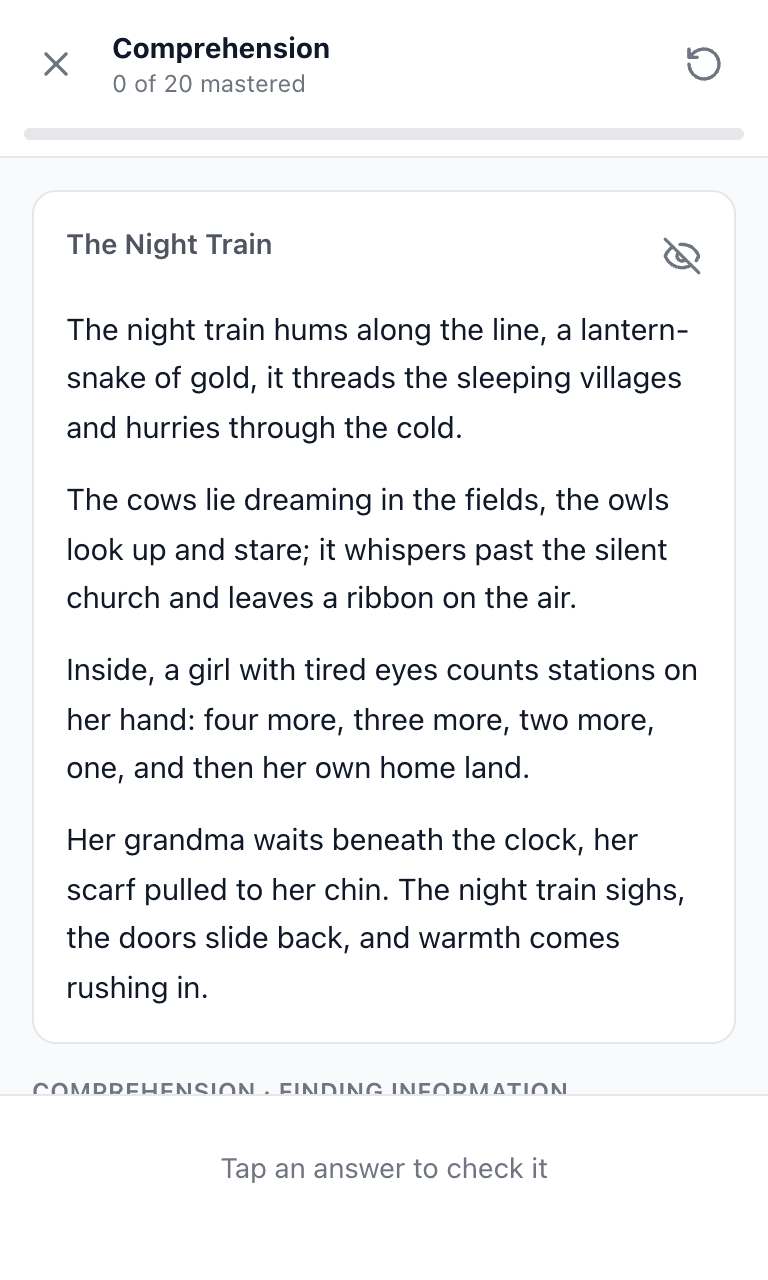
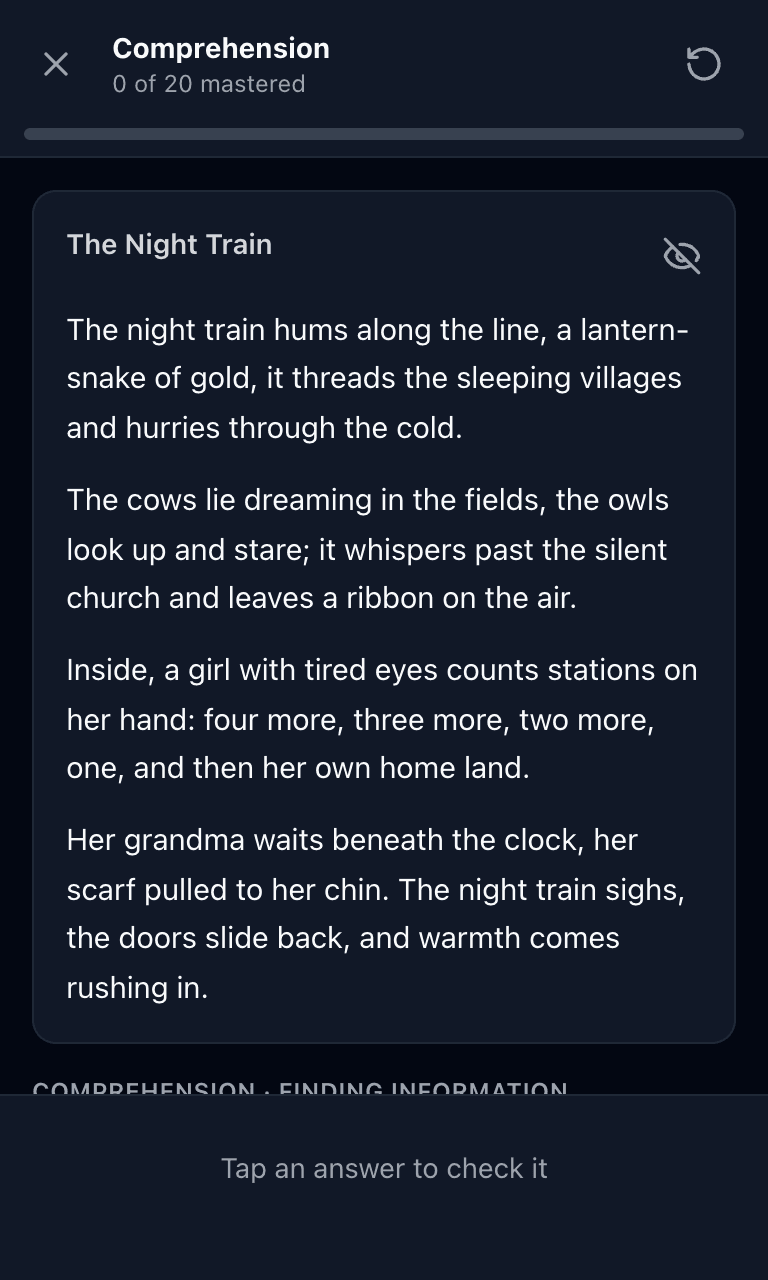
Train on mobile
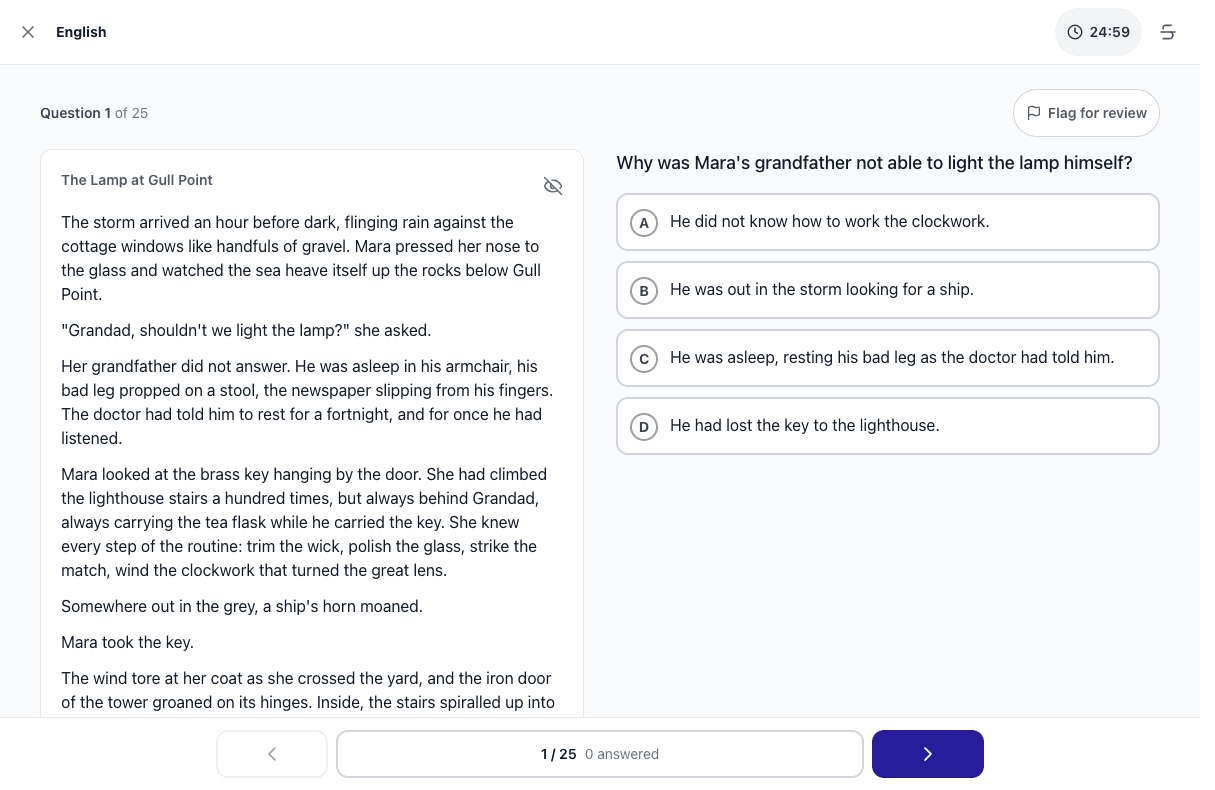
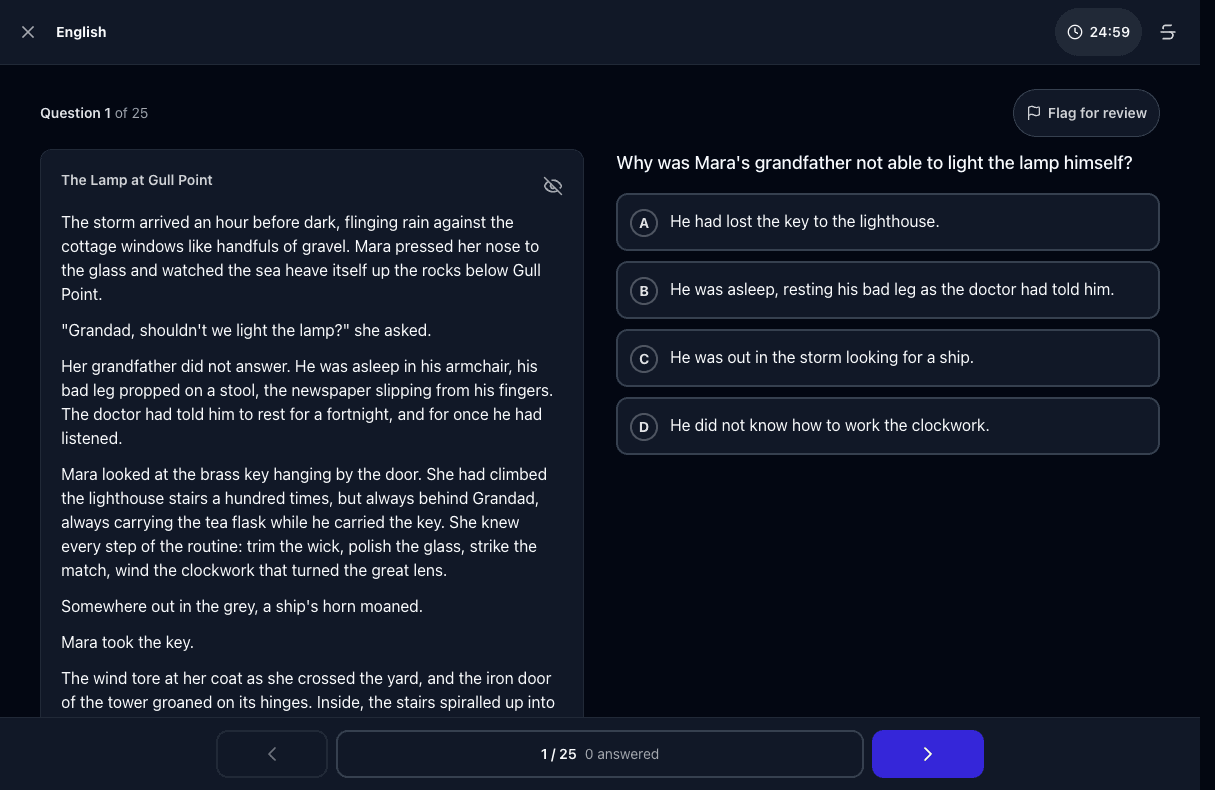
Test on desktop
The 11+ exam at a glance
The 11+ is the entrance test for grammar schools in parts of England and in Northern Ireland, usually sat in September of Year 6. There is no single national test: each area or school sets its own. Most multiple-choice 11+ tests are drawn from English (comprehension, spelling, punctuation and grammar), maths (Key Stage 2), verbal reasoning (word and code puzzles) and non-verbal reasoning (shape puzzles), with papers of about 45 to 60 minutes marked by computer. Raw marks are turned into an age-standardised score, and each area or school sets its own qualifying score.
Tigertest has two timed practice tests (English, Maths and Verbal Reasoning, 90 questions each) and six drills, four of which start with short click-through lessons on skills like hidden words, letter codes and fractions of amounts. Non-verbal reasoning is not covered. All of it is free with no account required.
- Who takes it
- Year 6 pupils applying to grammar schools, usually in September
- Papers
- English, maths, verbal reasoning and non-verbal reasoning; areas choose and combine them
- Format
- Multiple choice on a separate answer sheet, computer marked
- Typical length
- About 45 to 60 minutes a paper
- Passing score
- No single pass mark; an age-standardised score against a local qualifying score
- Set by
- Each local authority, consortium or grammar school
Updated by the Tigertest team. Practice questions follow the national curriculum in England for Key Stage 2 English and mathematics and the published formats of multiple-choice 11+ tests such as the Kent Test. Exam rules change, so confirm current details with Kent County Council: prepare for the Kent Test.
How It Works
Drills on a Phone or Tablet
Six drills, two for each paper. Comprehension, number and both verbal reasoning drills open with short lessons your child taps through, such as hidden words, letter codes or fractions of amounts. One tap checks each answer, an explanation follows straight away, and every miss comes back until it is learned.
Timed Practice Tests
English, Maths and Verbal Reasoning back to back with a short break between, a countdown clock and flag for review, so the timing on the day is not a surprise. Finish with a percent score for each paper and a list of what to drill next.
Built on the 11+ Papers
Each practice test is a shorter sitting of the three written 11+ papers, with English and maths taken from the Key Stage 2 national curriculum and verbal reasoning grouped by question type, as on the real paper. Results show which paper, and which question type, needs more work. Non-verbal reasoning is not included.

For Teachers and Tutors
Running an 11+ group or a Year 5 class? Set Tigertest as practice for free: share one link, pupils join with just their name, and you see who practised, their test scores and the question types your group misses most.
Make a class at tigertest.io/teachHow to Prepare for the 11+
1. Find out which papers your area uses
Every area runs its own 11+. Check the local authority or grammar school admissions page for which papers are sat, how long each one is and when the test takes place, usually September of Year 6.
2. Learn each verbal reasoning type once
Verbal reasoning is not taught at school, but each question type has a method that stays the same: read across the gap for hidden words, count the jumps for letter series, write the alphabet out for codes. The lessons at the start of each drill teach one method at a time.
3. Read every day
Comprehension, vocabulary and the word puzzles in verbal reasoning all get easier with wide reading. Stories, non-fiction and poems all help, and talking about new words afterwards helps most of all.
4. Practise against the clock last
Accuracy comes first, speed second. Once most drills are done, sit Practice Test 1 with the timer on, drill the weakest paper, then take Practice Test 2, whose questions never appear in the drills.
11+ Frequently Asked Questions
What is on the 11+?
It depends on where you live, because each area or grammar school sets its own test. Most multiple-choice 11+ tests are made from four kinds of paper: English (comprehension, spelling, punctuation and grammar), maths (Key Stage 2 content), verbal reasoning (word and code puzzles) and non-verbal reasoning (shape puzzles). Some areas use all four, some combine them into two booklets. Check your local authority or the school's admissions page to see which papers your child will sit.
Does Tigertest cover non-verbal reasoning?
Not yet. Non-verbal reasoning is entirely shapes and patterns, so it needs drawn figures for every question. Tigertest covers the three written papers: English, maths and verbal reasoning. If your area tests non-verbal reasoning too, practise it alongside.
Is this GL-style or CEM-style?
GL-style. The questions use the familiar multiple-choice formats: spot the part of a sentence with a mistake or choose No mistake, five answers to choose from in maths, and the classic verbal reasoning types such as hidden words, move a letter, letter codes and number series. Every question is original and written for Tigertest; none are taken from real papers or published practice books.
What score does my child need to pass the 11+?
There is no single pass mark. The real 11+ turns raw marks into an age-standardised score, so a younger child is not at a disadvantage, and each area or school sets its own qualifying score, which can change from year to year. Tigertest shows percent correct. As a rough guide, aim for 80 percent or more on a practice test, and higher for the most competitive schools.
When should my child start practising?
Most children sit the 11+ in September of Year 6, so practice usually starts in Year 5. A few short sessions a week is plenty: one drill takes about ten minutes on a phone or tablet. Leave the full practice tests until most drills are done, and keep Practice Test 2 for last, because its questions never appear in the drills.
What are the lessons before each drill?
Four of the six drills open with short click-through lessons. Each one teaches a single skill, such as reading across the gap to find a hidden word, counting jumps in the alphabet, cracking a letter code, finding a fraction of an amount or reading between the lines, and asks your child to supply each step rather than just watch. Two quick questions check it before the drill starts, and a missed question offers the lesson again.
Is the Tigertest 11+ practice free?
Yes, all of it: both practice tests, all six drills, every lesson and every explanation, with no account needed. An account saves progress across devices.
I teach an 11+ group or a Year 5 class. Can my students use Tigertest?
Yes, for free. Make a class at tigertest.io/teach, post one link, and students join with just their name. You see who practiced, their test scores and the topics your class misses most.
Related practice tests
Every test on Tigertest is free and needs no account to start.
- Times Tables Practice TestPrimary school · Year 2 to Year 4 MTC
- KS2 SATs Practice TestYear 6 SATs · Reading, GPS, Maths
- GCSE Maths Foundation Practice TestFoundation tier · AQA, Pearson Edexcel and OCR
- GCSE Maths Higher Practice TestAQA, Edexcel and OCR (England)
- GCSE Combined Science Practice TestGCSE double award · Biology, Chemistry, Physics
- GCSE Computer Science Practice TestAQA, OCR and Pearson Edexcel (England)
Ready for the 11+?
Free. No account needed. Two practice tests, six drills and the lessons, across English, maths and verbal reasoning.
Start practicing