
Free GCSE Combined Science Practice Test
Biology, chemistry and physics in two timed practice tests, plus six drills that teach the maths skills first. Free, no account needed.
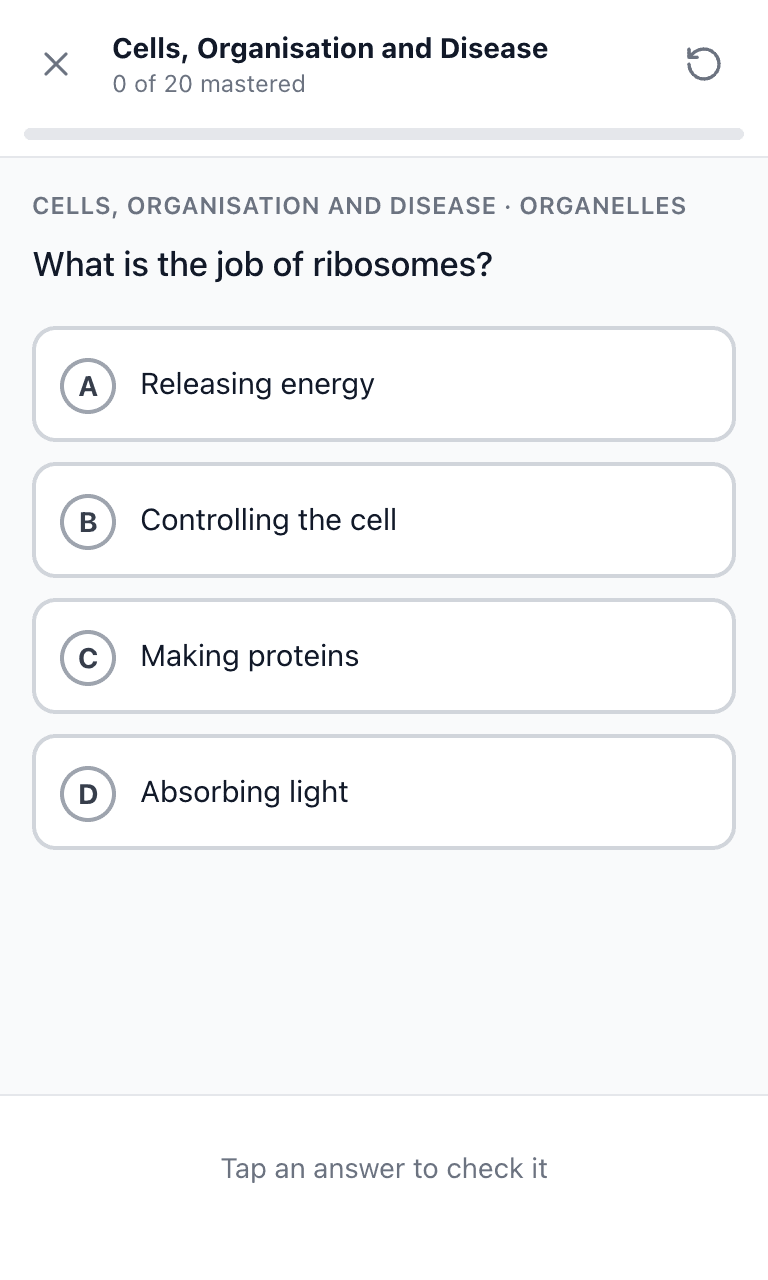
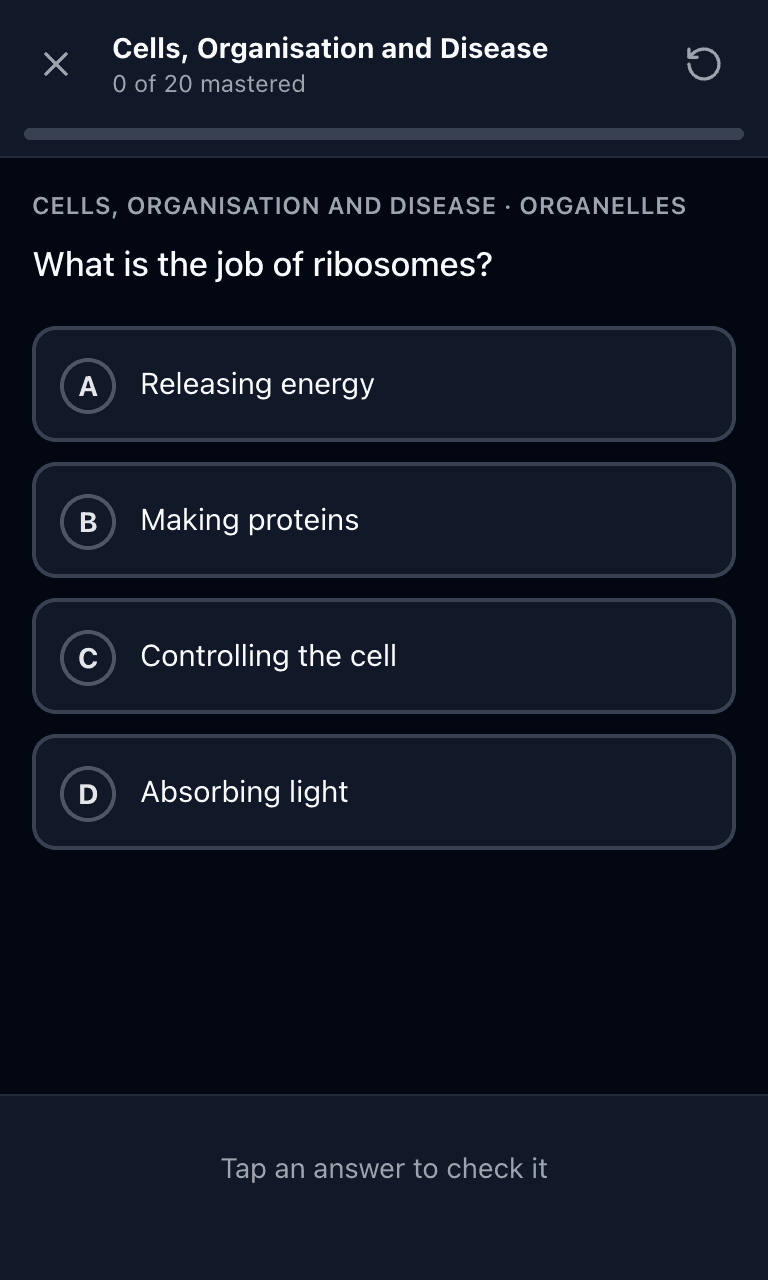
Train on mobile
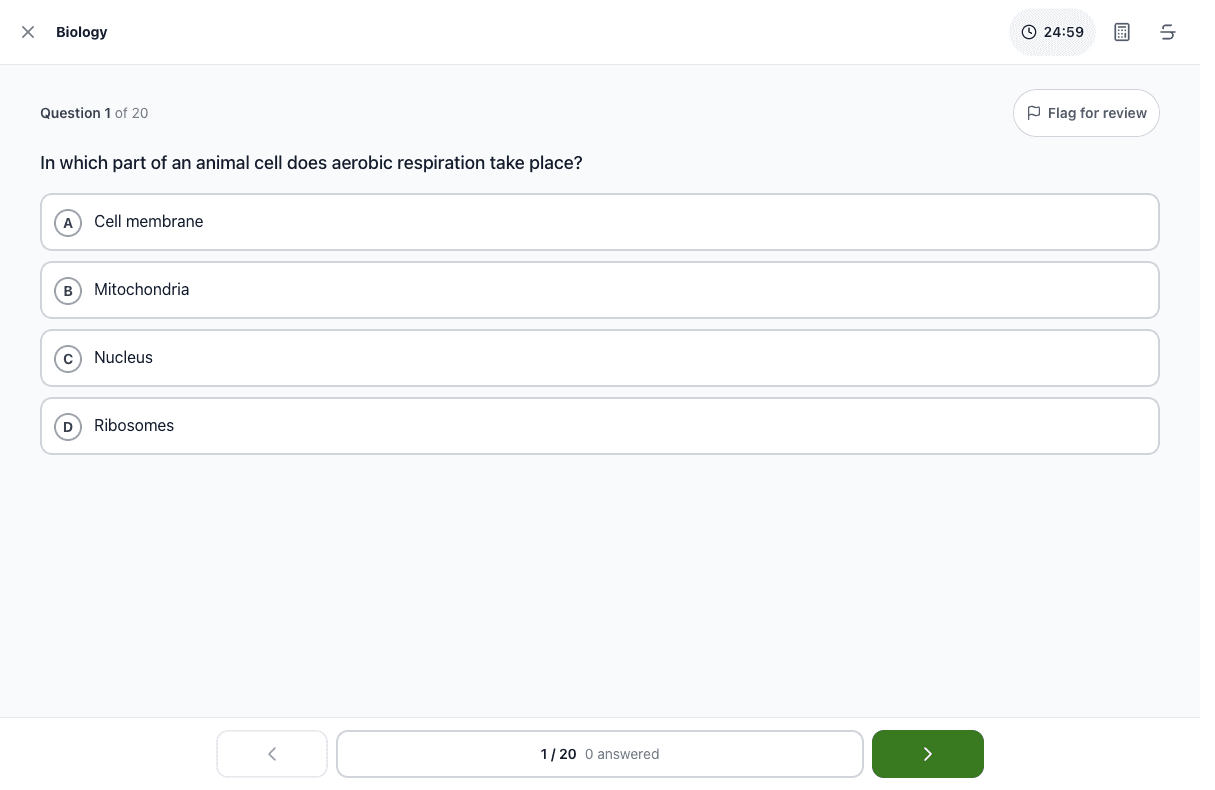
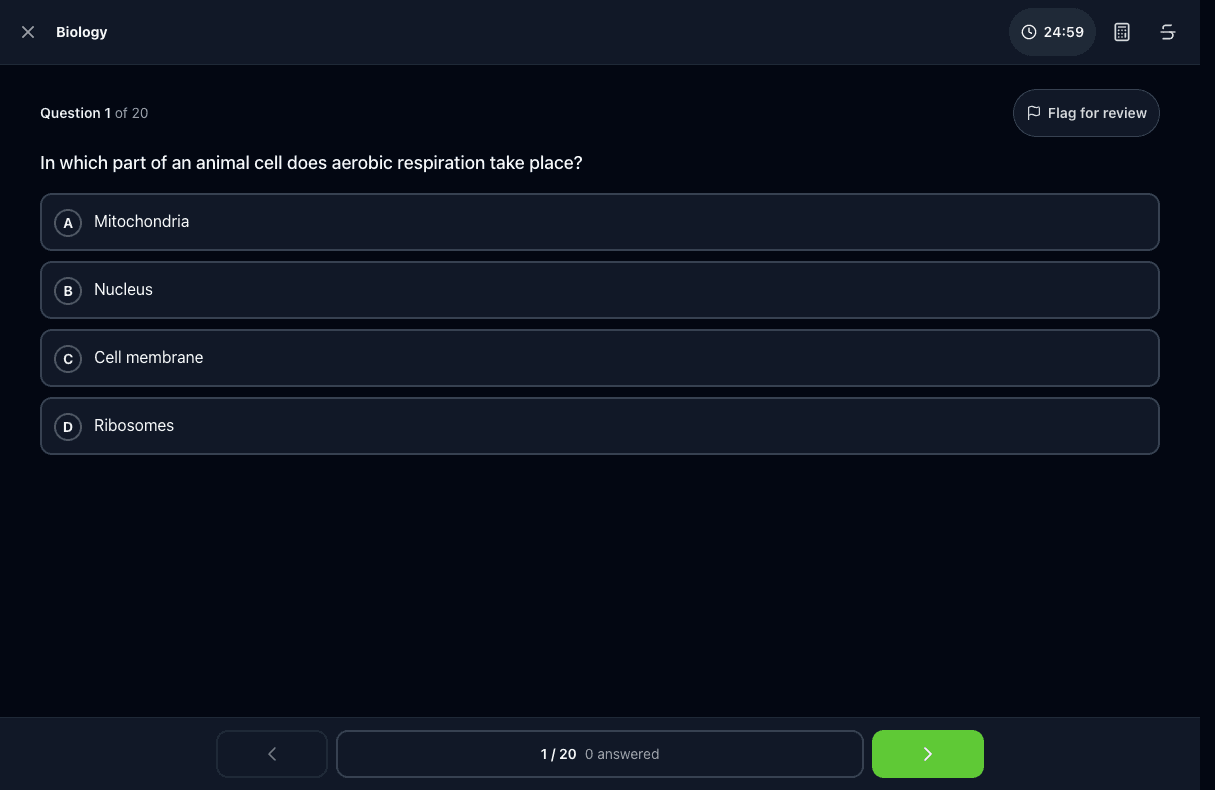
Test on desktop
The GCSE Science exam at a glance
GCSE Combined Science is a double award worth two GCSEs, taken by most students in England at the end of Year 11 and graded 9-9 down to 1-1. Students sit six written papers, two each for biology, chemistry and physics; on the most widely taken specification each paper lasts 1 hour 15 minutes, is worth 70 marks and counts for a sixth of the grade. There are Foundation (grades 1-1 to 5-5) and Higher (up to 9-9) tiers, calculators are allowed, and for the 2025 to 2027 exams every candidate is given a physics equation sheet.
Tigertest has two timed practice tests (20 biology, 20 chemistry and 20 physics questions each) and six drills split by paper 1 and paper 2 topics, four of which start with short lessons on the maths skills. All of it is free with no account required.
- Who takes it
- Most Year 11 students in England, in May and June
- Papers
- Six: two biology, two chemistry, two physics
- Time
- 1 hour 15 minutes a paper on the largest specification
- Grades
- 9-9 to 1-1 (double award); Foundation tier up to 5-5
- Given on the day
- Calculator; physics equation sheet (2025 to 2027)
- Set by
- Exam boards (AQA, Pearson Edexcel, OCR, Eduqas) on DfE subject content
Updated by the Tigertest team. Practice questions follow the Department for Education GCSE combined science subject content and the 2024 decision on equation sheets for 2025 to 2027. Exam rules change, so confirm current details with Department for Education: GCSE combined science subject content.
How It Works
Topic Drills on Your Phone
Six drills, one for each science's paper 1 and paper 2 topics. Four open with short lessons on the maths skills behind the questions: magnification, variables, relative formula mass, balancing equations, and using and rearranging physics equations. One tap to check, an explanation straight away, and every miss comes back until you have mastered it.
Timed Practice Tests
Biology, chemistry and physics in three 25-minute sections with a short break between them, a calculator, the physics equation sheet and flag for review. Finish with a percent score for each science and each topic group, so you know what to revise next.
Built on the GCSE Subject Content
Each practice test follows the Department for Education subject content for GCSE combined science, split the way the papers are: paper 1 and paper 2 topics for each science. Your results show which group of topics is holding you back.

Teach GCSE Science?
Science teachers and tutors can set it for a class for free: share one link, students join with just their name, and you see who has practised, their test scores and the topics your class misses most.
Make a class at tigertest.io/teachHow to Revise for GCSE Combined Science
1. Get the maths marks first
A good share of the marks need maths: magnification, relative formula mass, reading graphs and using physics equations. These are the most reliable marks to gain, because the method is the same every time. Start with the lessons inside the drills, then practise until the steps are automatic.
2. Know your required practicals
Every paper asks about practical work. For each required practical, be able to name the independent, dependent and control variables, describe the method in order and say what the results show.
3. Little and often, one topic group at a time
Ten minutes a day on one drill beats a long session the night before. Each drill brings back the questions you missed until you get them right, which is how facts like gas tests, hormone names and the electromagnetic spectrum stick.
4. Sit a practice test before your mocks
Take Practice Test 1 to see where you stand, drill the weakest topic group, then take Practice Test 2. Its questions never appear in the drills, so it is an honest check of what you know.
GCSE Combined Science FAQ
What is in the GCSE Combined Science exam?
GCSE Combined Science is a double award worth two GCSEs, graded from 9-9 down to 1-1. Students sit six written papers, two each for biology, chemistry and physics, and on the most widely taken specification each paper lasts 1 hour 15 minutes. Questions range from multiple choice to calculations and longer written answers. The Tigertest practice test covers the same three sciences in three 25-minute sections.
Is this for Foundation or Higher tier?
It is written for Foundation tier, which leads to grades 1-1 to 5-5, and for Higher tier students who want to secure the core content. It covers the topics both tiers share and leaves out most Higher-only content, such as moles, Le Chatelier's principle and the motor effect equation.
Do I need to learn the physics equations?
For the 2025, 2026 and 2027 exams, the Department for Education decided that students do not need to memorise most physics equations, so every candidate is given an equation sheet. You still need to know how to choose the right equation, substitute values, rearrange it and convert units. Tigertest gives the equation in each question and the full sheet in the tools drawer, and the physics drills open with short lessons on using and rearranging equations.
Are the required practicals included?
Yes, as written questions, the way the exam tests them: identifying independent, dependent and control variables, putting a method in order, reading results and spotting why a step is done. Examples include osmosis in potato cylinders, the amylase and iodine test, rates with a disappearing cross, making a soluble salt, specific heat capacity and quadrat sampling.
Which exam board does it follow?
It follows the Department for Education subject content for GCSE combined science, which every exam board's combined science specification is built on, so it suits AQA Trilogy, Edexcel, OCR and Eduqas students alike. Questions are original and use board-neutral wording; check your own specification for the exact topic list and paper order.
What score should I aim for?
Grade boundaries change every year, so there is no fixed percentage for each grade. Aim for 60 percent or better on a practice test as a solid Foundation target, then use your results by topic to choose which drill to do next.
Is it free?
Yes, all of it: both practice tests, all six drills, the lessons and every explanation, with no account needed. An account saves progress across devices.
I teach a GCSE science class. Can my students use Tigertest?
Yes, for free. Make a class at tigertest.io/teach, post one link, and students join with just their name. You see who practiced, their test scores and the topics your class misses most.
Related practice tests
Every test on Tigertest is free and needs no account to start.
- Times Tables Practice TestPrimary school · Year 2 to Year 4 MTC
- KS2 SATs Practice TestYear 6 SATs · Reading, GPS, Maths
- 11+ Practice TestGrammar school entry · English, maths, verbal reasoning
- GCSE Maths Foundation Practice TestFoundation tier · AQA, Pearson Edexcel and OCR
- GCSE Maths Higher Practice TestAQA, Edexcel and OCR (England)
- GCSE Computer Science Practice TestAQA, OCR and Pearson Edexcel (England)
Ready to Revise?
Free. No account required. Two practice tests, six drills and the maths skills, all three sciences.
Start practicing