
Free GCSE Maths Foundation Practice
Two full sets of Foundation practice papers, non-calculator and calculator, plus five topic drills that teach the basics first. Free, no account needed.
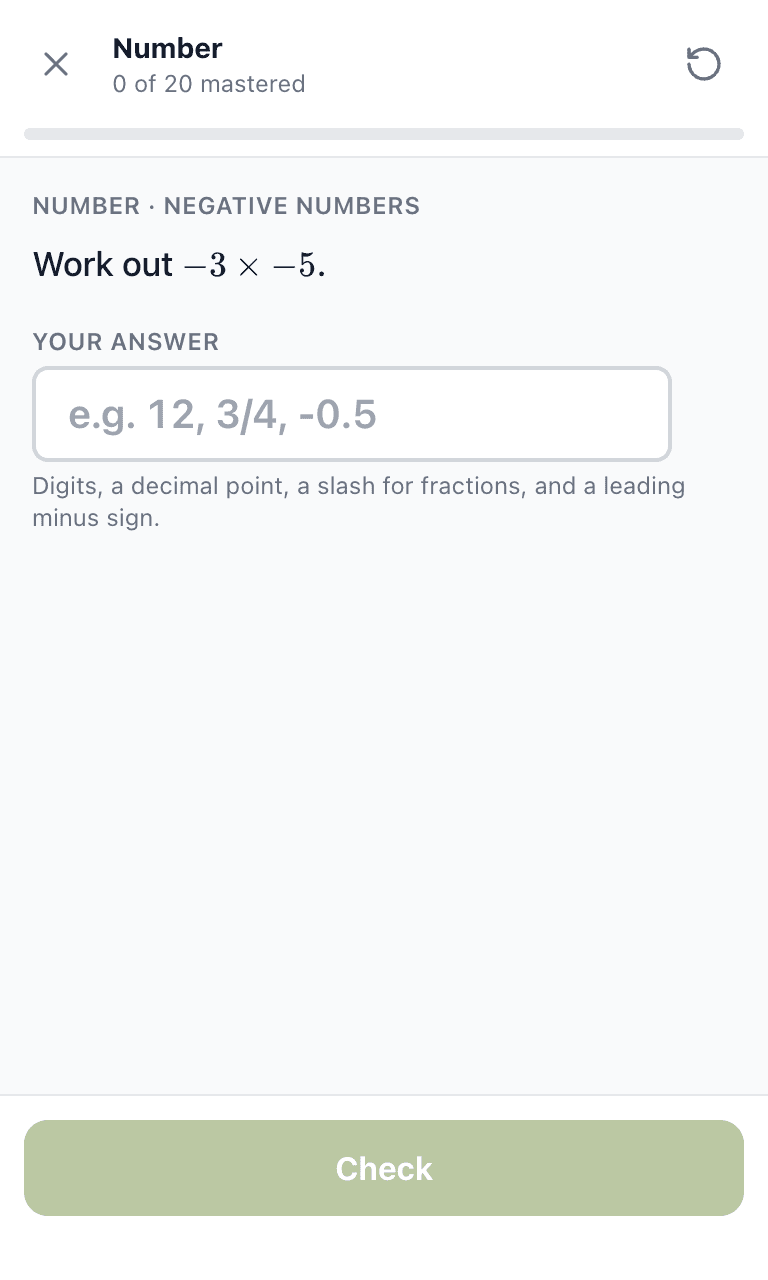
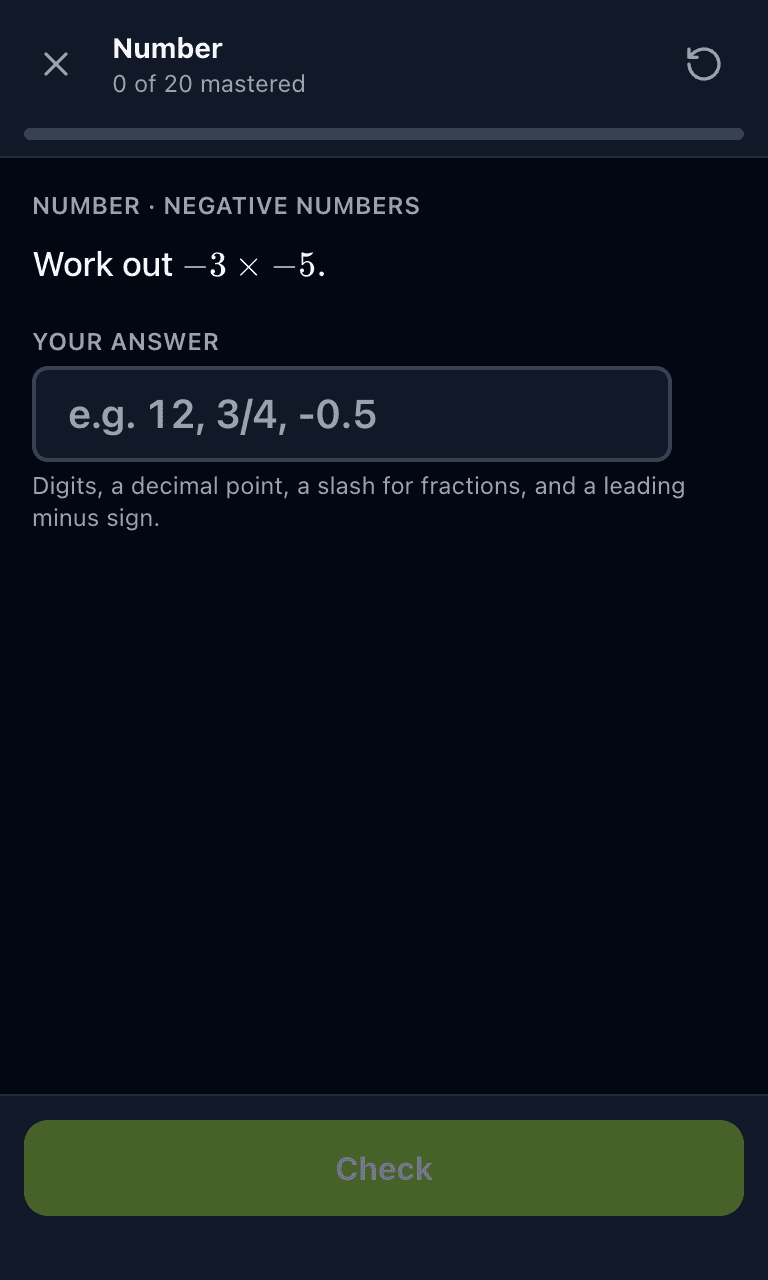
Train on mobile
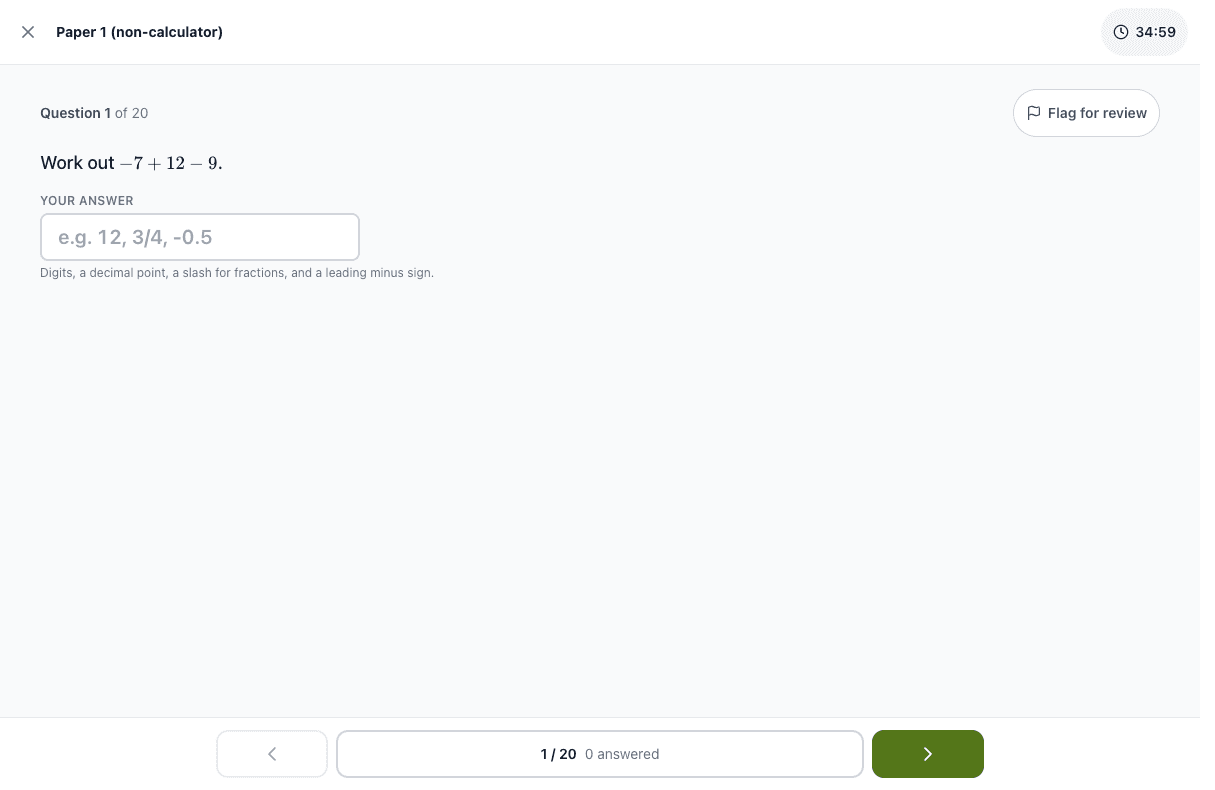
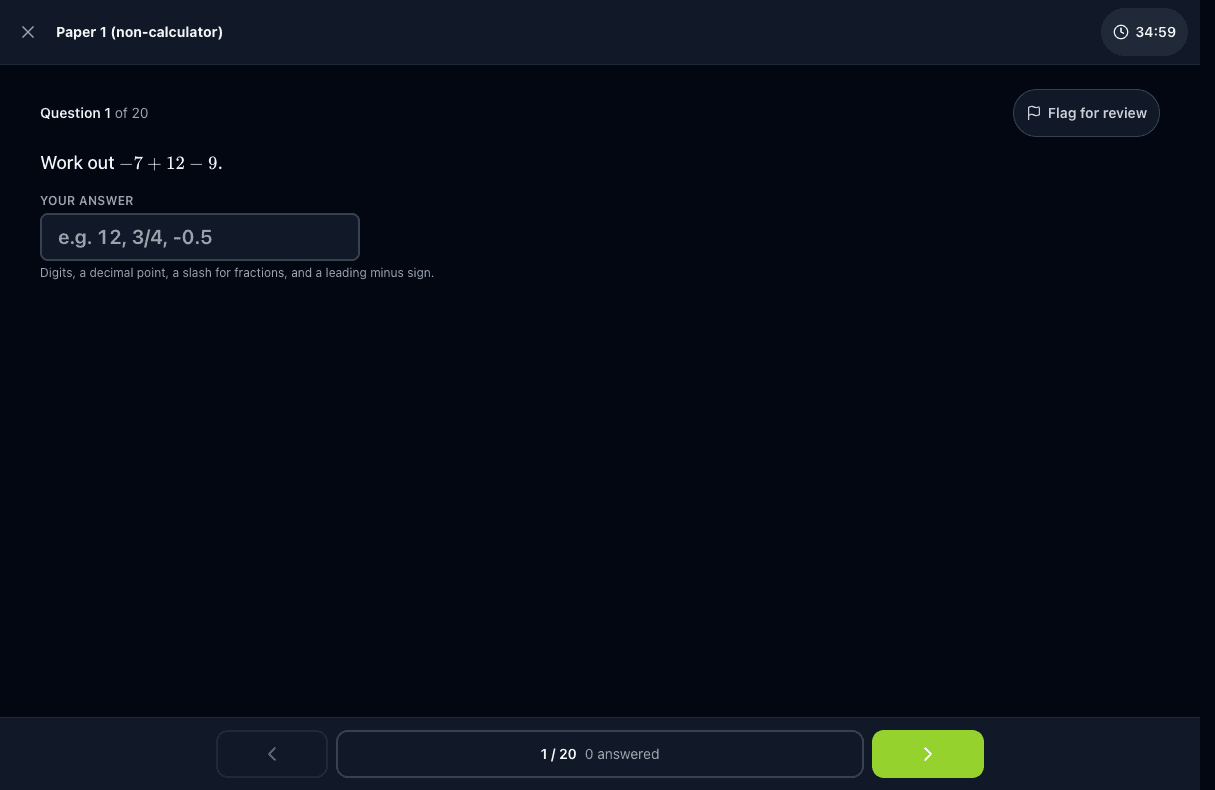
Test on desktop
The GCSE Maths exam at a glance
GCSE Mathematics in England is three written papers of 1 hour 30 minutes and 80 marks each: Paper 1 is non-calculator, and Papers 2 and 3 allow a calculator. The Foundation tier is graded 1 to 5 (4 is a standard pass, 5 a strong pass); about 25% of the marks are number, 20% algebra, 25% ratio, proportion and rates of change, 15% geometry and measures and 15% probability and statistics. AQA, Pearson Edexcel and OCR all follow the same Department for Education subject content, and grade boundaries are set after each exam.
Tigertest has two practice tests, each three timed papers of 20 questions (non-calculator, calculator, calculator) weighted like the Foundation tier, and five topic drills that open with short lessons on the basics. Every question has one final answer; the real papers also give marks for working. All of it is free with no account required.
- Papers
- 3 papers, 1 hour 30 minutes and 80 marks each
- Calculator
- Not on Paper 1; allowed on Papers 2 and 3
- Grades
- Foundation tier 1 to 5; 4 is a standard pass, 5 a strong pass
- Topics
- Number 25%, algebra 20%, ratio 25%, geometry 15%, probability and statistics 15%
- Pass mark
- Boundaries change by board and year; recently about 60% to 67% for a grade 4
- Exam boards
- AQA, Pearson Edexcel and OCR, same DfE subject content
Updated by the Tigertest team. Practice questions follow the Department for Education GCSE mathematics subject content (2013) and Ofqual's Foundation tier weightings, checked October 2026. Exam rules change, so confirm current details with GOV.UK: GCSE mathematics subject content and assessment objectives.
How It Works
Topic Drills on Your Phone
Five drills, one per topic area. Each opens with short lessons you tap through, like adding fractions or finding a percentage change, then 20 exam-style questions from easy to hard. One tap to check, a worked explanation straight away, and every miss comes back until you have mastered it.
Practice Papers
Three timed papers per practice test, easiest questions first like the real thing: Paper 1 with no calculator, Papers 2 and 3 with one. Flag questions to come back to, then get a score for each paper, your weakest topics and a plan for what to drill next.
Weighted Like the Foundation Tier
Every practice paper follows the Department for Education subject content and the Foundation tier topic weightings that AQA, Pearson Edexcel and OCR all use, so the topics you practise most are the ones worth the most marks.

Teach a GCSE Maths Class?
Set it as homework or resit practice for free: share one link, students join with just their name, and you see who practised, their paper scores and the topics your class finds hardest.
Make a class at tigertest.io/teachHow to Get a Grade 4 or 5
1. Secure the early marks
Foundation papers start easy and get harder. The first half of each paper is where most grade 4 marks are, so fix slips on negative numbers, fractions, percentages and basic angles before chasing the hard questions at the end.
2. Practise without a calculator
A third of the marks are on the non-calculator paper. Written methods for multiplying decimals, dividing fractions and finding 15% of an amount win marks there, and the Number and Algebra drills are built around them.
3. Learn the basics the drills open with
If a drill feels hard, go back to its lessons. Each one teaches one method, step by step, and asks you to supply each step, so you can do it on your own in the exam rather than just recognise it.
4. Show your working in the real exam
The real papers give method marks even when the final answer is wrong. Tigertest only checks the final answer, so on the day write every step down: it can turn a wrong answer into two or three marks.
GCSE Maths Foundation Questions
What is on the GCSE Maths Foundation exam?
Three papers of 1 hour 30 minutes, each worth 80 marks: Paper 1 is non-calculator, and Papers 2 and 3 allow a calculator. Every paper can test any topic. At Foundation tier about 25% of the marks are number, 20% algebra, 25% ratio, proportion and rates of change, 15% geometry and measures, and 15% probability and statistics. AQA, Pearson Edexcel and OCR all follow the same Department for Education subject content.
What grades can you get on the Foundation tier?
Grades 1 to 5. A grade 4 is a standard pass and a grade 5 a strong pass, and grade 5 is the highest grade available on Foundation. Grade boundaries are set after each exam and change by board and year; in recent years a grade 4 on Foundation has needed roughly 60% to 67% of the marks and a grade 5 roughly 73% to 78%.
How is the Tigertest practice test marked?
Each practice test is the three papers cut to 20 questions each, with the same topic weighting as the real Foundation tier. Every question has one final answer you type or tap, and it is marked right or wrong straight away with a worked explanation. The real papers give marks for working, so a question worth several marks there is one answer here. Your score is a percentage per paper and overall; aim for about 65% for a grade 4 and 75% for a grade 5.
Can I use a calculator?
Not on Paper 1, just like the real exam, so it trains the written methods for fractions, decimals and percentages. Papers 2 and 3 have a calculator in the tools drawer, or use your own. The drills have no built-in calculator and most of their numbers are friendly, but keep your own calculator handy for the few calculator-paper questions in them.
I need to resit GCSE Maths. Will this help?
Yes. Most resit students sit the Foundation tier and need a grade 4. Start with the drill for your weakest topic: each one opens with short lessons on the basics it needs, like fractions, BIDMAS or percentage change, before the exam-style questions. Then take Practice Test 1 to see where you stand, and Practice Test 2, which never appears in the drills, as an honest check before the real papers.
Is it free?
Yes, all of it: both practice tests, all five drills, every lesson and every explanation, with no account needed. An account saves your progress across devices, so you can practise on your phone on the bus and on a laptop at home.
I teach GCSE Maths. Can my students use Tigertest?
Yes, for free. Make a class at tigertest.io/teach, post one link, and students join with just their name. You see who practiced, their test scores and the topics your class misses most.
Related practice tests
Every test on Tigertest is free and needs no account to start.
- Times Tables Practice TestPrimary school · Year 2 to Year 4 MTC
- KS2 SATs Practice TestYear 6 SATs · Reading, GPS, Maths
- 11+ Practice TestGrammar school entry · English, maths, verbal reasoning
- GCSE Maths Higher Practice TestAQA, Edexcel and OCR (England)
- GCSE Combined Science Practice TestGCSE double award · Biology, Chemistry, Physics
- GCSE Computer Science Practice TestAQA, OCR and Pearson Edexcel (England)
Ready to Start?
Free. No account needed. Start with the drill for your weakest topic.
Start practicing