
Free GCSE Maths Higher Practice Test
Two full practice tests of three timed papers, Paper 1 without a calculator, plus five topic drills for grades 4 to 9. Free, no account needed.
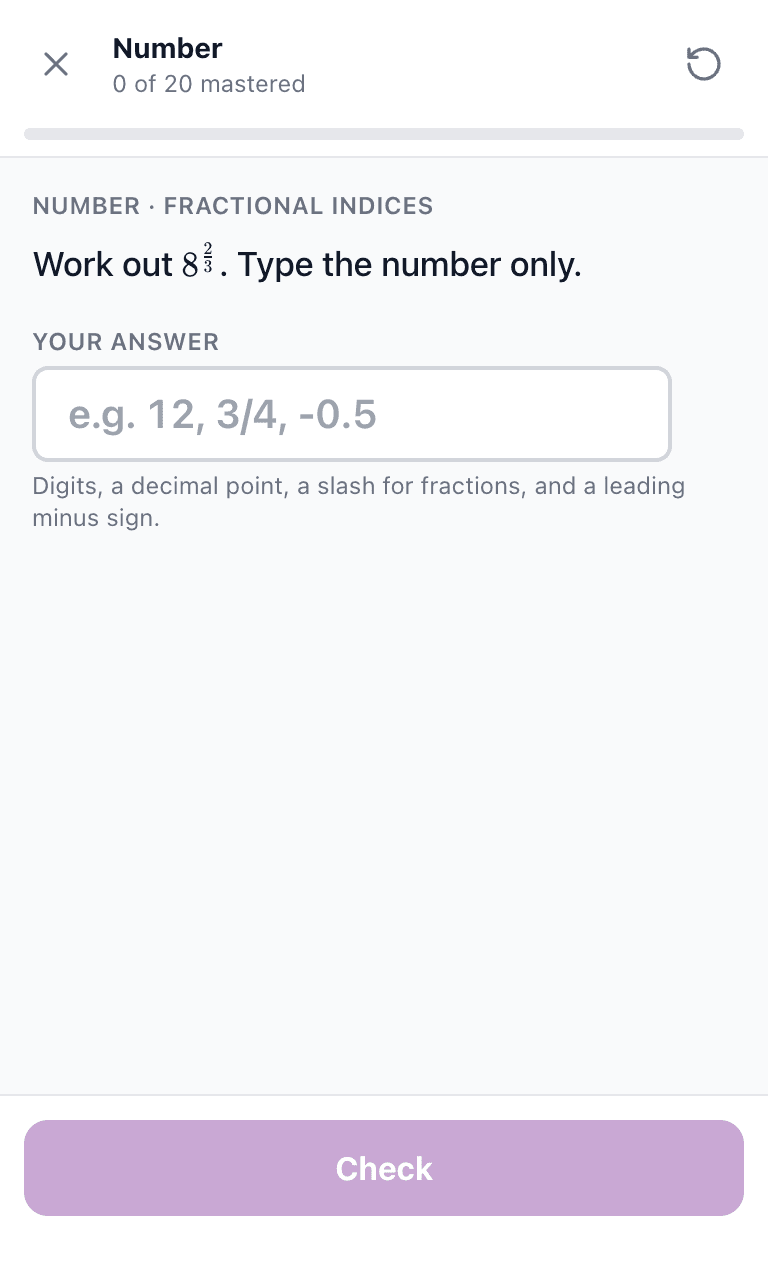
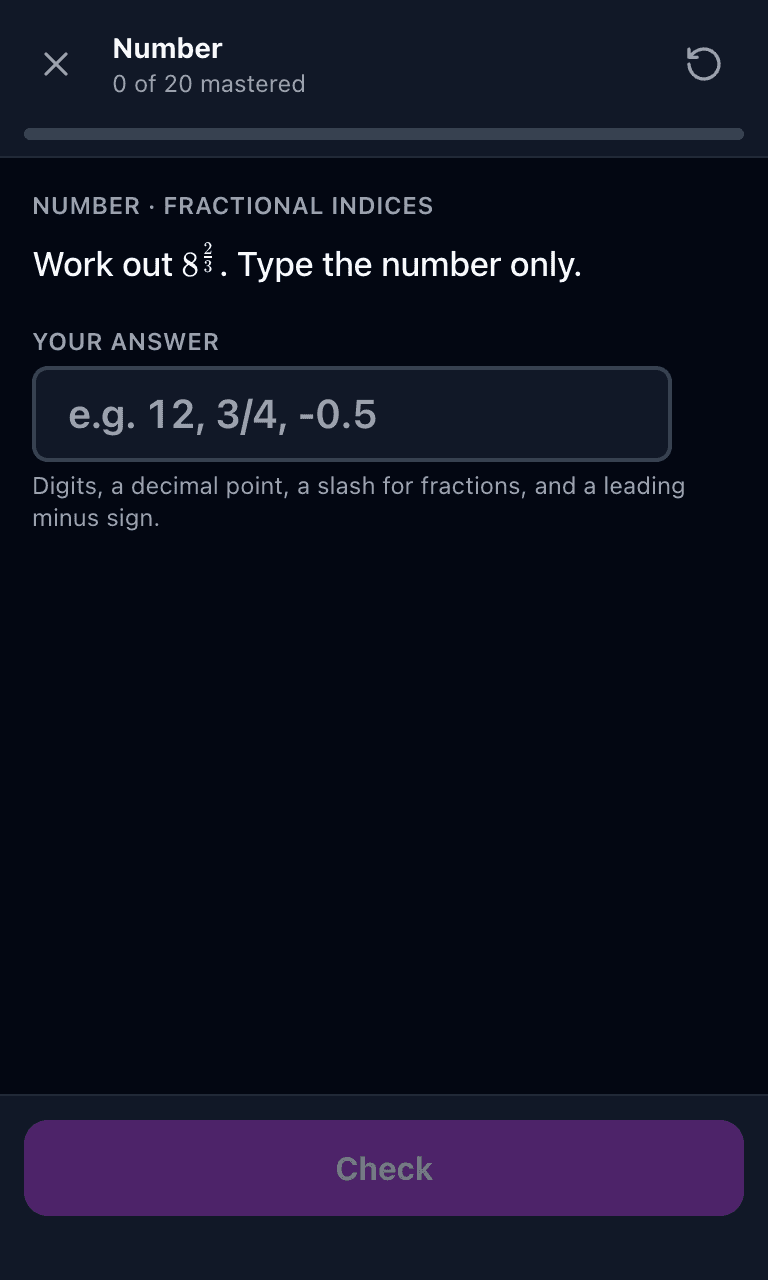
Train on mobile
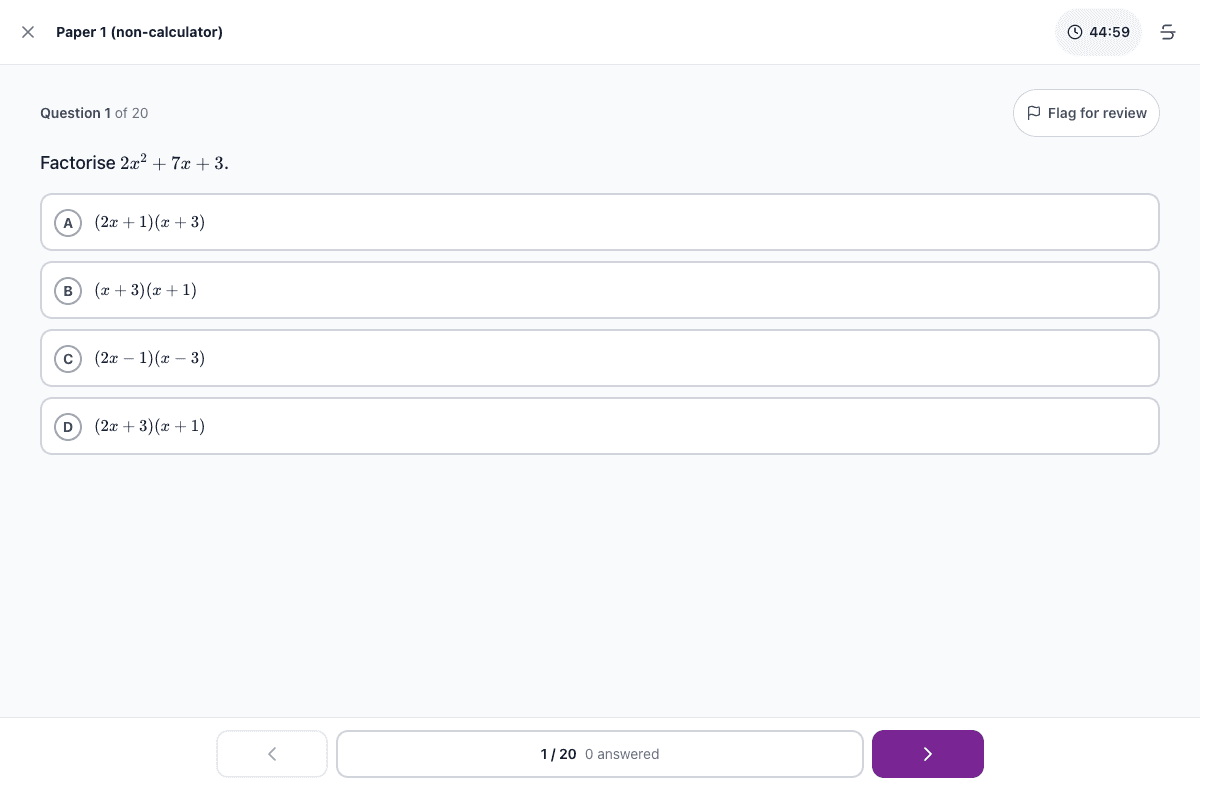
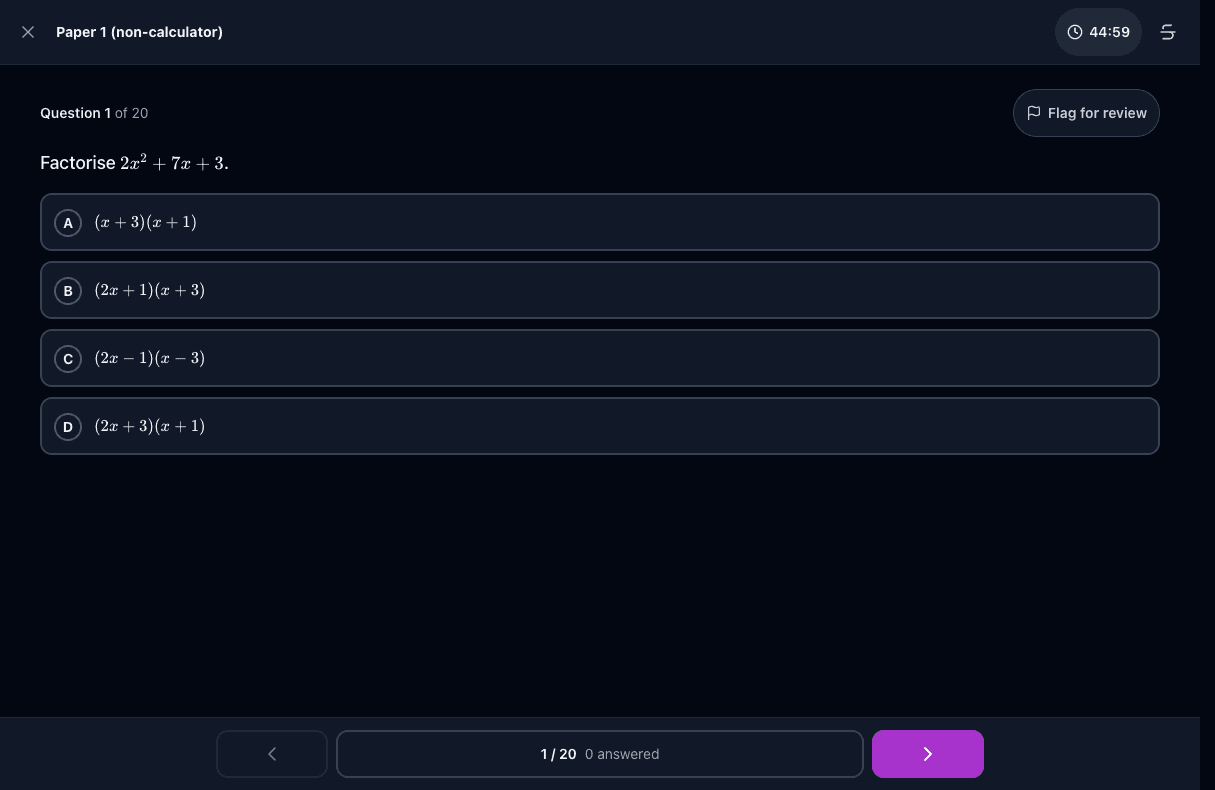
Test on desktop
The GCSE Maths Higher exam at a glance
GCSE Mathematics Higher tier is three written papers sat at the end of Year 11 in England: 1 hour 30 minutes and 80 marks each, with Paper 1 non-calculator and Papers 2 and 3 calculator. Any topic can appear on any paper, weighted 30% algebra, 20% ratio, proportion and rates of change, 20% geometry and measures, 15% number and 15% probability and statistics. Higher tier awards grades 9 to 4, with an allowed grade 3, and grade boundaries are set after each exam series.
Tigertest has two GCSE Maths Higher practice tests of three timed papers each (20 questions per paper, Paper 1 without a calculator) and five topic drills, four of which open with short Basics lessons. All of it is free with no account required; scores are percent correct, not grades.
- Who takes it
- Year 11 students in England (and resit students), usually in May and June
- Papers
- 3 papers, 1 hr 30 min and 80 marks each (240 marks)
- Calculator
- Paper 1 non-calculator; Papers 2 and 3 calculator
- Grades
- 9 to 4, with an allowed grade 3; boundaries change each year
- Content weighting
- Algebra 30%, ratio 20%, geometry 20%, number 15%, probability and statistics 15%
- Given by
- AQA, Pearson Edexcel or OCR, to the DfE subject content
Updated by the Tigertest team. Practice questions follow the Department for Education's GCSE mathematics subject content and assessment objectives (2013) and its Higher tier weightings. Exam rules change, so confirm current details with DfE: GCSE mathematics subject content and assessment objectives.
How It Works
Topic Drills on Your Phone
One drill per topic area, 20 non-calculator questions each. Check every answer as you go, read why it is right, and every miss comes back until you get it. Four drills start with short Basics lessons you can skip.
Full Three-Paper Tests
Paper 1 without a calculator, Papers 2 and 3 with the on-screen calculator, timed with a break between. Flag questions, go back, then see your score by paper and by topic.
Weighted Like the Higher Tier
Every paper follows the Department for Education's Higher tier weightings, so algebra gets the most practice, with plenty of the Higher-only topics that decide grades 7 to 9.

Teach a Year 10 or 11 Class?
Set it as revision for free: share one link, students join with just their first name, and you see who practised, their paper scores and the topics your class finds hardest.
Make a class at tigertest.io/teachHow to Revise for GCSE Maths Higher
1. Start with algebra
Algebra is 30% of the Higher papers and turns up inside geometry and ratio questions too. Secure factorising, solving quadratics and rearranging formulae first, and many other topics get easier.
2. Practise without a calculator
Paper 1 is a third of the marks. Surds, exact trig values, fractional indices and fraction arithmetic all need to be done by hand, which is why every drill here is non-calculator.
3. Learn the formulae you are not given
The quadratic formula, the sine and cosine rules, the area of a triangle using sine, and compound interest are not printed on the paper. Formulae for the volume of a cone or sphere are given in the question when needed.
4. Sit a full paper under time
Once the drills are green, take Practice Test 2 in one sitting with the clock on. It is kept out of the drills, so the score shows what you can do on questions you have not seen.
GCSE Maths Higher Questions
What is on the GCSE Maths Higher tier exam?
Three papers of 1 hour 30 minutes and 80 marks each, all sat at the end of Year 11. Paper 1 is non-calculator; Papers 2 and 3 allow a calculator. Every paper can test any topic, and Higher tier content is weighted 30% algebra, 20% ratio, proportion and rates of change, 20% geometry and measures, 15% number, and 15% probability and statistics. AQA, Pearson Edexcel and OCR all follow this structure because it comes from the Department for Education's subject content.
What grades can you get on the Higher tier?
Grades 4 to 9, with an allowed grade 3 for students who just miss grade 4. Grade boundaries are set after each exam series and change from year to year, so there is no fixed percentage for a grade. In June 2025, for example, Pearson Edexcel's Higher tier needed 53 of 240 marks (about 22%) for a grade 4 and 217 (about 90%) for a grade 9; other boards and other years differ.
Should I sit Higher or Foundation?
Foundation covers grades 1 to 5 and Higher covers 4 to 9, so a student aiming for grade 6 or above has to sit Higher. A student who is secure at grade 4 or 5 but not yet higher can do better on Foundation, where the top grade is 5. Your maths teacher decides entries, usually from mock results. If Foundation is right for you, Tigertest has a separate GCSE Maths Foundation practice test.
How is the Tigertest practice test set out?
Each practice test is three papers of 20 questions in 45 minutes, with the same mix of topics and the same calculator rules as the real papers, and a 10-minute break between them. Questions are multiple choice or a typed answer, marked right or wrong, so your score is a percentage rather than a grade. Practice Test 2 is kept out of the drills so it gives a clean measure of where you are.
What are the drills?
Five topic drills, one for each content area: number, algebra, ratio and proportion, geometry and measures, and probability and statistics. Each is 20 non-calculator questions that run from grade 4 style to grade 8 and 9 style, and every miss comes back until you get it right. Four drills open with short Basics lessons (indices, factorising, percentage change, SOH CAH TOA and more) that you can skip if you already know them.
Is it free?
Yes, all of it: both practice tests, all five drills, the Basics lessons and every explanation, with no account required. An account saves your progress across a phone and a laptop.
I teach a Year 10 or Year 11 maths class. Can my students use Tigertest?
Yes, for free. Make a class at tigertest.io/teach, post one link, and students join with just their name. You see who practiced, their test scores and the topics your class misses most.
Related practice tests
Every test on Tigertest is free and needs no account to start.
- Times Tables Practice TestPrimary school · Year 2 to Year 4 MTC
- KS2 SATs Practice TestYear 6 SATs · Reading, GPS, Maths
- 11+ Practice TestGrammar school entry · English, maths, verbal reasoning
- GCSE Maths Foundation Practice TestFoundation tier · AQA, Pearson Edexcel and OCR
- GCSE Combined Science Practice TestGCSE double award · Biology, Chemistry, Physics
- GCSE Computer Science Practice TestAQA, OCR and Pearson Edexcel (England)