
Free DAT Practice Test 2026
214 original questions in biology, general and organic chemistry, reading comprehension and quantitative reasoning. Free to start, no account needed.
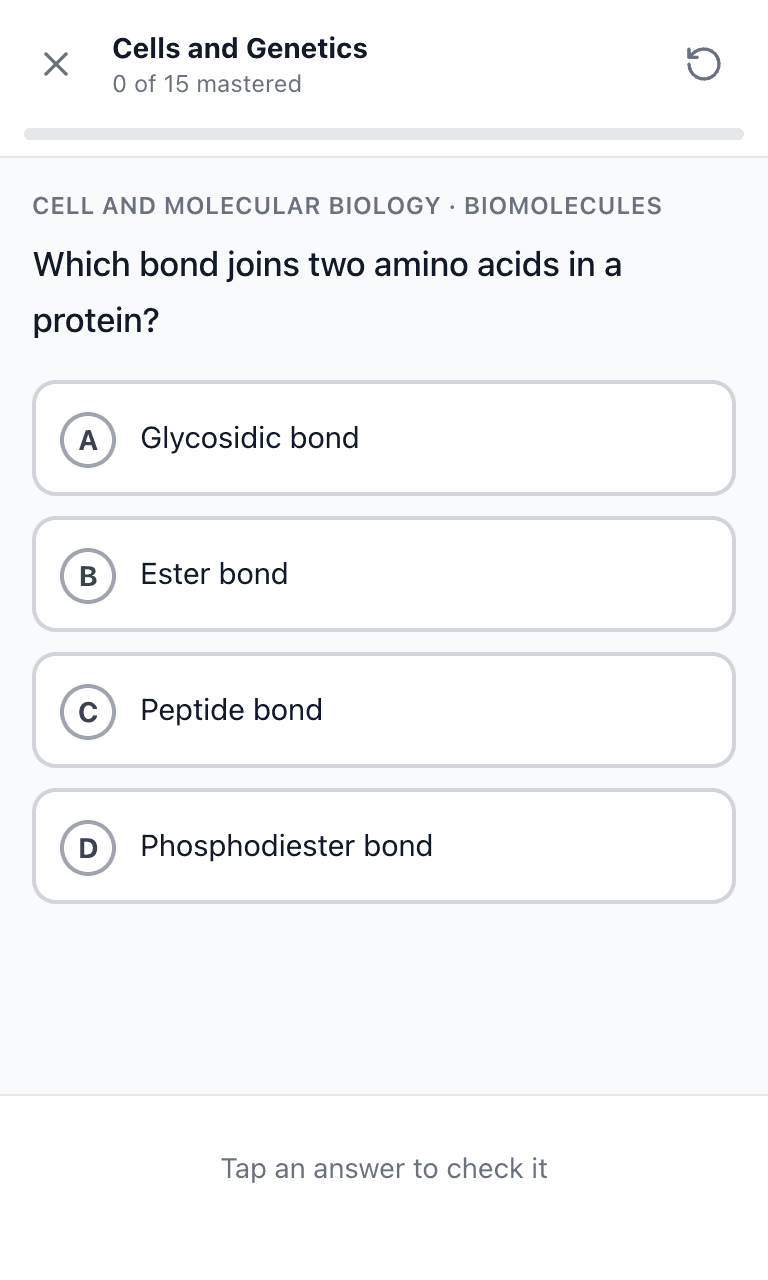
Train on mobile
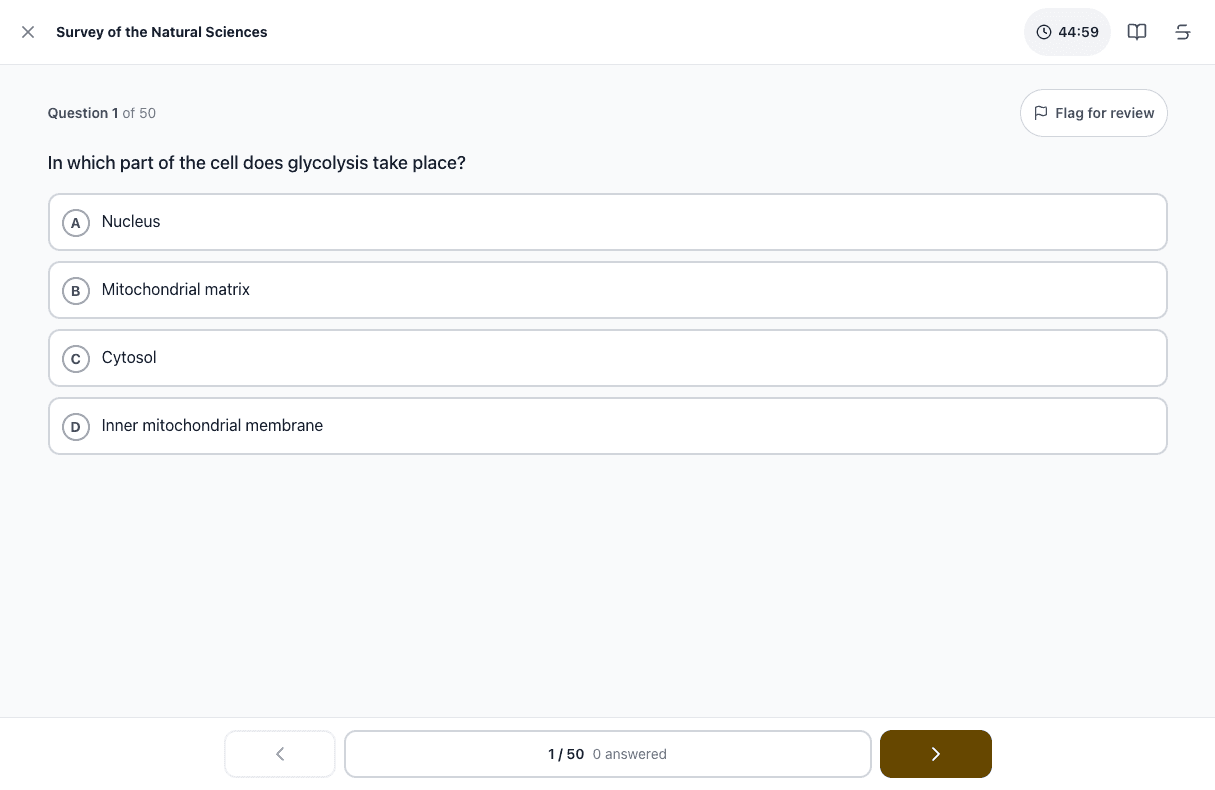
Test on desktop
The DAT exam at a glance
The DAT is the American Dental Association's computer-based Dental Admission Test, with four multiple-choice sections in this order: the Survey of the Natural Sciences (100 questions in 90 minutes: 40 biology, 30 general chemistry and 30 organic chemistry), the Perceptual Ability Test (90 questions in 60 minutes in six picture subtests), an optional 30-minute break, Reading Comprehension (50 questions on three scientific passages in 60 minutes) and Quantitative Reasoning (40 questions in 45 minutes, with an on-screen calculator). Since March 1, 2025 scores are reported from 200 to 600 in 10-point steps; there is no official passing score, each dental program decides what it accepts, and there is no penalty for guessing.
Tigertest has two DAT practice tests with the Survey of the Natural Sciences, Reading Comprehension and Quantitative Reasoning at half length and the real pace, and seven drills by topic. The picture-based Perceptual Ability Test is not included. It is free to start, with no account required.
- Sections
- Natural Sciences, Perceptual Ability, Reading, Quantitative
- Questions
- 280: 100, 90, 50 and 40
- Time
- 4 hr 15 min of testing; 5 hr 15 min with tutorial, break and survey
- Score
- 200 to 600 in 10-point steps; no official passing score
- Calculator
- On-screen, Quantitative Reasoning only; periodic table in General Chemistry
- Retakes
- 60 days apart, at most four in 12 months
- Given by
- ADA Department of Testing Services, at Prometric test centers
Updated by the Tigertest team. Practice questions follow the ADA's DAT 2026 Candidate Guide (updated August 4, 2026) and the Organic Chemistry specifications in force since April 2026. Exam rules change, so confirm current details with ADA.
How It Works
Drills by Topic
Seven drills: cells and genetics, organisms and ecology, general chemistry, organic chemistry, reading comprehension, algebra and comparisons, and data and word problems. Each question you miss comes back until you have mastered it.
Practice Tests
Two practice tests with the Survey of the Natural Sciences, Reading Comprehension and Quantitative Reasoning in the real order, each half the real length at the same pace, with a break after the sciences. You get a percent score for each section. Practice Test 2 is held out of the drills, so it measures readiness.
Built on the ADA Test Specifications
Each practice test keeps the real DAT's proportions at half length: 40% biology, 30% general chemistry and 30% organic chemistry in the sciences, then reading passages on scientific topics and a quantitative section with a calculator. Biology covers cell and molecular biology, diversity of life, organ systems, genetics, and evolution and ecology; organic chemistry follows the outline updated in April 2026. The Perceptual Ability Test is not included, because all six of its subtests are picture tasks.

Help Make Tigertest Better
Have an idea, a topic you'd like covered, or a question that could be clearer? We read every message and use it to improve every test.
Share FeedbackHow to Prepare for the DAT
1. Keep a pace of about a minute a question in the sciences
The Survey of the Natural Sciences gives 90 minutes for 100 questions across biology, general chemistry and organic chemistry. Answer what you know quickly, flag what you do not, and come back. A wrong answer costs nothing, so never leave a question blank.
2. Learn organic chemistry as patterns
Most organic questions turn on a few ideas used over and over: where electrons go in a mechanism, which carbocation or anion is most stable, what each reagent does to each functional group, and how stereochemistry follows from the mechanism. Group reactions by what they do rather than memorizing them one by one.
3. Read for details you can find again
Reading Comprehension gives three scientific passages and many detail questions in 60 minutes. Read each passage once for its structure, noting what each paragraph covers, so you can go straight back to the line a question asks about. Answer from the passage, not from what you already know about the topic.
4. Set up the math before you reach for the calculator
Quantitative Reasoning allows a basic on-screen calculator, but most time is lost setting problems up, not on arithmetic. Write the equation for a rate, mixture or percent problem first, and estimate the answer so you can catch a slip.
DAT Frequently Asked Questions
What is on the DAT?
The DAT has four multiple-choice sections. The Survey of the Natural Sciences has 100 questions: 40 biology, 30 general chemistry and 30 organic chemistry. The Perceptual Ability Test has 90 questions in six picture subtests: apertures, view recognition, angle discrimination, paper folding, cube counting and 3D form development. Reading Comprehension has 50 questions on three passages about scientific topics, and needs no prior knowledge of the topic. Quantitative Reasoning has 40 questions on algebra, data analysis and sufficiency, quantitative comparison, probability and statistics, and word problems.
How long is the DAT?
The Survey of the Natural Sciences takes 90 minutes, the Perceptual Ability Test 60, Reading Comprehension 60 and Quantitative Reasoning 45. With the optional 15-minute tutorial, an optional 30-minute break after the first two sections and an optional 15-minute survey, the whole appointment is 5 hours 15 minutes.
How is the DAT scored?
Since March 1, 2025, DAT results are scale scores from 200 to 600 in 10-point steps, which replaced the old 1 to 30 scale. There is no official passing score: each dental program decides what it accepts. You are not penalized for guessing, so answer every question. The ADA equates each test form and publishes no conversion from questions right, so Tigertest shows percent correct, not a DAT scale score.
Can I use a calculator on the DAT?
Only in Quantitative Reasoning, where a basic on-screen calculator is provided. The Survey of the Natural Sciences has no calculator, but a periodic table is available during the general chemistry questions. Tigertest's practice tests work the same way.
How is this practice test different from the real DAT?
Each practice test has the Survey of the Natural Sciences, Reading Comprehension and Quantitative Reasoning in the real order, each at half the real length at the same pace: 50 science questions in 45 minutes, 25 reading questions on two passages in 30 minutes and 20 quantitative questions in 23 minutes. The Perceptual Ability Test is left out because every one of its subtests is a picture task that cannot be shown faithfully in text. Organic structures are given as names and condensed formulas rather than drawings. Every question is original, written from the ADA's published test specifications.
Is the Tigertest DAT practice test free?
It is free to start, with no account required. Practice Test 1 and most drills are free; the last drill and Practice Test 2 are part of Tigertest Premium, one payment with no subscription. Create a free account if you want your progress saved across your phone and computer.
I teach DAT prep. Can my students use Tigertest?
Yes, for free. Make a class at tigertest.io/teach, post one link, and students join with just their name. You see who practiced, their test scores and the topics your class misses most.
DAT sample questions and answers
6 of the 214 practice questions, one from each topic, with the answer explained.
- 1.
Compare Quantity A and Quantity B. x is a negative integer. Quantity A: x². Quantity B: x³. Which is greater?
- A.
Quantity A is greater
- B.
Quantity B is greater
- C.
The two quantities are equal
- D.
The relationship cannot be determined
Answer: A.A negative number squared is positive and cubed is negative, so x² > x³ for every negative integer. For x = -1: A is 1 and B is -1.
- A.
- 2.
A diploid cell with 2n = 8 completes meiosis I. How many chromosomes does each daughter cell have, and how many chromatids?
- A.
8 chromosomes, 8 chromatids
- B.
4 chromosomes, 4 chromatids
- C.
8 chromosomes, 16 chromatids
- D.
4 chromosomes, 8 chromatids
Answer: D.Meiosis I separates homologs, so each daughter gets 4 chromosomes, but sister chromatids are still joined, giving 8 chromatids. They separate in meiosis II.
- A.
- 3.
Nondisjunction of chromosome 21 during meiosis can produce a gamete that leads to which condition after fertilization?
- A.
Triploidy
- B.
Monosomy X
- C.
Trisomy 21
- D.
Deletion of 21q
Answer: C.Nondisjunction leaves a gamete with two copies of chromosome 21; with a normal gamete the zygote has three copies (Down syndrome). Triploidy is a whole extra set of chromosomes.
- A.
- 4.
In the life cycle of a moss, which generation is the larger, longer-lived and photosynthetic one?
- A.
Diploid gametophyte
- B.
Haploid gametophyte
- C.
Diploid sporophyte
- D.
Haploid sporophyte
Answer: B.Mosses and other bryophytes are gametophyte-dominant: the green plant is the haploid gametophyte, and the small diploid sporophyte grows from it. Ferns and seed plants are sporophyte-dominant.
- A.
- 5.
Which hormone lowers blood glucose?
- A.
Cortisol
- B.
Insulin
- C.
Epinephrine
- D.
Glucagon
Answer: B.Insulin, from pancreatic beta cells, promotes glucose uptake and storage. Glucagon, cortisol and epinephrine all raise blood glucose.
- A.
- 6.
Carbon-14 undergoes beta-minus decay. What nucleus is formed?
- A.
Boron-14
- B.
Carbon-13
- C.
Nitrogen-14
- D.
Nitrogen-15
Answer: C.In beta-minus decay a neutron becomes a proton and an electron is emitted, so the atomic number rises by 1 (C to N) and the mass number stays 14.
- A.
Related practice tests
Every test on Tigertest is free to start, with no account needed.
Ready to Take On the DAT?
Start for free. No account required. 214 questions across the sciences, reading and quantitative reasoning.
Start practicing