
Free LSAT Practice Test 2026
203 original Logical Reasoning and Reading Comprehension questions in the current LSAT format. Tuned for mobile. Free to start, no account needed.
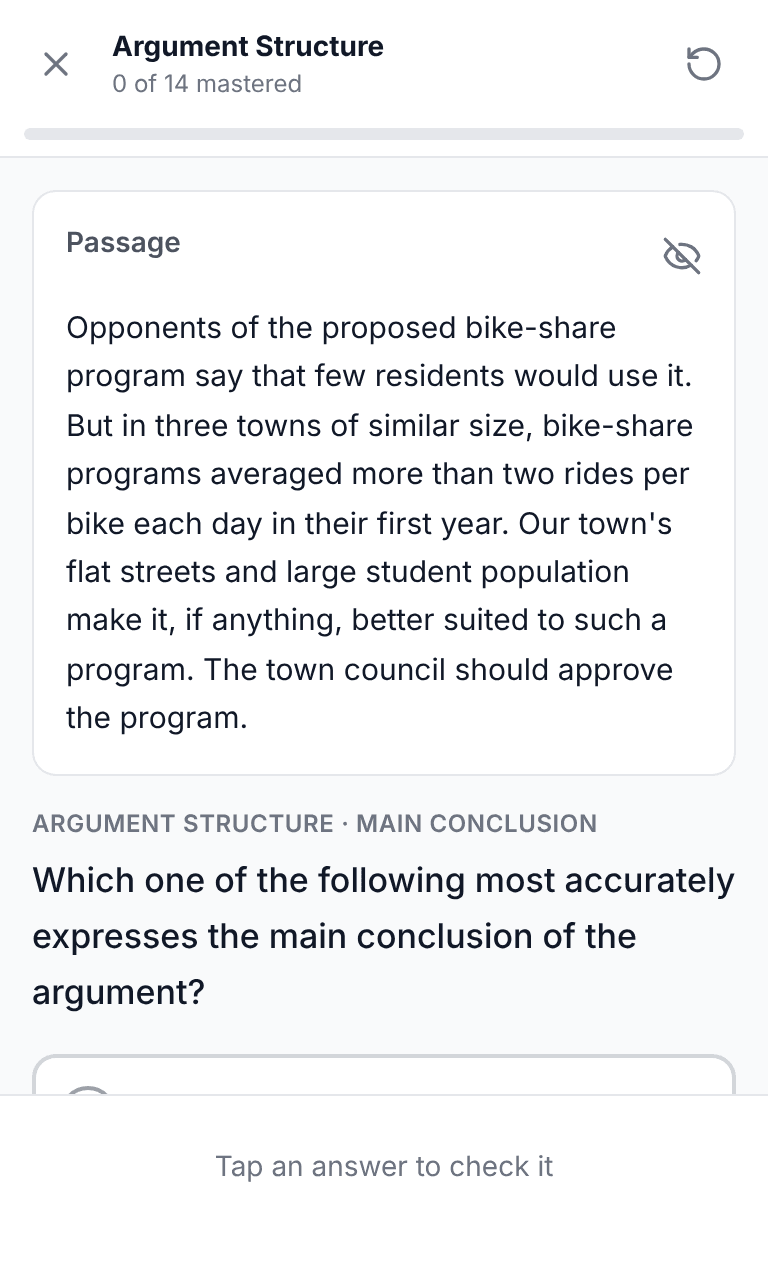
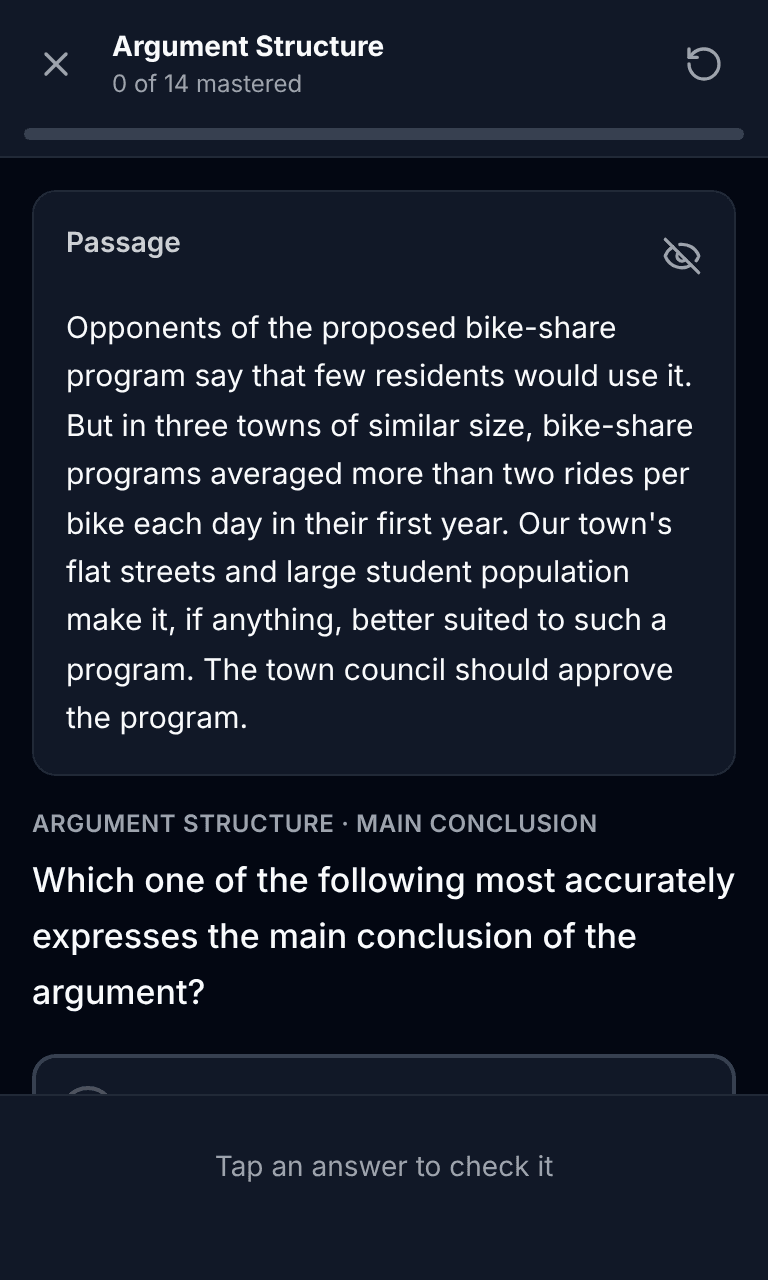
Train on mobile
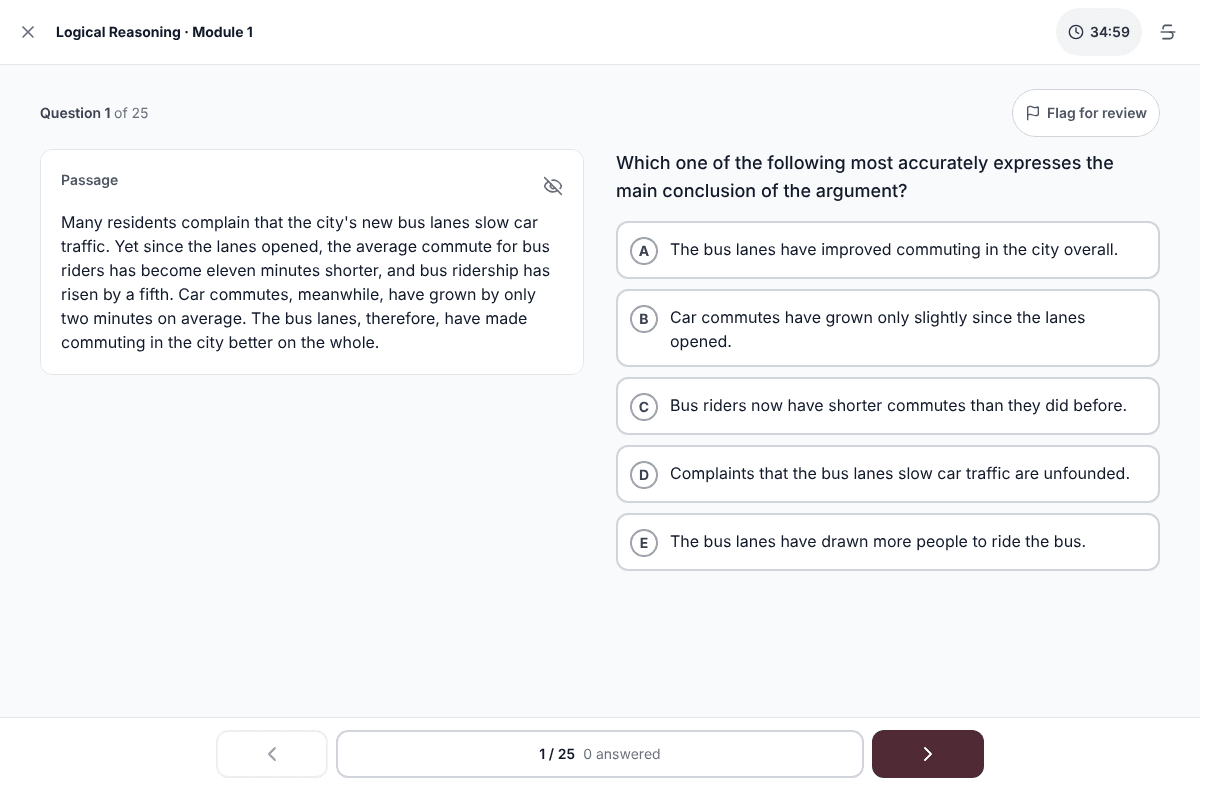
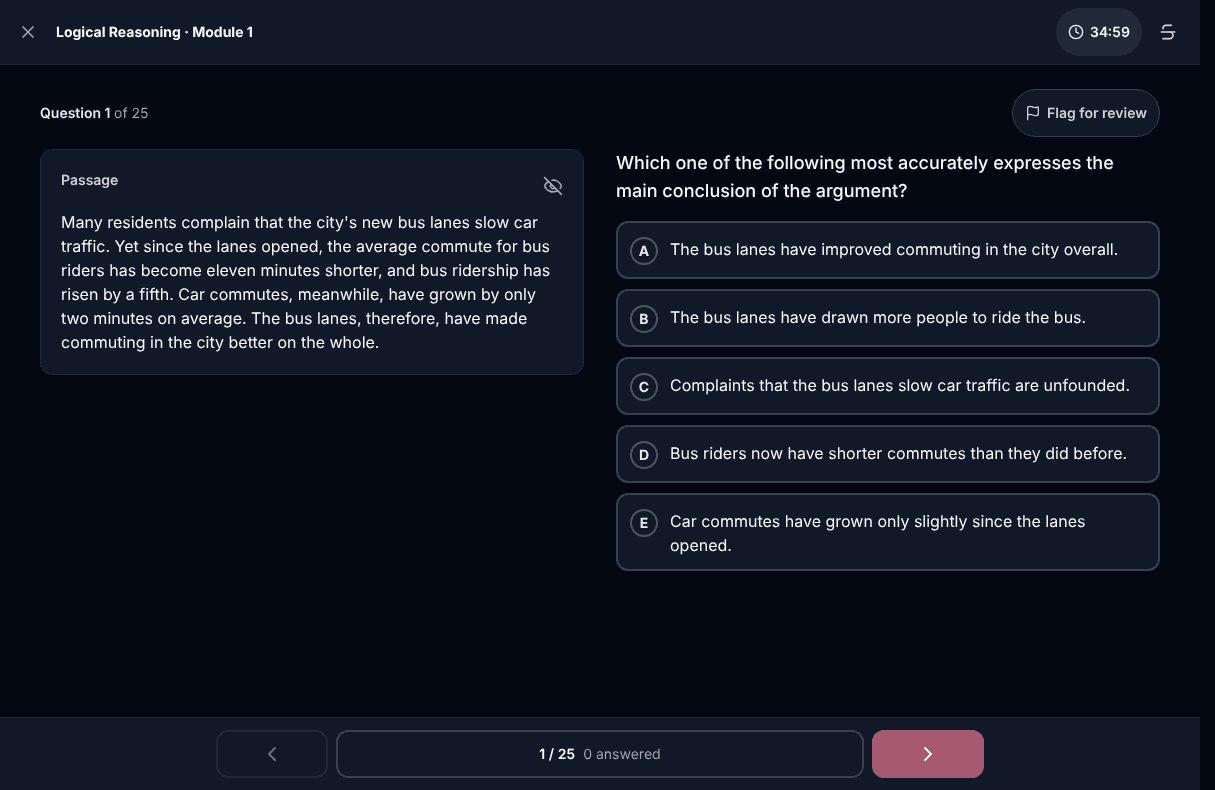
Test on desktop
The LSAT exam at a glance
The LSAT has four 35-minute multiple-choice sections: two scored Logical Reasoning sections, one scored Reading Comprehension section and one unscored variable section of either type that LSAC uses to try out new questions, with a 10-minute intermission between the second and third sections. Analytical Reasoning (logic games) was dropped in August 2024. The score runs from 120 to 180, based on the number of questions answered correctly, with no deduction for wrong answers. LSAT Argumentative Writing, a 50-minute unscored essay taken online, must be on file before a score is released. From August 2027 the unscored questions move inside the three sections, which LSAC says will test the same skills.
Tigertest has two full LSAT practice tests, the three scored sections at 35 minutes each with a 120 to 180 score estimate, and nine drills by question family. Start for free, no account required; the last two drills and Practice Test 2 are part of Premium. The variable section and the writing sample are not included.
- Sections
- 4 x 35 minutes: 2 Logical Reasoning, 1 Reading Comprehension, 1 unscored
- Break
- 10-minute intermission after the second section
- Score
- 120 to 180, from the number answered correctly
- Wrong answers
- No deduction
- Writing
- LSAT Argumentative Writing, 50 minutes, unscored
- Logic games
- Removed in August 2024
- Given by
- LSAC (Law School Admission Council)
Updated by the Tigertest team. Practice questions follow LSAC's LSAT test format, specifications and scoring pages (checked November 2026). Exam rules change, so confirm current details with LSAC.
How It Works
Drills by Question Family
Nine drills: argument structure, assumptions, strengthen and weaken, flaws, inference, and parallel reasoning and principles for Logical Reasoning, plus main point, detail and inference, and comparative reading for Reading Comprehension. Questions you miss come back until you have mastered them.
Practice Tests
Two full tests of the three scored sections on the real clock: two Logical Reasoning sections, the 10-minute intermission, then Reading Comprehension, 35 minutes each. You get an estimated score from 120 to 180. Practice Test 2 is held out of the drills, so it measures readiness.
Built on the Current LSAT Format
Since August 2024 the LSAT scores two Logical Reasoning sections and one Reading Comprehension section. Every practice test here has those three sections at the real time and about the real length (25, 25 and 27 questions; current forms vary by a question or two), with the full range of argument questions and a Reading Comprehension section of three single passages and one comparative pair.

Help Make Tigertest Better
Have an idea, a topic you'd like covered, or a question that could be clearer? We read every message and use it to improve every test.
Share FeedbackHow to Prepare for the LSAT
1. Find the conclusion first
Most Logical Reasoning questions turn on the gap between an argument's evidence and its conclusion. Before reading the choices, say the conclusion in your own words and ask what it takes for granted. Assumption, strengthen, weaken and flaw questions are all about that gap.
2. Learn conditional reasoning
"Only if," "unless," "every" and "no" carry much of the test. Know that a condition being necessary does not make it sufficient, that a rule tells you nothing when its condition is absent, and how a chain of conditionals links up. Inference and parallel reasoning questions reward this most.
3. Read passages for their structure
In Reading Comprehension, note what each paragraph does and where the author stands before you look at the questions. Main point, purpose and attitude questions then take seconds. For comparative pairs, ask what the two passages share and where they part ways.
4. Practice under the clock, then drill your weakest family
Each section gives you about 1 minute 20 seconds a question, and a wrong answer costs nothing, so answer every question. Take a full timed test, then use the score breakdown to pick the drill that costs you the most points, and work it until you have mastered it.
LSAT Frequently Asked Questions
What is on the LSAT?
The LSAT has four 35-minute multiple-choice sections: two scored Logical Reasoning sections, one scored Reading Comprehension section and one unscored variable section, which can be either type and is used to try out new questions. There is a 10-minute intermission between the second and third sections. Separately, you write LSAT Argumentative Writing, a 50-minute unscored essay taken online, which must be on file before LSAC releases your score.
Are logic games still on the LSAT?
No. Analytical Reasoning, the section known as logic games, was removed starting with the August 2024 LSAT and replaced by a second scored Logical Reasoning section. That is why this practice test has two Logical Reasoning sections and no games.
How is the LSAT scored?
Your score is based on the number of questions you answer correctly, converted to a scale from 120 to 180, and there is no deduction for wrong answers, so never leave a question blank. Each test form has its own conversion. Tigertest estimates a 120 to 180 score from your total correct on its practice tests, so treat it as a guide, not an official score.
Is the LSAT changing in 2027?
LSAC has announced that from the August 2027 test the unscored questions will be built into the three scored sections instead of filling a fourth section: Reading Comprehension first, then two Logical Reasoning sections, with a break after each of the first two. LSAC says the test will measure the same skills with the same kinds of questions, so practice on today's question types still applies. Check lsac.org for the format in force when you test.
Is this practice test the same format as the real LSAT?
It follows the scored part of the test: two Logical Reasoning sections and one Reading Comprehension section on four passage sets, one of them a comparative pair, each 35 minutes, with five answer choices and the intermission after the second section. Tigertest uses 25, 25 and 27 questions, the scored counts LSAC gives for the August 2027 format; current forms can vary by a question or two. The unscored variable section and the writing sample are not included. Every question and passage is original, not taken from LSAC PrepTests or official samples.
Is the Tigertest LSAT practice test free?
It is free to start, with no account required. Practice Test 1 and every drill but the last two are free; those two drills and Practice Test 2 are part of Tigertest Premium, one payment with no subscription. Create a free account if you want your progress saved across your phone and computer.
I teach LSAT prep. Can my students use Tigertest?
Yes, for free. Make a class at tigertest.io/teach, post one link, and students join with just their name. You see who practiced, their test scores and the topics your class misses most.
LSAT sample questions and answers
6 of the 203 practice questions, one from each topic, with the answer explained.
Philosopher: Some say that because we cannot foresee the long-term consequences of our actions, we cannot be blamed for them. But if that were so, no one could be blamed for anything, since every action has long-term consequences that no one can foresee. Yet we rightly blame people for many of their actions.
1.The philosopher's argument proceeds by:
- A.
arguing that the long-term consequences of actions can in fact usually be foreseen
- B.
offering a case in which consequences were foreseen in order to refute a generalization
- C.
distinguishing two senses of the word blame that the opposing view runs together
- D.
showing that a view, if accepted, leads to a conclusion that is clearly unacceptable
- E.
questioning the motives of the people who hold the view that the philosopher opposes
Answer: D.The philosopher grants the view for argument's sake, shows it would excuse everyone, and rejects it because we rightly blame people. No particular case is offered, and foreseeability is not disputed.
- A.
Historian: The letters said to have been written by the merchant Corvin could not have been written by him. The letters mention the harbor fire of 1612, and records show that Corvin died in 1609.
2.The historian's argument requires assuming which one of the following?
- A.
Corvin was not known to write letters to anyone outside his own family.
- B.
The harbor fire of 1612 destroyed most of the town's written records.
- C.
The letters do not refer to the fire as an event that had not yet happened.
- D.
Whoever wrote the letters lived in the harbor town at the time of the fire.
- E.
The records of Corvin's death are the only ones surviving from that period.
Answer: C.If the letters described the fire as a danger still to come, a writer who died in 1609 could have mentioned it, and the argument would fail. Where the writer lived is not needed.
- A.
Reading scores at Fairview Elementary rose sharply in the two years after the school replaced its printed textbooks with tablets. The district concludes that switching to tablets improved students' reading.
3.Which one of the following, if true, most seriously weakens the argument?
- A.
Teachers at Fairview needed several weeks of training to use the tablets well.
- B.
Two years ago the state adopted an easier test, and scores rose at nearly every school.
- C.
Some students at Fairview read far more on their tablets than they ever did in printed books.
- D.
Fairview's math scores rose by less over those two years than its reading scores.
- E.
The tablets cost the district more than the printed textbooks they replaced.
Answer: B.If an easier test raised scores almost everywhere, Fairview's rise is no sign that tablets helped. More reading on tablets would, if anything, support the district.
- A.
Toxicologist: Twelve studies have examined the effect of the new pesticide on honeybees, and none found that it shortens the bees' lives. So the pesticide is harmless to honeybees.
4.The toxicologist's reasoning is flawed because it:
- A.
overlooks harm the pesticide could do without shortening bees' lives
- B.
relies on too few studies to support any conclusion about honeybees
- C.
fails to say which organizations paid for the twelve studies
- D.
assumes that pesticides harmless to honeybees are harmless to people
- E.
takes for granted that all twelve studies measured lifespan the same way
Answer: A.The studies looked only at lifespan, while a pesticide could still impair foraging, navigation or reproduction. Twelve studies is not too few for a claim about lifespan; the gap is between lifespan and harm in general.
- A.
Moths of a certain species are either pale or dark. Relative to their numbers, birds catch far more dark moths than pale ones in woodland where the tree bark is pale. In woodland where the bark is darkened with soot, birds catch far more pale moths than dark ones, again relative to their numbers.
5.The statements above, if true, most strongly support which one of the following?
- A.
Dark moths now outnumber pale moths in woodland darkened by soot.
- B.
Birds prefer the taste of dark moths to the taste of pale moths.
- C.
Moths choose to rest on tree bark that matches their own color.
- D.
Soot in the air harms the health of pale moths more than dark moths.
- E.
Birds find it harder to spot moths that match the bark they rest on.
Answer: E.In each woodland the moths that contrast with the bark are caught more often, which fits the idea that matching moths are harder to see. The statements are about catch rates, not about which moths are more numerous.
- A.
If the new exhibit is reviewed favorably, it will draw large crowds. The exhibit drew large crowds, so it must have been reviewed favorably.
6.The flawed pattern of reasoning in the argument above is most similar to that in which one of the following?
- A.
If the orchard gets enough rain, it will give a large harvest. It did not give a large harvest, so it did not get enough rain.
- B.
If the orchard gets enough rain, it gives a large harvest, and it always gets enough rain, so it always gives a large harvest.
- C.
The orchard will give a large harvest only if it gets enough rain. It gave a large harvest, so it must have had enough rain.
- D.
If the orchard gets enough rain, it will give a large harvest. It gave a large harvest, so it must have had enough rain.
- E.
If the orchard gets enough rain, it will give a large harvest. It did not get enough rain, so it will not give a large one.
Answer: D.The exhibit argument infers the condition from the result it guarantees, and so does the large-harvest argument with the if-clause. Reasoning from no rain is a different flaw, and the only-if and no-large-harvest versions are valid.
- A.
Related practice tests
Every test on Tigertest is free to start, with no account needed.
Ready to Take On the LSAT?
Start for free. No account required. 203 questions across both question types.
Start practicing