
Free MCAT Practice Test 2026
234 original passage-based and discrete questions across all four MCAT sections. Tuned for mobile. Free to start, no account needed.
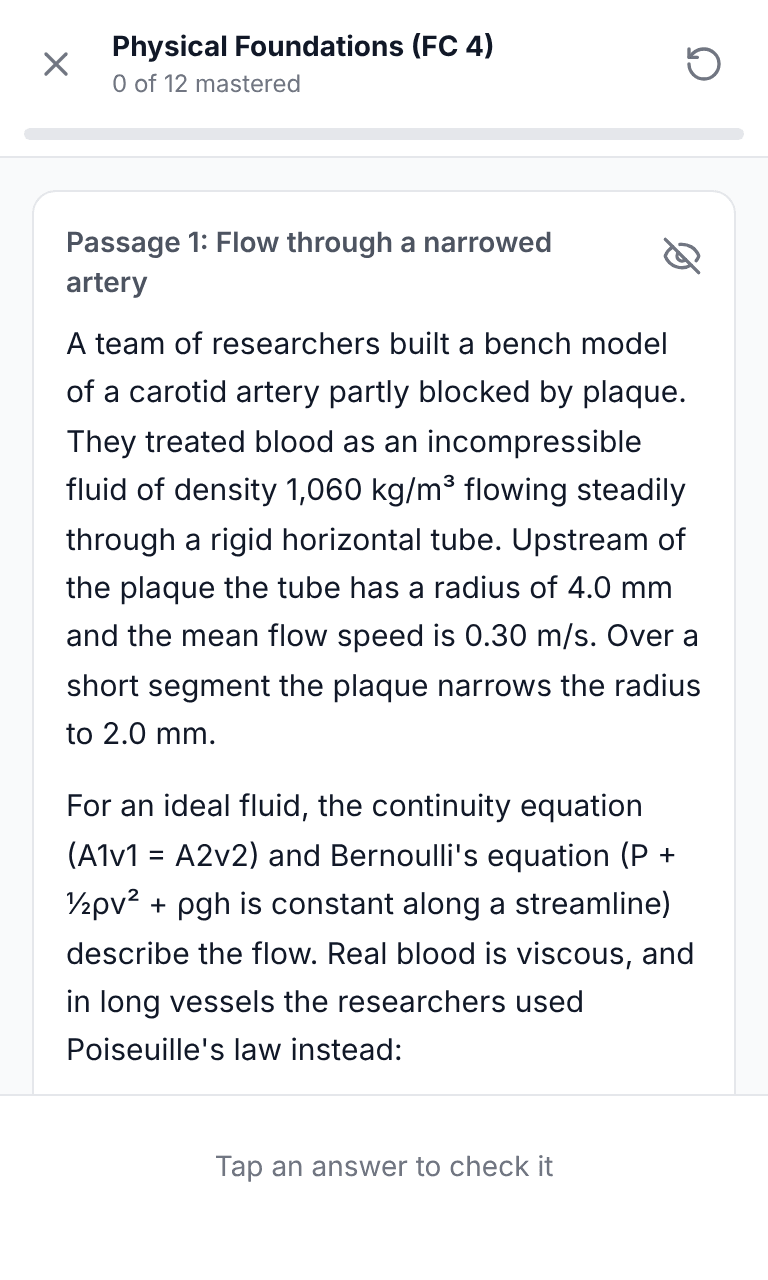
Train on mobile
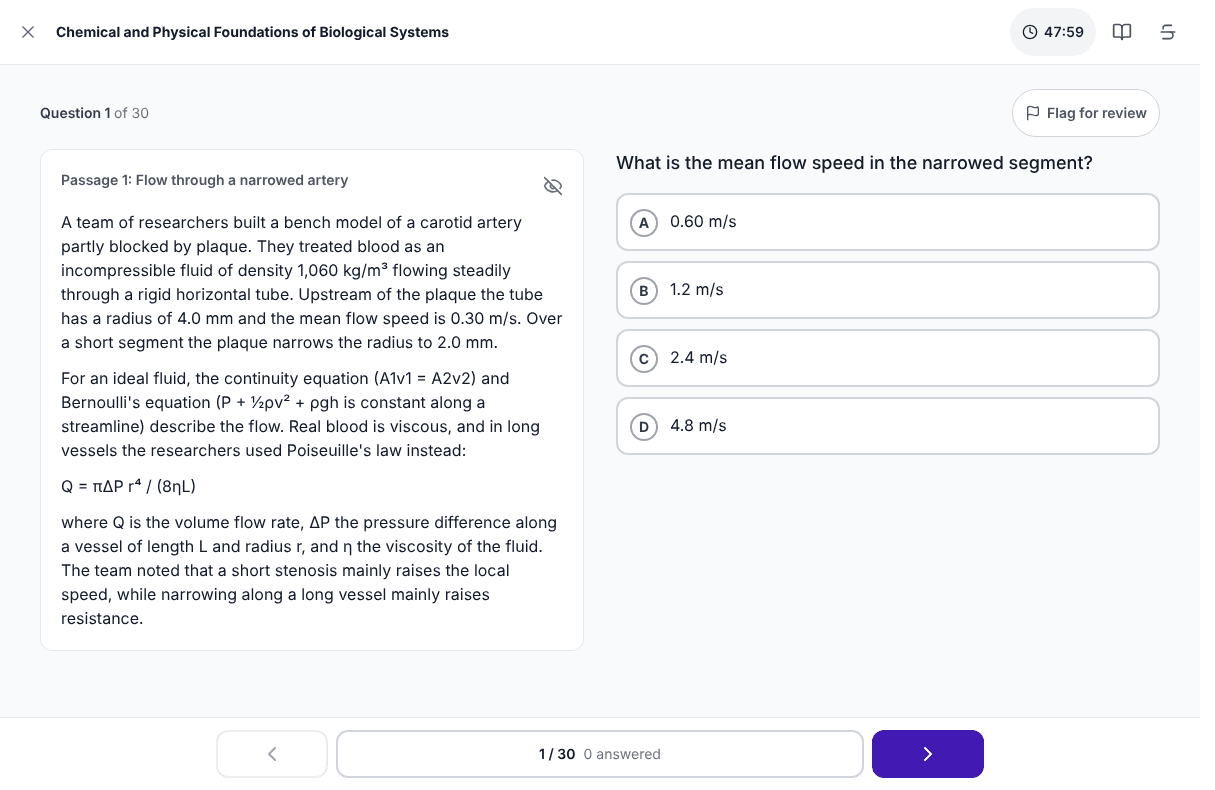
Test on desktop
The MCAT exam at a glance
The MCAT is the AAMC's computer-based Medical College Admission Test, with four multiple-choice sections in this order: Chemical and Physical Foundations of Biological Systems (59 questions, 95 minutes), Critical Analysis and Reasoning Skills (53 questions, 90 minutes), Biological and Biochemical Foundations of Living Systems (59, 95) and Psychological, Social, and Biological Foundations of Behavior (59, 95). The science sections mix passage-based sets with discrete questions; CARS is all passage-based and needs no outside knowledge. Each section is scored 118 to 132 and the total runs from 472 to 528, and wrong answers count the same as blank ones.
Tigertest has two MCAT practice tests with all four sections at about half length and the real pace, a 472 to 528 score estimate and nine drills by foundational concept and CARS skill. It is free to start, with no account required.
- Sections
- Chem/Phys, CARS, Bio/Biochem, Psych/Soc
- Questions
- 230: 59, 53, 59 and 59
- Time
- 6 hr 15 min of testing; about 7 hr 30 min seated
- Breaks
- Three optional breaks: 10, 30 and 10 minutes
- Score
- 118 to 132 per section; 472 to 528 total
- Calculator
- None; a periodic table is provided
- Given by
- AAMC, at test centers
Updated by the Tigertest team. Practice questions follow the AAMC's "What's on the MCAT Exam?" outline and the MCAT Essentials for Testing Year 2027. Exam rules change, so confirm current details with AAMC.
How It Works
Drills by Concept and Skill
Nine drills: physical and chemical foundations, the three CARS skills, biomolecules, cells and organ systems, mind and behavior, and self and society. Each question you miss comes back until you have mastered it, and the passage stays beside it.
Practice Tests
Two practice tests with all four sections in the real order, each about half the real length at the same pace, with short breaks between. You get an estimated score for each section and a total from 472 to 528. Practice Test 2 is held out of the drills, so it measures readiness.
Built on the AAMC Content Outline
Questions are spread across the foundational concepts the way the AAMC outline weights them: in Chem/Phys 40% physical principles and 60% chemistry; in Bio/Biochem 55% biomolecules; in Psych/Soc mostly psychology with a third sociology; and in CARS 30% comprehension, 30% reasoning within the text and 40% reasoning beyond it, on humanities and social science passages in equal measure.

Help Make Tigertest Better
Have an idea, a topic you'd like covered, or a question that could be clearer? We read every message and use it to improve every test.
Share FeedbackHow to Prepare for the MCAT
1. Learn the content, then use it on passages
Most science questions sit on a passage about an experiment or a clinical case, so knowing a fact is only the start. Practice pulling the variables, the result and the conclusion out of a passage quickly, then bringing in what you know: an enzyme mechanism, a buffer equation, a learning principle.
2. Do the math by hand
There is no calculator, so get quick at estimation, ratios, scientific notation and logarithms. Most calculations reduce to a clean number if you set them up first: write the formula, cancel what you can, and round sensibly before multiplying.
3. Read CARS for the argument
CARS needs no outside knowledge. For each passage, find the author's main claim and attitude, and note what each paragraph does. Questions then ask what the author says, how a part of the argument works, and how the ideas would apply to a new case or change with new information. Answer from the passage, not from what you believe.
4. Practice under the clock, then drill your weakest area
The real exam gives about a minute and a half per question in each section. Take a timed practice test, use the score breakdown to find the concept or CARS skill that costs you the most, and drill it until you have mastered it.
MCAT Frequently Asked Questions
What is on the MCAT?
The MCAT has four sections. Chemical and Physical Foundations of Biological Systems tests general and organic chemistry, physics and biochemistry. Critical Analysis and Reasoning Skills (CARS) tests reading and reasoning on humanities and social science passages. Biological and Biochemical Foundations of Living Systems tests biology and biochemistry. Psychological, Social, and Biological Foundations of Behavior tests psychology and sociology with some biology. The three science sections have 59 questions in 95 minutes each and mix passage sets with discrete questions; CARS has 53 questions in 90 minutes, all on passages.
How is the MCAT scored?
Each of the four sections is scored from 118 to 132, and the total is their sum, from 472 to 528. Wrong answers count the same as blank ones, so it pays to answer every question. The AAMC converts the number you get right to a scaled score through equating for each test form and does not publish a conversion table, so Tigertest's scores are estimates from its own conversion, not official scores.
How long is the MCAT?
The four sections take 6 hours 15 minutes, and the whole day is about 7 hours 30 minutes in the seat, not counting check-in. There are three optional breaks: 10 minutes after the first section, 30 minutes at the midpoint and 10 minutes after the third section.
Can I use a calculator on the MCAT?
No. Personal electronic devices are not allowed, and you do calculations by hand on the noteboard booklet the test center gives you. A periodic table is provided, and questions are written so that arithmetic, estimation, logarithms and scientific notation can be done by hand. Every calculation in Tigertest's practice tests is written the same way.
How is this practice test different from the real MCAT?
Each practice test has all four sections in the real order, with passages and discrete questions weighted like the AAMC content outline, four choices per question and no calculator. To fit a practice session, each section is about half the real length at the same pace: 30 questions in 48 minutes for the science sections and 27 in 46 for CARS. Every passage and question is original; none is taken from AAMC official practice material or commercial prep.
Is the Tigertest MCAT practice test free?
It is free to start, with no account required. Practice Test 1 and most drills are free; the last two drills and Practice Test 2 are part of Tigertest Premium, one payment with no subscription. Create a free account if you want your progress saved across your phone and computer.
I teach MCAT prep. Can my students use Tigertest?
Yes, for free. Make a class at tigertest.io/teach, post one link, and students join with just their name. You see who practiced, their test scores and the topics your class misses most.
MCAT sample questions and answers
6 of the 234 practice questions, one from each topic, with the answer explained.
- 1.
How many acetyl-CoA molecules does the complete beta-oxidation of one palmitate (16 carbons) produce?
- A.
4
- B.
7
- C.
8
- D.
16
Answer: C.Each acetyl-CoA carries two carbons, so 16 carbons give 8. It takes 7 rounds, because the last round splits a four-carbon unit into two acetyl-CoA.
- A.
- 2.
Which molecule crosses a pure phospholipid bilayer most readily by simple diffusion?
- A.
Sodium ions
- B.
Glutamate
- C.
Glucose
- D.
Oxygen gas
Answer: D.Small nonpolar molecules such as O2 dissolve in the hydrophobic core and diffuse straight through. Glucose, ions and charged amino acids need transport proteins.
- A.
- 3.
The rising phase of a neuron's action potential is caused mainly by:
- A.
the sodium-potassium pump speeding up
- B.
potassium flowing out through leak channels
- C.
sodium flowing in through voltage-gated channels
- D.
chloride flowing in through ligand-gated channels
Answer: C.Once threshold is reached, voltage-gated sodium channels open and Na⁺ rushes in, driving the membrane positive. Potassium leaving through voltage-gated channels then repolarizes it.
- A.
- 4.
A tracer with a half-life of 6.0 hours is injected. What percent of its activity remains after 24 hours?
- A.
3.1%
- B.
6.25%
- C.
12.5%
- D.
25%
Answer: B.Twenty-four hours is four half-lives, so the fraction left is (1/2)⁴ = 1/16 = 6.25%. Three half-lives would leave 12.5%.
- A.
- 5.
A molecule has three chirality centers and no internal plane of symmetry. How many stereoisomers can it have?
- A.
3
- B.
6
- C.
8
- D.
9
Answer: C.With n chirality centers and no meso forms, the maximum number of stereoisomers is 2ⁿ = 2³ = 8. Multiplying 3 by 2 gives 6, which undercounts.
- A.
- 6.
A man's heart races after a near-miss on the road. He notices he is with a friend who is laughing, and he decides he is excited, not afraid. This account best fits which theory of emotion?
- A.
The opponent-process theory
- B.
The James-Lange theory
- C.
The Cannon-Bard theory
- D.
The two-factor theory
Answer: D.The two-factor theory holds that emotion is physiological arousal plus a cognitive label taken from the situation. James-Lange says the feeling follows from the bodily response alone, with no labeling step.
- A.
Related practice tests
Every test on Tigertest is free to start, with no account needed.
Ready to Take On the MCAT?
Start for free. No account required. 234 questions across all four sections.
Start practicing